
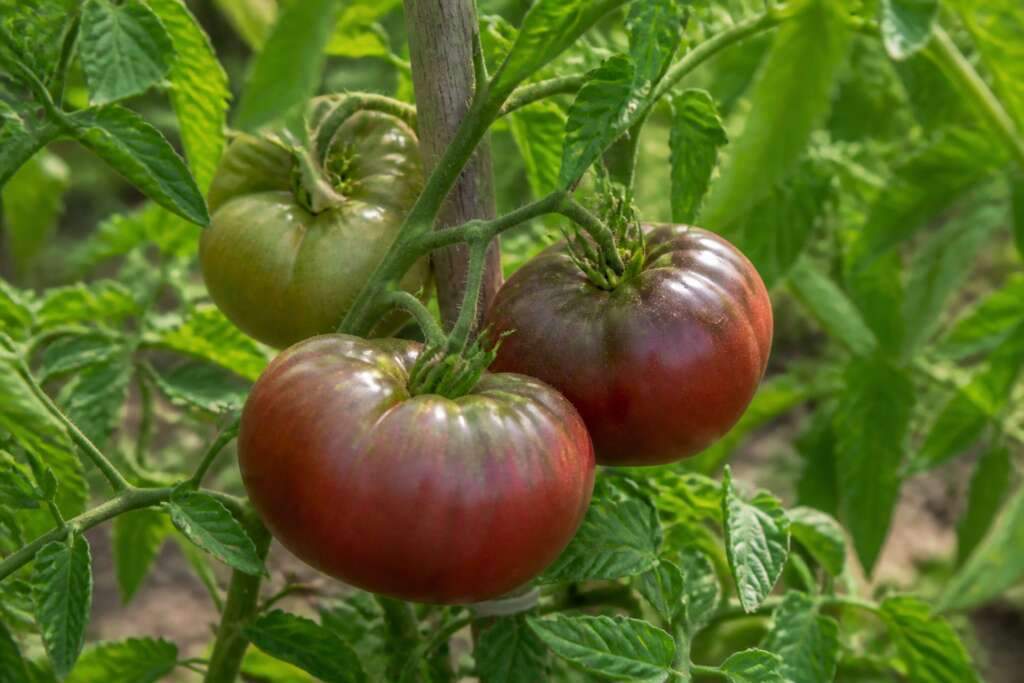
Cherokee Purple is one of the most celebrated heirloom beefsteaks in home gardens. Its fruit is large and irregularly shaped, with dusky rose-purple skin, dark brick-red flesh, and a rich, smoky-sweet flavor that is difficult to find in commercial tomatoes. This indeterminate variety climbs and produces all season long, but it rewards growers who give it time, warmth, strong support, and consistent care. Starting seeds at the right moment indoors is the most reliable way to get ripe fruit before fall weather closes in.
Quick How-to
Start Cherokee Purple seeds indoors 6 to 8 weeks before your last expected spring frost. Sow about 1/4 inch deep in warm, moist seed-starting mix. Move seedlings under strong light as soon as they emerge. Harden off for 7 to 10 days, then transplant after nights are reliably mild and soil is warm. Install a heavy-duty cage at planting time — this is an indeterminate vine with large, heavy fruit and it will need that support all season.
Quick Guide
| Fact | Recommendation |
|---|---|
| Best method | Start indoors, then transplant |
| Sowing depth | About 1/4 inch |
| Germination temperature | 75 to 85 F; steady warmth is key |
| Days to germination | About 5 to 10 days at 80 F |
| Light for germination | Cover seed; strong light needed immediately after sprouting |
| Spacing | 24 to 36 inches apart; allow 4 feet between rows |
| Sun | Full sun, 8 or more hours daily |
| Water | Even moisture; 1 inch per week; mulch after soil warms |
| Harvest | About 75 to 90 days from transplant |
| Plant size | Indeterminate; vines can exceed 6 feet — sturdy cage or stake required |
Before You Sow
Cherokee Purple is a long-season heirloom, so starting on time indoors is not optional in most climates. Count back 6 to 8 weeks from your last frost date and mark that as your sowing date. Use a fresh seed-starting mix (not garden soil), clean cells or small pots, and water the mix thoroughly before sowing so the seed sits in even moisture from the start.
A seedling heat mat under the trays speeds germination reliably. Once sprouts appear, remove the mat or reduce the temperature so seedlings do not stretch toward light they cannot find. Have your grow light or a south-facing window ready before sowing — seedlings that emerge in warmth but insufficient light quickly become pale and weak-stemmed.
Indoor Starting
Press seed about 1/4 inch into pre-moistened seed-starting mix and cover lightly. Keep the mix at 75 to 85 F for germination. A humidity dome can help retain moisture, but open it a little daily for airflow and remove it entirely once seedlings emerge.
As soon as sprouts appear, move them under strong overhead light — a grow light works well at 14 to 16 hours per day. Weak light is the leading cause of leggy, fragile tomato seedlings. When true leaves develop, pot up into 3- to 4-inch containers. Tomatoes will grow additional roots along any buried stem, so planting somewhat deep when potting up is beneficial.
Water from below when possible and let the top of the mix surface dry slightly between waterings to promote root depth. Fertilize lightly once the first true leaves appear; heavy nitrogen at this stage pushes leaf growth at the expense of roots.
Hardening Off and Transplanting
Begin hardening off 7 to 10 days before your transplant date. Start with 30 to 60 minutes of sheltered shade outdoors and gradually increase exposure to sun and wind over the week. Do not rush this step — Cherokee Purple, like all tomatoes, can drop leaves, stall, or develop sunscald if moved outside abruptly.
Transplant only after frost risk has passed and night temperatures stay above 50 F. Cherokee Purple fruit development is genuinely hindered by cold soil; waiting for soil to warm above 60 F will produce better results than planting early into chilly ground. Install a heavy cage — at least 5 feet tall and well-anchored — at transplant time. Driving stakes or cage legs later risks damaging established roots.
Plant deeply, burying the stem up to the lowest set of leaves if the plant is already tall. Water in well and mulch after planting to moderate soil temperature and reduce moisture swings.
Soil, Sun, and Water
Cherokee Purple performs best in fertile, well-drained soil with a pH around 6.0 to 6.8. Work in compost before planting, but go easy on high-nitrogen fertilizers once plants are in the ground; excess nitrogen feeds leaf growth, not fruiting. A balanced fertilizer at transplant and again at first flower is sufficient for most garden soils.
Full sun — at least 8 hours, preferably more — is necessary for flavor and ripening. Shaded plants produce slower, less intensely flavored fruit.
Water consistently at the soil level, targeting about 1 inch per week from rain or irrigation. Drip or soaker hose at the base of the plant keeps foliage dry and reduces fungal pressure. Even moisture is especially important during fruit fill: big swings from dry to saturated soil are linked to blossom end rot symptoms and fruit cracking, both of which are more noticeable in large-fruited heirlooms like Cherokee Purple. Mulch once the soil is warm to even out moisture retention and moderate root-zone temperature.
Top Mistakes
- Starting too late indoors: Cherokee Purple needs 75 to 90 days from transplant to ripe fruit. In most climates, sowing on time indoors is the difference between a good harvest and a frost-killed vine full of green tomatoes.
- Insufficient support: This is a vigorous indeterminate with fruit that can exceed a pound per tomato. Standard small cages collapse or tip over. Use a robust 5- to 6-foot cage, a strong stake, or a Florida-weave trellis and set it up at planting, not after the problem appears.
- Planting into cold soil: Transplanting when soil is still cold from winter or early spring delays root establishment and can make plants look sick for weeks. Wait for consistently warm nights and soil above 60 F.
- Overhead watering on foliage: Wet leaves invite early blight and septoria leaf spot, which spread quickly on heirloom tomatoes that lack modern disease resistance. Water at the base.
- Expecting uniform, blemish-free fruit: Cherokee Purple is an heirloom with irregular shape, color “shoulders,” and slight cracking around the stem end as a natural trait of the variety, not a sign of a problem with the planting.
Troubleshooting by Symptom
| Symptom | Likely causes | What to do next |
|---|---|---|
| No sprouts after 10 to 14 days | Germination mix too cold, seed too deep, mix dried out, or saturated conditions | Check soil temperature — aim for 75 to 85 F; keep mix evenly moist and resow at 1/4 inch if needed |
| Seedlings tall, thin, and pale | Insufficient light after germination, excess warmth on heat mat | Move light source closer, extend light duration to 14-16 hours, reduce bottom heat once sprouts appear |
| Seedlings collapse at soil level | Damping-off conditions: wet mix, poor airflow, crowded tray | Remove affected seedlings, improve airflow, water carefully from below, start fresh in clean mix |
| Plants stall for weeks after transplant | Cold soil, transplant shock, insufficient hardening-off | Protect from cold nights, water deeply to encourage root exploration, give plants time as soil warms |
| Fruit cracks radially around stem | Heavy rain or irrigation following a dry period during fruit fill | Maintain even soil moisture with mulch; consistent watering is the best prevention |
| Dark sunken spot on blossom end of fruit | Blossom end rot: irregular moisture causing calcium uptake disruption | Mulch, water evenly, avoid over-fertilizing with nitrogen; soil calcium is usually adequate in most gardens |
| Flower clusters drop without setting | Temperature extremes (nights below 55 F or above 75 F), drought stress | Maintain even watering; flowers set again as temperatures normalize |
Harvest and Kitchen Use
Cherokee Purple is ready when the skin shows its characteristic dusky rose-purple color, the shoulders stay slightly green or dark, and the fruit gives gently to pressure. Do not wait for uniform red — it will not come. The flesh inside should be dark brick-red and richly flavored.
Pick with a slight twist or use clean scissors to avoid tearing the vine. Check plants every few days as the season advances; ripe fruit left on the vine too long splits readily, especially after rain. Eat fresh on its own or in salads where the color and flavor can be appreciated. Cherokee Purple also makes exceptional sandwiches and bruschetta.
Seed Saving
Cherokee Purple is an open-pollinated heirloom that saves true to type under good isolation conditions. Tomatoes are primarily self-pollinating, but cross-pollination by insects can occur when multiple varieties grow nearby. For reliable true-to-type seed, isolate by at least 25 feet from other tomato varieties, or use bagging or caging on selected flowers.
Save seed from fully ripe, healthy fruit. Scoop seed and gel into a jar of water, ferment for 2 to 3 days while stirring daily, then rinse when the gel separates and the plump seeds settle. Dry thoroughly on a non-stick surface, label with the variety name and year, and store cool, dry, and dark.
Storing Leftover Seed
Keep unused Cherokee Purple Tomato seed in its labeled packet inside a sealed container in a cool, dry, dark indoor location. Avoid garages, sheds, greenhouses, and sunny windowsills, where temperature and humidity swing sharply. Label home-saved seed with the variety and harvest year before storing it.
FAQ
Is Cherokee Purple really purple?
The exterior is a dusky rose-purple-brown, particularly around the shoulders, and the flesh is deep brick-red to purple-red inside. It is not a bright red or uniformly purple tomato, but the color is striking and unmistakable at the market or farmers table.
Why is my Cherokee Purple slow to ripen compared to other tomatoes?
This is a long-season beefsteak. At 75 to 90 days from transplant, it takes more time to reach harvest than most modern slicers or cherry types. Adequate sun, consistent warmth, and even moisture throughout the season are the factors most within a gardener’s control.
Can I grow Cherokee Purple in a container?
It is possible in a very large container — at least 15 to 20 gallons — with strong cage support and more frequent watering and feeding than in-ground plants require. Most gardeners find indeterminate beefsteaks like Cherokee Purple more rewarding in the ground where the root zone can expand freely.
How do I know when Cherokee Purple is ripe if it never turns red?
Press the fruit gently — ripe Cherokee Purple gives slightly without being mushy. The skin has a dusky rose hue, the blossom end softens, and the fruit hangs downward with a small amount of give. Cut one open to check; deep red-brick interior with rich aroma means it is ready.