
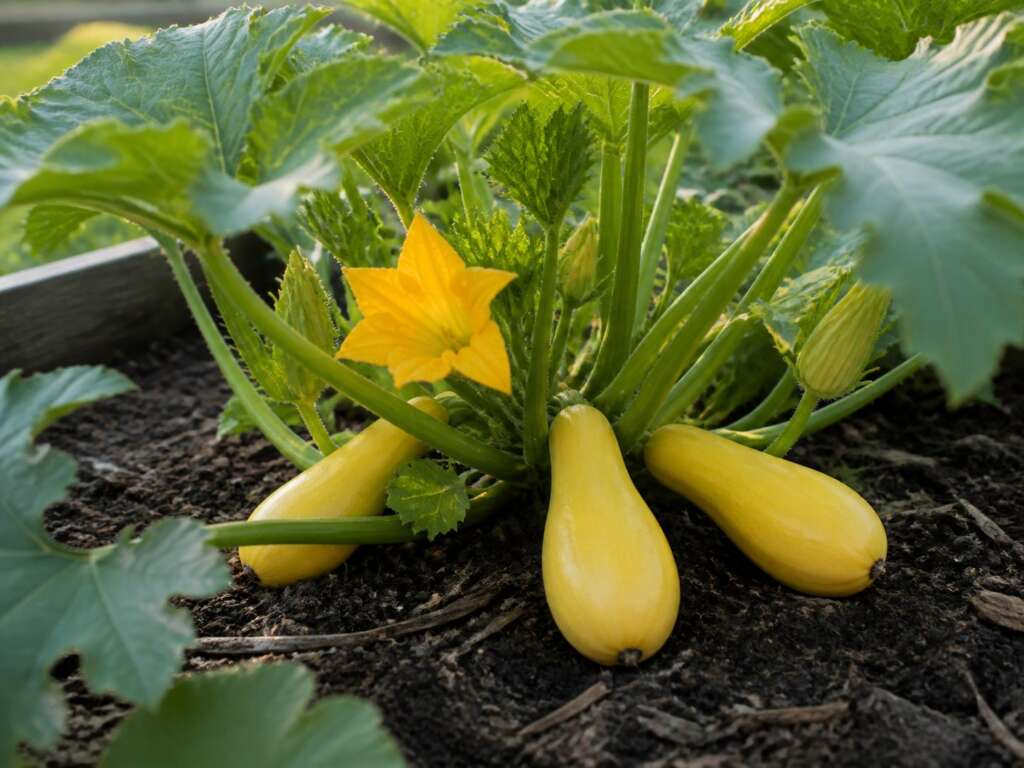
Straightneck summer squash is a warm-season Cucurbita pepo grown for tender yellow fruit with a broad blossom end and a narrower, straight neck. Unlike crookneck squash, its stem end stays mostly straight. Most open-pollinated straightneck types, including Early Prolific Straightneck, grow on productive bushy plants and begin bearing in roughly 45 to 55 days. The fruit is best picked young, while the skin is glossy and easy to pierce and the seeds are still small.
Quick How-to
Wait until frost danger has passed and soil at planting depth is at least 70 F. Sow 2 to 3 seeds about 1/2 to 1 inch deep at each planting spot, then thin to the strongest seedling. Give bush plants about 2 to 3 feet of room, full sun, and deep, consistent watering. Remove row covers when flowering starts so bees can reach the blooms. Harvest yellow straightneck squash at about 4 to 6 inches long for the most tender texture, checking plants every day or two during warm weather.
Quick Guide
| Fact | Recommendation |
|---|---|
| Best method | Direct sow after frost once the soil is genuinely warm |
| Sowing depth | About 1/2 to 1 inch |
| Germination temperature | Warm soil, ideally about 70 to 95 F |
| Days to germination | Usually 5 to 10 days in warm, evenly moist soil |
| Indoor start | Optional, 2 to 3 weeks before transplanting |
| Spacing | About 24 to 36 inches between bush plants |
| Sun | Full sun, ideally 8 or more hours |
| Water | Deep, even moisture at the root zone; avoid repeated dry-wet swings |
| Days to harvest | Commonly about 45 to 55 days, depending on cultivar and conditions |
| Harvest size | About 4 to 6 inches for tender fruit; harvest frequently |
Before You Sow
Straightneck squash seed needs warmth, not merely a frost-free forecast. Seed placed in cold, wet soil may swell and rot before it can germinate. Use a soil thermometer if spring weather is unsettled, and wait until the soil is at least 70 F at about 2 inches deep. A later sowing into warm ground usually catches and passes an early sowing that struggled in cold soil.
Choose a site with full sun, good drainage, and enough open space for large leaves. Most straightneck cultivars are bush types, but a mature plant can still spread 2 to 3 feet across. Crowding that looks harmless when seedlings are small can later trap humidity, hide pests, and make harvest difficult.
Work finished compost into the bed before planting. Summer squash grows quickly and uses substantial water and nutrients once flowering begins. Rich, well-drained soil supports that growth, but excessive nitrogen can create a huge leafy plant with delayed fruiting. Avoid fresh manure immediately before sowing, and do not plant where squash, cucumbers, melons, or pumpkins had serious disease problems the previous season if another bed is available.
Direct Sowing
Direct sowing is the simplest and usually the most reliable method. Plant 2 to 3 seeds at each station, 1/2 to 1 inch deep. Use the shallower end of that range in heavy soil and the deeper end in loose, fast-drying soil. Cover, press the soil gently for good seed contact, and water thoroughly without washing the seed out of place.
Keep the seed zone evenly moist until emergence. Do not keep it saturated. Once seedlings have one or two true leaves, keep the strongest plant and snip the others at soil level. Pulling extras can disturb the shallow roots of the seedling you want to keep.
For a longer harvest, make a second small sowing about 3 weeks after the first. Summer squash plants can slow under pest, heat, or disease pressure later in the season, and a younger succession often carries production forward.
Indoor Starting and Transplanting
Indoor starting is optional and most useful where the frost-free season is short. Start only 2 to 3 weeks before you expect to transplant. Squash grows fast and dislikes being held in a small pot, so an overgrown transplant can lose more time to root stress than it gained indoors.
Sow in individual 3- to 4-inch pots or large cells, keep the mix warm and evenly moist, and place seedlings under strong light as soon as they emerge. Harden them off over 5 to 7 days. Transplant after the soil has warmed, keeping the root ball intact and setting it at the same depth it grew in the pot. Water immediately and protect from cold wind for the first few days.
Soil, Sun, Water, and Feeding
Give straightneck squash full sun. Eight or more hours supports compact growth, abundant flowers, and rapid fruit development. Plants in part shade may survive but often stretch, stay damp longer after rain, and produce fewer fruits.
Water deeply enough to moisten the full root zone, then allow the surface to begin drying before watering again. The goal is steady moisture below the surface, not a permanently wet crown. Drip irrigation or a watering wand aimed at the soil keeps leaves drier than overhead sprinklers. Once the soil is warm, 2 to 3 inches of clean mulch can reduce evaporation and keep fruit off bare soil. Leave a small open ring around the stem so the crown stays dry.
If the bed was prepared with compost, a light side dressing of balanced fertilizer when flowering begins is usually enough. Pale older leaves and slow growth can indicate a nutrient shortage, but dark green foliage with few female flowers often points to too much nitrogen. Feed according to what the plant is showing rather than adding fertilizer on a calendar.
Pollination and Fruit Set
Straightneck squash produces separate male and female flowers on the same plant. Male flowers sit on narrow stems. Female flowers have a miniature squash directly behind the petals. It is normal for a young plant to open mostly male flowers first; female flowers usually follow as the plant matures.
Bees transfer pollen between the flowers. If you use insect barrier or row cover for early pest protection, remove it once flowering starts. When a tiny fruit grows briefly, then yellows and shrivels, incomplete pollination is more likely than a fertilizer problem. Hand-pollinate in the morning by moving fresh pollen from a male flower to the center of a newly opened female flower with a soft brush or the male flower itself.
Heat, cold, drought, and heavy rain can temporarily disrupt flowering or bee activity. A few failed fruits during difficult weather are not a reason to remove the plant. Correct moisture problems and give the next flush of flowers a chance.
Container and Small-Space Notes
Straightneck squash can grow in a container, but it needs more root room than its seedling size suggests. Use one plant in a container of at least 10 gallons, with drainage holes and a stable, moisture-retentive potting mix. Place it in full sun and leave room around the pot for the leaves to spread.
Containers may need daily watering in hot weather. Water until excess drains from the bottom, then check the mix before watering again. A small pot that alternates between bone dry and soaked produces stressed plants and misshapen fruit. Container plants also need regular light feeding because nutrients wash out with frequent irrigation.
Top Mistakes
- Sowing into cold soil: Frost may be over while the soil is still too cold. Seed that sits in chilly, saturated ground often rots. Wait for at least 70 F soil at planting depth.
- Leaving several seedlings at one station: A clump competes for water, nutrients, and airflow. Thin early to one strong plant rather than hoping multiple plants will share the space.
- Keeping row cover on after flowers open: The cover blocks both squash beetles and pollinators. Remove it at flowering or hand-pollinate every female bloom.
- Watering only the surface: Frequent shallow sprinkles encourage shallow roots and leave the deeper root zone dry. Water slowly and deeply, then recheck the soil below the surface.
- Mistaking early male flowers for a fruit-set problem: Male flowers normally appear first. Look for the tiny squash behind female flowers before diagnosing the plant.
- Letting fruit become oversized: Large fruit develops tougher skin and larger seeds and can slow additional production. Pick at 4 to 6 inches and check often.
Troubleshooting by Symptom
| Symptom | Likely causes | What to do next |
|---|---|---|
| No seedlings after 10 days | Cold soil, saturated soil, seed planted too deep, or seed predation | Check soil temperature and moisture below the surface; resow 1/2 to 1 inch deep once soil is warm |
| Seedling stem pinches and collapses | Damping-off favored by cool, wet mix and low airflow | Discard affected seedlings, improve airflow, use clean mix, and let the surface begin to dry between waterings |
| Plant is large but has no fruit | Only male flowers so far, excess nitrogen, low light, or heat stress | Identify flower sex, stop high-nitrogen feeding, confirm full sun, and wait for the next flowering cycle |
| Tiny squash turns yellow and drops | Incomplete pollination or severe moisture stress | Hand-pollinate newly opened female flowers in the morning and keep root-zone moisture even |
| Leaves wilt at midday but recover by evening | Temporary heat stress, especially on large leaves | Check soil 2 inches deep before adding water; deep-water in the morning if the root zone is dry |
| Plant stays wilted even in the morning | Dry root zone, squash vine borer, root injury, or bacterial wilt | Water only if soil is dry; inspect the stem base for holes and sawdust-like frass; remove plants with spreading bacterial wilt |
| White powdery patches spread across leaves | Powdery mildew, often worsened by crowding and shade | Improve airflow, water at soil level, remove badly affected leaves, and avoid wetting foliage late in the day |
| Leaves are ragged or plants suddenly weaken | Squash bugs, cucumber beetles, or other chewing pests | Inspect leaf undersides and crowns, remove egg clusters and pests, and use row cover only before flowering |
| Fruit is bulbous, narrow, or uneven | Incomplete pollination or irregular moisture during early fruit growth | Improve pollination and watering consistency; harvest the fruit and let later flowers develop under better conditions |
| Fruit is hard-skinned and seedy | It remained on the plant too long | Harvest younger at 4 to 6 inches and check plants every 1 to 2 days |
Harvest and Kitchen Use
Harvest straightneck squash while it is glossy, tender, and about 4 to 6 inches long. Some cultivars remain usable at 7 or 8 inches, but younger fruit has thinner skin, smaller seeds, and a more delicate texture. In warm weather, a pollinated fruit can reach harvest size within about a week, so check under the leaves every day or two.
Cut the stem with a clean knife or pruners rather than twisting the fruit from the plant. Frequent picking keeps the plant directing energy into new flowers and fruit. Remove overlooked oversized squash even if you do not plan to eat it.
Straightneck squash can be sliced for sauteing, roasting, grilling, or fresh vegetable trays. Small fruits are tender enough to cook with the skin. Refrigerate unwashed fruit and use it within several days; summer squash is not a curing or long-storage crop.
Seed Saving
Straightneck squash is usually Cucurbita pepo and crosses readily with other C. pepo plants, including zucchini, crookneck and pattypan summer squash, acorn and delicata squash, many pumpkins, and some ornamental gourds. Crossing does not change this season’s fruit, but saved seed may produce unexpected fruit the following year.
For true-to-type seed, grow only one C. pepo variety within pollinator range or hand-pollinate and protect selected female flowers. Leave the chosen fruit on the plant far beyond eating maturity until the rind is hard and the fruit has fully colored. After harvest, let it sit for another 2 to 3 weeks, then remove and wash the seeds. Dry them in a single layer with good airflow until they snap rather than bend before sealing them for storage.
Storing Leftover Seed
Keep unused Straightneck Summer Squash seed in its labeled packet inside a sealed container in a cool, dry, dark indoor location. Avoid garages, sheds, greenhouses, and sunny windowsills, where temperature and humidity swing sharply. Label home-saved seed with the variety and harvest year before storing it.
FAQ
Is straightneck squash the same as crookneck squash?
No. Both are yellow summer squash, but straightneck fruit has a mostly straight, tapered neck. Crookneck fruit has a curved neck and often develops a more pronounced warty surface as it ages. Their garden care is very similar.
Is Early Prolific Straightneck included in this guide?
Yes. Early Prolific Straightneck is a classic open-pollinated yellow straightneck cultivar and follows this general method. It commonly matures in about 50 days and is best harvested around 4 to 6 inches long.
Do I need two squash plants to get fruit?
One plant can make both male and female flowers, so a second plant is not strictly required. Two or more plants can improve the odds that male and female flowers are open together and can make hand pollination easier.
Why are the first flowers falling off?
The first flowers are often male, and male flowers naturally fall after they release pollen. Look for a tiny immature squash behind the petals to identify a female flower. If female flowers drop with yellowing fruit, check pollination and soil moisture.
Can I grow straightneck squash vertically?
Most straightneck cultivars are bushy rather than naturally climbing. A sturdy stake can help support the central stem and lift foliage, but do not force or tightly tie brittle stems. Container size, full sun, and root-zone moisture matter more than vertical training.
Why is my squash bitter?
Do not eat unusually bitter squash. Rarely, cucurbits can contain elevated bitter compounds, especially in off-type volunteer or crossed plants. Spit it out and discard the fruit rather than trying to cook away the bitterness.