
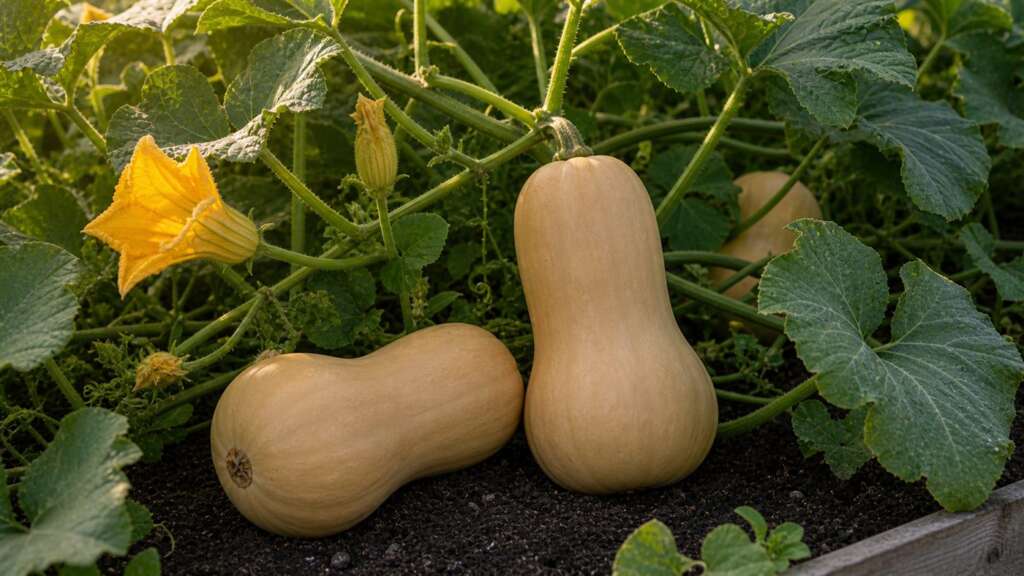
Waltham Butternut Squash is a classic heirloom winter squash grown for its smooth tan skin, dense orange flesh, and long storage life. Like other members of Cucurbita moschata, it is a warm-season vine that wants heat, sun, and steady moisture. The path to a good crop is patient: wait for warm soil, give the vines room, water deeply, and harvest only when the fruit is fully mature.
Quick How-to
Direct sow Waltham Butternut after your last frost, once daytime soil temperatures are reliably in the 70s F. Plant seeds about 1/2 to 1 inch deep, in hills or rows, and keep the seedbed evenly moist. Expect germination in roughly 5 to 10 days under warm conditions. Where the season is short, start a small number of plants indoors 2 to 3 weeks before transplanting, then move them out gently once nights stay mild. Harvest in fall when the rind is hard, the skin has turned deep tan, and the stem is corky.
Quick Guide
| Fact | Recommendation |
|---|---|
| Best method | Direct sow once soil is warm; brief indoor start in short-season areas |
| Sowing depth | About 1/2 to 1 inch |
| Germination temperature | Best around 70 to 95 F; steady warmth matters more than peak heat |
| Days to germination | Often 5 to 10 days under warm conditions |
| Light for germination | Cover seed; provide bright light immediately after sprouts emerge |
| Spacing | About 3 to 4 feet between plants, with rows or hills 5 to 8 feet apart |
| Sun | Full sun |
| Water | Deep, even moisture at the base; avoid soggy crowns |
| Harvest | About 100 to 110 days from sowing; harvest when rind is deep tan and hard |
| Plant size | Long-running vines; plan trellis or sprawl space at planting time |
Before You Sow
Butternut squash is a heat-loving vine that does its best work in stable warmth. Cold wet soil is the most common reason seed fails to launch, so plan the calendar around soil temperature rather than the calendar date alone. A simple soil thermometer at 2 inches deep is more reliable than guessing.
Choose a sunny spot with room to roam. The Waltham strain produces long vines that can travel several feet in every direction, so a corner of the garden, an edge bed, or a sturdy trellis works better than a tight interior plot. If space is limited, plan to train vines onto a trellis or arch with a sling under each developing fruit.
Work in finished compost before planting. Butternut appreciates fertile, well-drained soil with steady moisture, but it does not need heavy nitrogen pushes once vines are running. Too much nitrogen tends to grow leaves at the expense of flowers and fruit.
Direct Sowing
Direct sowing is the most natural method for Waltham Butternut because the plant resents root disturbance. Wait until the danger of frost has passed and soil at planting depth is genuinely warm. Hills are a traditional approach: mound the soil slightly to encourage drainage, drop 3 to 4 seeds per hill, and thin to the two strongest seedlings once they have true leaves. In rows, sow seeds singly with enough room to thin later.
Cover seed with about 1/2 to 1 inch of fine soil and press gently so the seed makes contact with damp soil. Water with a soft spray so seeds are not displaced. Keep the seedbed evenly moist until emergence, then water more deeply and less often as roots reach down.
If late spring is wet and cool, a black plastic mulch or a sheet of row cover can help warm the bed and protect young plants from early cucumber beetles or squash bugs. Remove row cover once flowers begin to open so pollinators can reach the blooms.
Indoor Starting
Indoor starting is optional and best kept brief. Sow about 2 to 3 weeks before transplanting in roomy individual cells or 3- to 4-inch pots so roots are not disturbed when planting out. Use fresh seed-starting mix, cover seed lightly, and keep the mix warm and evenly moist for germination.
Move seedlings into strong light the moment they emerge. Squash seedlings stretch fast under weak light, and a stretched, top-heavy seedling will not transplant as cleanly as a short sturdy one. Avoid letting plants outgrow their pots. Roots that circle and bind inside a small cell can stall after transplanting and never quite catch up to a direct-sown plant beside them.
Hardening Off and Transplanting
Harden off seedlings over 7 to 10 days before planting out. Begin with a sheltered, shaded spot for a few hours, then gradually increase sun, breeze, and total time outside. Transplant in the evening or on an overcast day to reduce wilting, plant at the same depth the seedling was growing, and water in well.
Wait for mild nights and warm soil. Butternut can survive a cool snap, but it will sulk in cold ground and may take weeks to resume real growth. Protect new transplants from chilly nights with a cloche or row cover if a late dip is forecast.
Soil, Sun, and Water
Give Waltham Butternut full sun and the most fertile, well-drained soil you can manage. The vines are productive but hungry, so a generous helping of finished compost worked into the planting area pays off. Mulch after the soil has warmed to even out moisture, suppress weeds, and reduce soil splash onto leaves.
Water deeply rather than often. Aim for steady moisture in the root zone through flowering and fruit fill, and water at the soil level when possible to keep foliage dry. Powdery mildew is the most common cosmetic issue late in the season, and dry foliage with good airflow slows it down considerably.
Pollination Notes
Butternut squash produces separate male and female flowers on the same plant. Males open first, often by several days, which can worry new growers when early female flowers drop without setting fruit. Be patient: once both sexes are blooming and bees are working the patch, fruit set typically follows quickly.
If pollinators are scarce, you can hand-pollinate. Pick a freshly opened male flower in the morning, remove the petals to expose the pollen-covered center, and gently brush it against the stigma inside an open female flower. The female is easy to identify by the small immature fruit at its base.
Top Mistakes
- Planting before the soil warms: Seeds sown into cold, wet ground often rot rather than sprout. Wait for stable warmth even if it pushes planting back a week or two.
- Crowding the vines: Skimping on spacing leads to poor airflow, mildew, and tangled, hard-to-harvest plants. Give each plant the room the packet recommends.
- Inconsistent watering: Big swings from dry to soaked stress the plant and can contribute to misshapen or undersized fruit. Mulch and a steady watering rhythm help.
- Harvesting too early: A butternut picked before the rind hardens will not store well and will taste flat. Wait for full color and a corky stem.
Troubleshooting by Symptom
| Symptom | Likely causes | What to do next |
|---|---|---|
| Seeds rot before sprouting | Cold, wet soil or overly deep planting | Wait for warmer soil, sow at 1/2 to 1 inch, and avoid saturated beds |
| Patchy germination | Crusted surface, uneven depth, or dry pockets | Smooth and pre-moisten the bed, sow at consistent depth, and water gently |
| Seedlings stretched and pale | Weak light indoors, too much warmth after sprouting, or crowded cells | Move under stronger overhead light, thin to one per cell, and reduce extra bottom heat |
| Early female flowers drop without setting fruit | Males not yet open, low pollinator activity, or heat stress | Wait a few days for both sexes to bloom; hand-pollinate in the morning if needed |
| Small fruits shrivel and drop | Incomplete pollination or plant stress | Improve pollinator access, water steadily, and avoid heavy nitrogen feeding |
| Powdery white coating on leaves | Mildew encouraged by crowding, wet foliage, or cool nights | Increase spacing, water at soil level, and remove the worst-affected leaves |
| Plants wilt midday but recover by evening | Heat stress on hot days | Often normal; check soil moisture morning and evening before reacting |
| Persistent wilting that does not recover | Squash vine borer or root damage | Inspect lower stems for entry holes and frass; consult local extension for control options |
| Fruit shape is uneven or stubby | Incomplete pollination or stress during fruit fill | Maintain even moisture and pollinator access; partial set still produces edible fruit |
| Mature fruit is bland or stores poorly | Harvested too early or not cured before storage | Wait for hard rind and corky stem, then cure 10 to 14 days in a warm, dry, ventilated spot |
Harvest and Curing
Waltham Butternut is a winter squash, which means it is meant to be harvested fully mature, not young like a summer squash. Look for skin that has turned a uniform deep tan, a rind hard enough to resist a thumbnail, and a stem that has dried and corked over. Cut, do not snap, the fruit from the vine with at least an inch or two of stem attached. A missing stem creates an open wound and shortens storage life.
Cure the harvested fruit for about 10 to 14 days in a warm, dry, ventilated spot, ideally around 80 to 85 F if you can manage it, out of direct rain. Curing toughens the skin and develops sweetness. After curing, store in a cool, dry place, around 50 to 60 F, on a single layer with airflow. Properly cured and stored butternut often keeps for several months.
Seed Saving
Waltham Butternut is an open-pollinated heirloom, so saved seed will come true to type if it has not crossed with another Cucurbita moschata variety nearby. Squash crosses readily within a species, so isolation by distance, timing, or hand-pollination is important if you grow multiple moschata varieties. The good news is that butternut does not cross with most pumpkins or summer squash, which belong to other Cucurbita species.
Save seed only from fully mature, healthy fruit. Scoop out the seed cavity, rinse the seeds clean of pulp, spread them in a single layer to dry thoroughly, and store labeled with the variety and year.
Storing Leftover Seed
Keep unused Waltham Butternut Squash seed in its labeled packet inside a sealed container in a cool, dry, dark indoor location. Avoid garages, sheds, greenhouses, and sunny windowsills, where temperature and humidity swing sharply. Label home-saved seed with the variety and harvest year before storing it.
FAQ
Can I grow Waltham Butternut in a container?
It is possible but demanding. Use the largest container you can manage, a minimum of about 15 to 20 gallons of soil volume, train the vine onto a trellis, and plan to water and feed more often than in the ground. Most home gardeners get better results from a sunny in-ground bed.
How many plants do I need for a household?
A single healthy vine often produces several fruits in a typical season, with totals depending on weather and care. Two or three plants are usually plenty for a small family that also stores some for winter.
Should I pinch the vine tips?
Some growers pinch growing tips late in the season to push the plant to finish existing fruit rather than start new ones it cannot ripen. This is optional and most useful in short-season areas as fall approaches.
Will butternut cross with my zucchini or pumpkins?
Waltham Butternut is Cucurbita moschata. It does not cross with summer squash, zucchini, or most jack-o-lantern pumpkins, which are Cucurbita pepo, nor with most large pumpkins, which are Cucurbita maxima. It will cross with other moschata varieties such as some tan pumpkins and trombocino types.
Is it normal for the first flowers to fall off?
Yes. The earliest flowers are usually male and are supposed to drop after blooming. Female flowers, which have a tiny immature fruit at the base, arrive a little later.