
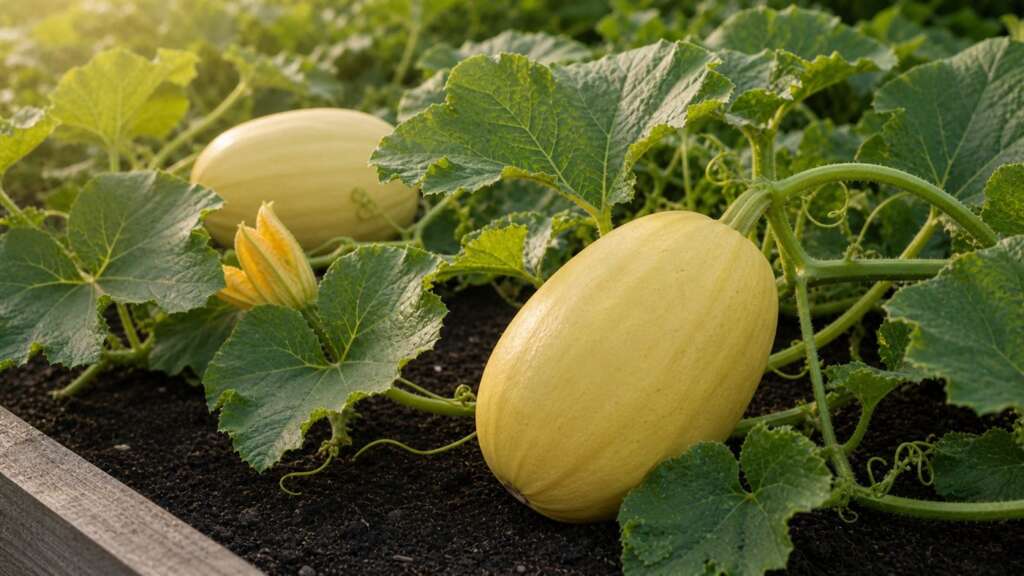
Spaghetti squash is a warm-season winter squash grown for its mild, pale-yellow flesh that pulls apart into long, noodle-like strands after cooking. It is a long-vining member of the cucurbit family that wants warm soil, full sun, and plenty of room to run. With the right timing and a little patience at harvest, it is one of the more forgiving winter squashes for a home garden.
Quick How-to
Direct sow spaghetti squash outdoors after the last spring frost, once the soil has warmed to roughly 70 F. Plant seed about 1 inch deep, two or three seeds per spot, then thin to the strongest seedling. In short-season areas you can start indoors in peat or fiber pots 2 to 3 weeks before transplanting, but no longer than that, because squash seedlings dislike root disturbance and tend to stall when held in a tray. Expect germination in about 7 to 10 days in warm soil and fruit ready to harvest roughly 90 to 100 days after sowing.
Quick Guide
| Fact | Recommendation |
|---|---|
| Best method | Direct sow after soil warms; brief indoor start in short-season areas |
| Sowing depth | About 1 inch |
| Germination temperature | About 70 to 95 F; 70 F is a practical minimum |
| Days to germination | About 7 to 10 days in warm soil |
| Light for germination | Cover seed; provide strong light immediately after emergence |
| Spacing | Hills 4 to 6 feet apart, or single plants 24 to 36 inches apart in rows 6 to 8 feet wide |
| Sun | Full sun, ideally 8 or more hours |
| Water | Deep, even moisture; about 1 inch per week, more in heat |
| Days to harvest | About 90 to 100 days from sowing, with fruit left to harden fully on the vine |
| Plant size | Vining habit; vines commonly reach 8 to 12 feet |
Before You Sow
Spaghetti squash needs warmth, sun, and space. Pick the sunniest part of the garden and budget for a vine that wants to wander. A 10-by-10-foot patch is reasonable for two or three plants; less than that and you will be redirecting vines or training them up a sturdy trellis.
Prepare the bed by working in finished compost or aged manure. Cucurbits are moderately heavy feeders and respond well to soil that holds moisture without staying soggy. If your soil is heavy clay, build low mounds or hills about 6 to 12 inches high to improve drainage and let the soil warm faster in spring. A dark mulch or black plastic laid down for a week or two before sowing can also speed soil warm-up in cool climates.
Have a plan for pest pressure before seedlings emerge. Cucumber beetles, squash bugs, and squash vine borers are the three most common problems on spaghetti squash and they tend to arrive early. Floating row cover over young plants is one of the most effective preventive steps, removed once flowering begins so pollinators can reach the blooms.
Direct Sowing
Direct sowing is the most reliable method for spaghetti squash because the seedlings establish quickly in warm soil and resent transplant shock. Wait until nights are consistently above about 50 F and soil at planting depth is at least 70 F. Sowing earlier into cool damp ground often produces uneven stands, seed losses, and stalled seedlings that never quite catch up.
For hills, mound the soil slightly and plant three or four seeds per hill, spaced a few inches apart, 1 inch deep. Cover, firm gently, and water in. When seedlings have one or two true leaves, snip the weaker ones at the soil line with scissors to leave one or two strong plants per hill. Pulling extra seedlings tends to disturb the roots of the keeper.
For row planting, sow seed every 12 to 18 inches and thin to one plant every 24 to 36 inches, with rows 6 to 8 feet apart to give the vines room to roam.
Indoor Starting
Indoor starting is optional and only worth doing if your frost-free window is genuinely short. Sow 2 to 3 weeks before your intended transplant date, no earlier. Use 3- or 4-inch peat, paper, or fiber pots so the entire pot can go into the ground without disturbing roots; squash plants started in plastic cells often check after transplanting.
Sow one or two seeds per pot, 1 inch deep, and keep the mix warm and evenly moist. A heat mat shortens germination noticeably. The moment sprouts appear, give them strong overhead light and pull them off any extra bottom heat so the stems stay short and stocky. Thin to one seedling per pot before the true leaves crowd one another.
Harden off over 5 to 7 days, starting in dappled shade and working up to full sun. Transplant on a calm, mild day, water in deeply, and protect from cool nights with a cloche or row cover.
Soil, Sun, and Water
Full sun is non-negotiable. Spaghetti squash grown in part shade tends to set fewer fruit and ripen them poorly. Soil should be rich, well-drained, and slightly acidic to neutral, roughly pH 6.0 to 6.8.
Water deeply and consistently rather than lightly and often. About 1 inch of water per week is a useful starting point, more during hot dry stretches or once fruit is sizing up. Drip irrigation or a soaker hose at the base of the plant is far better than overhead watering, which keeps the broad leaves wet and invites powdery mildew. A 2- to 3-inch layer of straw or shredded leaf mulch laid down after the soil has warmed helps hold moisture, keep ripening fruit off bare dirt, and reduce weed competition.
Side-dress with a balanced fertilizer or compost once vines begin to run, then again as the first fruit start to swell. Avoid pushing nitrogen heavily after flowering begins; lush leaves without fruit set are usually a sign of too much nitrogen, too little sun, or too few pollinators.
Pollination
Spaghetti squash carries separate male and female flowers on the same plant. Male flowers usually open first and may bloom for a week or more before the first females appear, which is normal. A female flower has a tiny squash-shaped swelling at the base; a male flower sits on a plain straight stem.
Fruit set depends on bees and other pollinators moving pollen between the two. If pollinator activity is low or weather has been rainy, you can hand-pollinate by transferring pollen from a freshly opened male flower to the center of a freshly opened female flower in the morning. If you used row cover for pest protection, take it off once flowering begins so insects can reach the blooms.
Top Mistakes
- Planting into cold soil. Spaghetti squash seed sits and often rots when soil is below about 65 to 70 F. Wait for genuine warmth rather than the calendar.
- Crowding the vines. A spaghetti squash plant that looks small at transplant becomes a 10-foot vine by midsummer. Tight spacing leads to mildew, hidden fruit, and tangled harvests.
- Inconsistent watering during fruit fill. Wide swings from dry to soaked stress the plant and contribute to misshapen or cracked fruit.
- Picking too early. Spaghetti squash needs to ripen fully on the vine. Immature fruit cooks up watery and bland, with strands that fall apart instead of separating cleanly.
- Skipping the cure. Even properly ripe fruit benefits from a 1- to 2-week cure before storage, which toughens the rind and improves keeping quality.
Troubleshooting by Symptom
| Symptom | Likely causes | What to do next |
|---|---|---|
| Seed fails to emerge in 10 to 14 days | Soil too cold, soil saturated, seed buried too deep, or rodent loss | Confirm soil is at least 70 F, ease back on watering, resow at 1 inch, and protect new sowings if mice or voles are present |
| Seedlings collapse at the soil line | Damping-off from cold, wet conditions, or cutworms | Improve drainage and airflow, water in the morning, and check for cutworms at the base of clipped seedlings |
| Lots of flowers, no fruit | Only male flowers are open yet, or pollinators are scarce | Wait a week for females to appear, hand-pollinate in the morning, and remove row cover once blooms open |
| Small fruit shrivel and drop at the stem end | Incomplete pollination | Encourage pollinators, hand-pollinate, and ensure even moisture during fruit set |
| White powdery patches on leaves | Powdery mildew, common on cucurbits in late summer | Improve spacing, water at the base, remove the worst affected leaves, and accept some late-season mildew as normal |
| Sudden wilting of a healthy vine | Squash vine borer in the main stem, or bacterial wilt from cucumber beetles | Inspect the lower stem for sawdust-like frass and entry holes; slit the stem to remove the borer if found, mound soil over the wound, and monitor cucumber beetle pressure |
| Gray-brown sunken spots on young fruit | Squash bug feeding or contact with wet soil | Scout for squash bug egg clusters on leaf undersides, hand-remove, and mulch under developing fruit |
| Vines wilt midday but recover at night | Heat and high transpiration on healthy plants | This is often normal; check soil moisture before adding more water |
| Fruit ripens pale and small | Too much shade, crowding, or a short cool season | Give the vines more sun and room next season, and consider an earlier indoor start in cool climates |
Harvest and Curing
Spaghetti squash is ready when the rind has turned a deep, even golden yellow and resists a fingernail pressed firmly into the skin. The stem will begin to dry and cork. A fruit picked too green will be pale ivory or greenish-yellow and the rind will still dent easily; leave it on the vine another week or two if frost is not imminent.
Cut, do not pull, the fruit from the vine with a sharp knife or pruners, leaving a 2- to 4-inch stem attached. Squash without a stem stores poorly because the open wound invites rot. Handle ripe fruit gently; bruises become storage problems later.
Cure harvested fruit for 7 to 14 days in a warm, dry, well-ventilated spot around 80 to 85 F if you can manage it, or simply on a sunny porch out of rain. Curing hardens the rind and lengthens storage life. After curing, store at about 50 to 55 F in a dry place; well-cured spaghetti squash often keeps 2 to 3 months, sometimes longer. Check stored fruit weekly and use any with soft spots first.
If a hard frost is forecast and fruit is close to ripe, harvest and cure indoors rather than risk frost damage on the vine.
Seed Saving
Spaghetti squash is Cucurbita pepo, the same species as zucchini, summer squash, acorn squash, delicata, pattypan, and many ornamental gourds. All of these cross readily with one another by insect pollination, and the resulting seed will not grow true to type. Saving usable spaghetti squash seed at home requires either growing only one C. pepo variety within roughly half a mile, or hand-pollinating and taping closed flowers to control crossing.
If you can manage isolation or hand-pollination, let the chosen fruit ripen fully on the vine, then cure it for another few weeks indoors before scooping out seed. Rinse seed clean of pulp, spread in a single layer on a screen or paper, and dry thoroughly until a seed snaps rather than bends. Label with variety and year before storing.
Storing Leftover Seed
Keep unused Spaghetti Squash seed in its labeled packet inside a sealed container in a cool, dry, dark indoor location. Avoid garages, sheds, greenhouses, and sunny windowsills, where temperature and humidity swing sharply. Label home-saved seed with the variety and harvest year before storing it.
FAQ
Can I grow spaghetti squash on a trellis?
Yes, and many gardeners prefer it. A sturdy trellis or arbor saves ground space, improves airflow, and keeps fruit cleaner. Use a strong structure, since mature fruit can weigh several pounds, and consider supporting individual fruit with cloth slings made from old T-shirts or pantyhose once they reach softball size.
How many fruits should I expect per plant?
A healthy spaghetti squash vine commonly sets 3 to 5 ripe fruit over the season, sometimes more in a long warm summer with good pollination. Heat, light, available space, pollinator activity, and disease pressure all affect the final count.
Why are my vines flowering but not setting fruit?
The most common reasons are timing (only male flowers are open yet), poor pollinator activity, or excess nitrogen pushing leaves over fruit. Give it another week, watch for female flowers with the small swelling at the base, and hand-pollinate if needed.
Do I need more than one plant for pollination?
No. Spaghetti squash carries both male and female flowers on the same plant, so a single plant can set fruit. More plants and more pollinators simply improve the odds.
Is spaghetti squash a summer or winter squash?
Winter squash, despite being grown through the summer. The “winter” label refers to its hard rind and long storage life, not the growing season.