
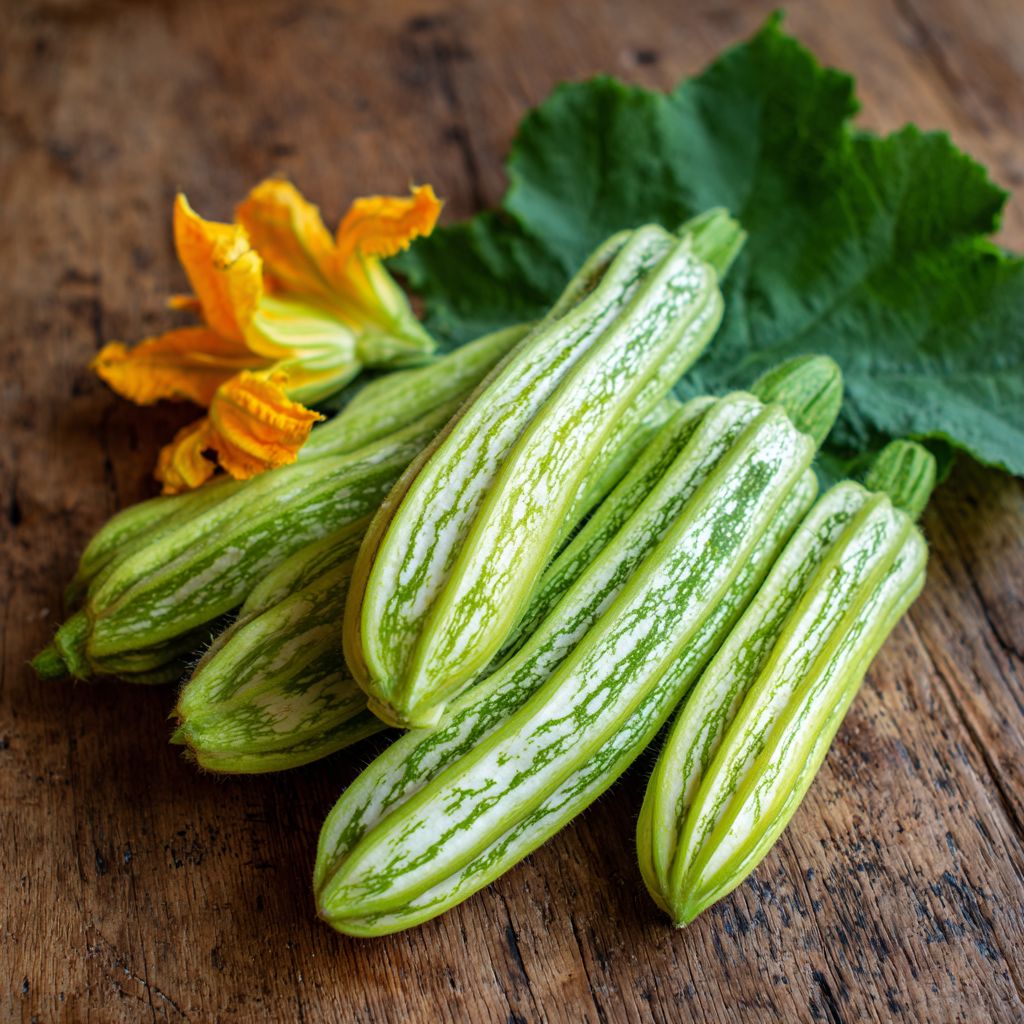
Costata Romanesco is an Italian heirloom summer squash – a zucchini-type Cucurbita pepo – with deeply ribbed, pale-striped fruit and a dense, meaty texture that sets it apart from smooth-skinned modern zucchini. Where most zucchini is mild and watery, Costata Romanesco has a sweet, nutty, earthy flavor and holds its structure through roasting, grilling, and sauteing. The plant is large and sprawling, demanding more space than bush types, and it produces fewer fruits per week – but the quality of each fruit makes the tradeoff worthwhile for gardeners with room to spare. This is a summer squash grown for flavor, not volume.
Quick How-to
Direct sow Costata Romanesco outdoors once soil temperature is at least 70 F and frost risk is past. Sow 2 to 3 seeds per planting point at about 1 inch deep, thin to the strongest plant, and allow 4 to 6 feet of ground space per plant. Harvest fruit when 6 to 12 inches long; fruits remain good eating even at 16 inches but are sweetest and most tender at younger sizes. Check plants every day or two – summer squash size up quickly.
Quick Guide
| Fact | Recommendation |
|---|---|
| Best method | Direct sow after soil warms; indoor start 2 to 3 weeks before transplant date |
| Sowing depth | About 1 inch |
| Germination temperature | 70 to 95 F; minimum 60 F soil temperature |
| Days to germination | 7 to 10 days in warm soil |
| Light for germination | Cover seed; bright light needed once seedlings emerge |
| Spacing | 4 to 6 feet between plants; allow sprawling room in all directions |
| Sun | Full sun, at least 6 to 8 hours |
| Water | Consistent, deep watering; mulch to retain moisture |
| Days to harvest | Approximately 52 to 62 days from direct sow |
| Plant size | Large sprawling plant; primary stems can root into surrounding soil and mulch |
Before You Sow
Costata Romanesco is a large plant. Before deciding where to sow, realistically assess available space. A single plant can easily fill a 4 by 4 foot area, and secondary stems will sprawl further, especially if they root into loose mulch. In a typical home garden, plan for 2 plants at most unless you have a dedicated squash bed.
The plant’s sprawling habit is not a flaw – it is part of what makes Costata Romanesco productive. Stems that contact moist soil may form additional roots, strengthening the root system and helping support the long vine. Leave healthy rooted sections in place unless they block a path or crowd another crop.
Prepare the planting area with generous compost. Squash is a hungry crop and responds well to rich, well-amended soil. Good drainage matters; squash roots will not tolerate sitting in water.
Timing the planting away from peak cucumber beetle and squash bug season – in many regions, a late May or mid-June sowing avoids the first wave of squash vine borers – can reduce pest pressure significantly without sacrificing the season.
Direct Sowing
Sow 2 to 3 seeds per planting location, 1 inch deep. Once seedlings have one or two true leaves, thin to the single strongest plant. Thin by cutting the unwanted seedlings at soil level with scissors rather than pulling, to avoid disturbing the remaining plant’s roots.
Water gently after sowing and maintain even moisture until germination. In warm soil at 70 F or above, expect emergence in 7 to 10 days.
Indoor Starting and Transplanting
Indoor starting is optional and works best when the goal is a 2 to 3 week head start in short-season gardens. Use individual 3 to 4 inch pots – squash transplants poorly when rootbound or bare-rooted. Sow no more than 2 to 3 weeks before your planned outdoor date. Costata Romanesco grows quickly; a seedling started too early and held too long indoors will stall after transplanting.
Harden off for 5 to 7 days before planting out. Transplant into warm soil with minimal root disturbance, water in well, and protect from wind for the first several days.
Soil, Sun, and Water
Full sun is non-negotiable for Costata Romanesco. The large leaves need light to support the plant’s substantial growth and fruit production. In part-shade conditions, the plant will grow but production falls off sharply and flavor suffers.
Soil should be rich, well-draining, and moisture-retentive. A pre-plant application of compost and a mid-season side dressing of balanced fertilizer once plants are actively fruiting covers most nutritional needs. Excess nitrogen pushes leafy growth and soft fruit; balanced feeding produces better-tasting squash.
Water deeply and consistently. Mulching around the base of established plants – while keeping mulch away from the stem to prevent crown rot – holds moisture, moderates temperature, and provides a rooting medium for sprawling stems. Inconsistent watering can cause blossom drop during heat, and the large leaf canopy increases transpiration demand on hot days.
Top Mistakes
- Underestimating plant size: Costata Romanesco planted in a space meant for a bush zucchini will crowd out neighboring crops and itself. Allow 4 to 6 feet per plant and plan accordingly before sowing.
- Expecting zucchini-level yields: This variety produces fewer fruits per week than modern hybrid zucchini. The payoff is flavor quality. Gardeners expecting a steady daily harvest often find they need two or three plants to keep up with a household’s needs.
- Harvesting too large: The fruit is edible at up to 16 to 18 inches, but sweetness, tenderness, and best texture are at 6 to 12 inches. At larger sizes the skin thickens, seeds enlarge, and the flesh becomes drier and more fibrous.
- Neglecting to harvest the male flowers: Costata Romanesco produces large, showy male blossoms that are excellent stuffed and fried or added to pasta. Harvesting excess male flowers does not hurt fruit set – female flowers, which have a tiny immature fruit at the base, are what produce squash. Leaving too many male flowers on the plant wastes an excellent culinary ingredient.
- Sowing too early into cool soil: Squash seeds can rot in soil below 60 F. Waiting for genuine soil warmth produces faster, more uniform germination and healthier early growth than trying to push the season in cold ground.
Troubleshooting by Symptom
| Symptom | Likely causes | What to do next |
|---|---|---|
| Seeds do not germinate after 10 to 14 days | Soil below 60 F, seed too deep, or waterlogged bed | Check soil temperature; re-sow at 1 inch depth in well-drained, warm soil |
| Young fruit shrivels and drops | Incomplete pollination of female flowers, heat stress, or inadequate water | Check that bees are visiting; hand-pollinate if pollinators are scarce; maintain steady soil moisture |
| Leaves show yellow mosaic or mottling | Cucumber mosaic virus or other cucurbit virus, spread by aphids | Remove severely affected plants; control aphid populations; use row cover early to reduce virus pressure |
| Powdery white coating on upper leaf surface | Powdery mildew, common as season progresses | Improve airflow by removing overcrowded or dead leaves; water at soil level; the plant often continues producing despite mildew late in season |
| Sudden vine wilting, hollow stem when cut | Squash vine borer, a serious pest across much of North America | Look for frass (sawdust-like material) at the vine base; cover with row cover before vine borers emerge; a mid-June direct sow can help escape the first flight |
| Fruit rots at blossom end | Wet conditions around the fruit, poor airflow, or pollination issues | Improve drainage and airflow; harvest fruit before it rests too long on wet soil; mulch under fruits |
| Plant grows vigorously but produces very few fruits | Excess nitrogen, too little sun, or a short window where only male flowers have appeared | Reduce high-nitrogen feeding; ensure 6+ hours of direct sun; be patient – male flowers precede female flowers by a week or more at the start of the season |
Harvest and Kitchen Use
Costata Romanesco is best harvested at 6 to 12 inches long. At this size the ribbed shape is fully developed, the skin is tender, and the flavor is at its sweetest. Unlike smooth-skinned zucchini, Costata Romanesco holds up well to high-heat cooking: roasting, grilling on a hot grill, or sauteing in a dry pan brings out its nutty, almost eggplant-like character. It also slices beautifully for carpaccio-style preparations with olive oil and herbs.
Pick fruit frequently – every 1 to 2 days during peak season – to encourage continued production. Fruits that are missed and allowed to grow very large can be usable but are best sliced thin and cooked rather than eaten raw.
The male flowers, which appear before female flowers early in the season and in greater numbers throughout, are prized in Italian cooking. Stuff them with ricotta and herbs, dip in a light batter, and fry briefly. They are best used the day they are cut.
Seed Saving
Costata Romanesco is open-pollinated and can be saved true to type. However, Cucurbita pepo includes a wide range of compatible squash types – zucchini, acorn squash, delicata, spaghetti squash, patty pan, many pumpkins, and ornamental gourds all belong to the same species and will cross readily via bee pollination. To save true seed, isolate from all other C. pepo types by at least a quarter mile, or hand-pollinate by bagging male and female flowers separately before they open, transferring pollen by hand in the early morning, and taping the female flower shut until pollination is complete.
Allow the seed-saving fruit to remain on the vine until the skin hardens well past the eating stage and the vine begins to die back. Remove seeds, ferment briefly in water to loosen pulp, rinse clean, and dry on a non-stick surface for 1 to 2 weeks. Store labeled and sealed in a cool, dry place.
Storing Leftover Seed
Keep unused Costata Romanesco Squash seed in its labeled packet inside a sealed container in a cool, dry, dark indoor location. Avoid garages, sheds, greenhouses, and sunny windowsills, where temperature and humidity swing sharply. Label home-saved seed with the variety and harvest year before storing it.
FAQ
Is Costata Romanesco a summer squash or a winter squash?
It is a summer squash – a zucchini type grown for tender, young fruit harvested through the season. Like all summer squash, it is in the species Cucurbita pepo, the same species as acorn and spaghetti squash, but it is picked and eaten when immature rather than cured and stored like a winter squash.
Why does Costata Romanesco taste different from regular zucchini?
The heirloom genetics prioritize flavor and texture rather than the uniform appearance and high output that modern hybrids were selected for. The flesh is denser, drier, and richer-tasting, with a nutty quality that shows particularly well when roasted or grilled. This is a deliberate characteristic of the variety, not a flaw.
How many plants do I need for a family of four?
Two to three plants is a reasonable starting point. Costata Romanesco produces less fruit per plant than high-yield hybrid zucchini, so if you want a steady supply through the summer, plan for more plants than you might otherwise think necessary.
Can I eat the male flowers?
Yes, and they are excellent. Male flowers (which have a plain stem, not a tiny fruit at the base) appear first and in larger numbers than female flowers. Harvest them in the morning while fresh and use them the same day – stuffed with soft cheese, lightly battered and fried, or added to pasta and risotto.