
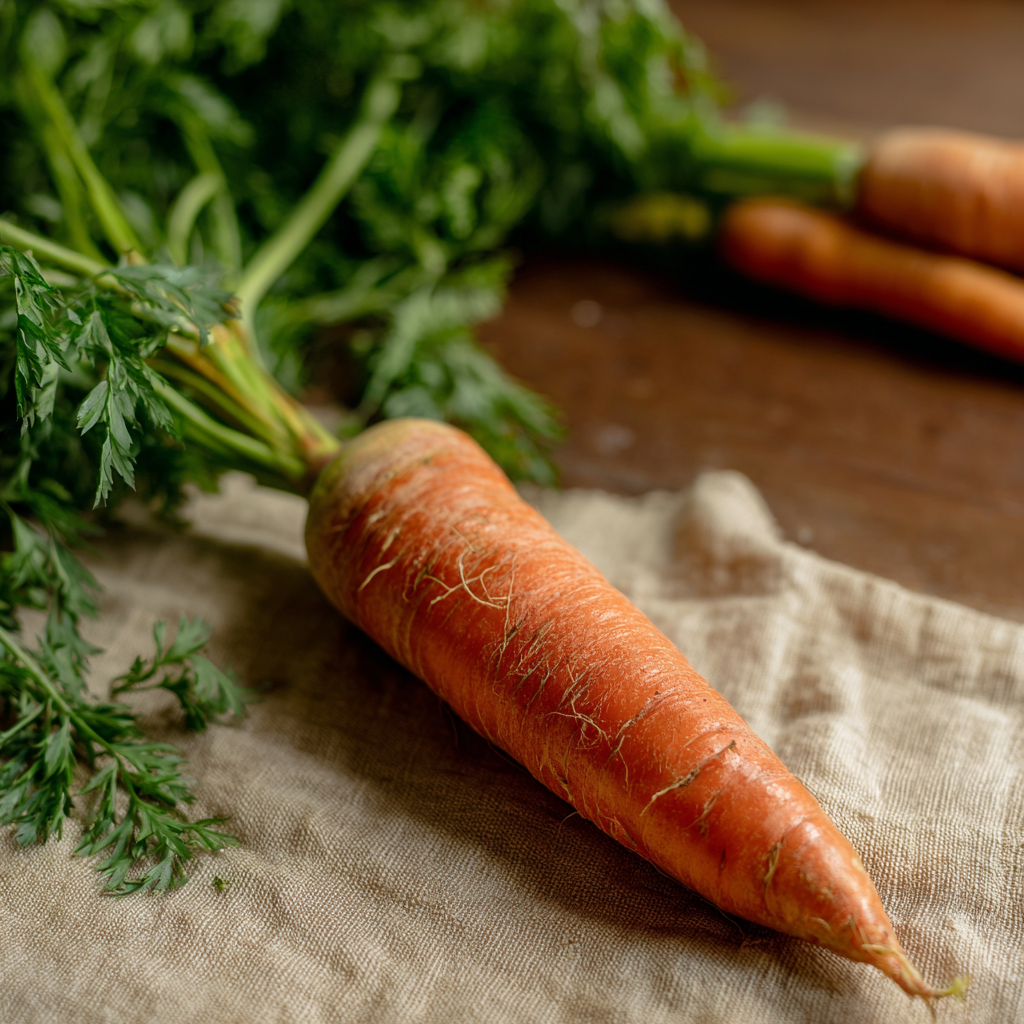
Royal Chantenay Carrot is a broad-shouldered, stump-rooted carrot that grows 5 to 6 inches long and reaches 2 to 2.5 inches across at the shoulder before tapering to a blunt tip. The stout shape is not a compromise; it is a deliberate trait. Chantenay-type carrots push through heavier clay and denser soils that would stop a longer, tapered variety in its tracks. Royal Chantenay is also considered an excellent keeper: the dense, orange-red flesh stores well into winter when kept properly. It matures in about 65 to 70 days from sowing and is planted by direct sow in cool soil. Flavor is sweet and improves after a light frost, making a fall planting particularly rewarding.
Quick How-to
Sow Royal Chantenay Carrot directly in the garden as soon as soil temperature reaches 45 F in spring, or time a midsummer sowing so the crop matures in fall. Cover seed with about 1/4 inch of fine soil, keep the surface evenly moist, and thin to 2 to 4 inches apart when seedlings are 1 to 2 inches tall. Hill soil up around exposed crowns at mid-season to prevent green shoulders. Begin checking roots once their shoulders are about 1.5 inches across; full-size roots are usually 5 to 6 inches long and 2 to 2.5 inches across at the shoulder at about 65 to 70 days.
Quick Guide
| Fact | Recommendation |
|---|---|
| Best method | Direct sow; roots are damaged by transplanting |
| Sowing depth | About 1/4 inch; very fine cover of soil only |
| Germination temperature | 55 to 65 F ideal; 45 F minimum; germination slows in cold |
| Days to germination | About 10 to 21 days |
| Light for germination | Cover seed at correct depth; do not leave exposed |
| Spacing | Thin to 2 to 4 inches apart; rows 12 to 18 inches apart |
| Sun | Full sun |
| Water | Consistent moisture throughout; avoid drought followed by heavy watering, which can split roots |
| Harvest | About 65 to 70 days from sowing; flavor peaks with cool fall weather |
| Root size | 5 to 6 inches long, 2 to 2.5 inches across at shoulder; stump-rooted type |
Before You Sow
Loosen the top 6 to 8 inches of soil. Even though Royal Chantenay tolerates heavier soil better than long-rooted varieties, the seed needs a fine, workable seedbed to germinate and the young root needs some give to begin developing. Break up large clods, remove visible rocks and debris, and rake the surface smooth before sowing.
If your soil is genuinely heavy clay, working in some coarse sand or compost to improve the top few inches will help germination. Below 6 inches, Chantenay carrots are more forgiving than most carrot types. That is the key advantage of the stump-root form: the root reaches its full 5 to 6 inches in soil that would fork or halt a 10-inch Imperator.
Avoid adding fresh manure or heavy nitrogen directly before planting. High nitrogen encourages leafy tops and can cause branching, hairy roots, or root splitting in carrots.
Direct Sowing
Sow carrot seed directly; transplanting is not practical for this crop. Carrot taproot cells are established early and do not tolerate root disturbance.
For spring: sow as soon as soil temperature reaches 45 F. Germination at lower temperatures is possible but slow. Temperatures of 55 to 65 F give the most even, prompt germination.
For a fall crop: sow in midsummer, roughly 70 to 75 days before the first expected hard frost in your area. Royal Chantenay roots exposed to light frost develop increased sweetness, making fall harvest a worthwhile goal.
Sow seed at 1/4 inch depth. Carrot seed is small; oversowing then thinning is easier than trying to place individual seeds perfectly. Cover with fine soil or a thin layer of seed-starting mix, press gently, and water with a soft spray that does not disturb the fine covering.
Maintaining Moisture During Germination
The most critical phase is the 10 to 21 days between sowing and emergence. Keep the surface of the seedbed consistently moist. A crust that forms between waterings can physically block seedlings from emerging, especially with the fine, slow seed of carrots. Using floating row cover laid directly over the bed until seedlings emerge is a reliable way to retain surface moisture; remove it as soon as the first seedlings appear.
Thinning and Hilling
Thin Royal Chantenay Carrot to 2 to 4 inches apart when seedlings are 1 to 2 inches tall. Use scissors to snip unwanted seedlings at soil level; pulling them disturbs the roots of the plants you are keeping.
Once plants have developed 7 to 10 leaves, check for exposed crowns. If the orange-green shoulder of the root is visible above the soil, hill soil up around the crown to cover it. Exposed carrot crowns develop a mildly bitter green coloration (from chlorophyll formation in the root tissue exposed to light). Hilling corrects this and is a routine step with any carrot.
Soil, Sun, and Water
Royal Chantenay is selected for tolerance of heavier soils, but good drainage still matters. Waterlogged soil causes root rot at any stage. The difference between Chantenay types and longer carrots is their ability to develop a full, complete root in soil that resists deep penetration. Drainage at the top 6 to 8 inches is what matters most.
Full sun is preferred. Partial shade slows growth and produces paler, less developed roots.
Water consistently from sowing through harvest. The most damaging irrigation pattern is alternating drought and heavy watering, especially as roots approach maturity. That cycle is the most common cause of root cracking in all carrot types. Reduce watering slightly in the final 1 to 2 weeks before planned harvest while still maintaining even soil moisture.
Top Mistakes
- Skipping thinning: Royal Chantenay grown too close produces competition for nutrients and the wide shoulders crowd each other, producing small, poorly-shaped roots. Thin to at least 2 inches; 3 to 4 inches is better for full-sized roots.
- Forgetting to hill exposed crowns: Leaving the top of the root exposed to light causes green shoulders. The green tissue is edible but noticeably more bitter. Hill routinely at mid-season.
- Irregular watering near harvest: Cracking is the most common harvest-time disappointment with carrots and nearly always traces to a wet spell after dry conditions. Consistent moisture, slightly reduced near harvest, is the solution.
- Harvesting too early: At 5 to 6 weeks, a Chantenay carrot is growing fast but has not developed its full sweetness or storage quality. Give it the full 65 to 70 days.
- Storing washed roots: Washing before long-term storage removes the skin’s protective layer and shortens shelf life significantly. Store unwashed roots in cool, slightly humid conditions.
Troubleshooting by Symptom
| Symptom | Likely causes | What to do next |
|---|---|---|
| No emergence after 3 weeks | Surface dried and crusted; soil too cold; seed too deep or too shallow | Keep surface consistently moist; confirm soil is at least 45 F; cover with just 1/4 inch of fine soil |
| Green shoulders on roots | Crowns exposed to light as soil settled | Hill soil up around crowns at mid-season; this is preventable and easy to correct |
| Roots forked or branched | Rock or debris in soil; fresh manure in the bed; nematode damage in some regions | Clear debris before sowing; do not use fresh manure; rotate carrot beds annually |
| Roots cracking at or near harvest | Irregular moisture; heavy rain after a dry spell | Maintain even watering; harvest before an expected heavy rain if roots are close to mature |
| Stunted tops with pale leaves | Very poor soil fertility; compacted subsoil limiting root drainage; overly wet conditions | Improve surface drainage; light feeding with balanced fertilizer can help in very poor soil |
| Hairy or rough root surface | Excess nitrogen in soil; dry conditions causing secondary root initiation | Reduce nitrogen; water consistently; hairy roots are edible and may be peeled |
Harvesting and Storing Royal Chantenay Carrot
Royal Chantenay is ready at around 65 to 70 days, when the shoulder reaches 1.5 to 2.5 inches in diameter. Loosen the soil with a fork or trowel 2 to 3 inches away from the root before pulling; this prevents snapping the stout root. Chantenay carrots have a solid, dense texture that holds up well to cooking, roasting, and long storage.
For storage: do not wash roots intended for long-term keeping. Trim the tops to about 1 inch and store roots in damp sand, sawdust, or perforated bags in a cool (near 32 to 40 F), moderately humid location. Properly stored Royal Chantenay carrots can keep for up to 4 to 6 months, which is one of the variety’s traditional strengths.
For refrigerator storage, place unwashed roots in a sealed bag and use within 3 to 4 weeks.
Seed Saving
Like all carrots, Royal Chantenay is a biennial that flowers in its second year. Seed saving requires overwintering roots and replanting the following spring. Carrots cross-pollinate freely with other carrot varieties and with wild carrot (Queen Anne’s Lace). Producing reliably true-to-type seed requires significant isolation from other carrot pollen sources, so most home gardeners choose to focus on growing roots rather than maintaining an isolated seed crop.
Storing Leftover Seed
Keep unused Royal Chantenay Carrot seed in its labeled packet inside a sealed container in a cool, dry, dark indoor location. Avoid garages, sheds, greenhouses, and sunny windowsills, where temperature and humidity swing sharply. Label home-saved seed with the variety and harvest year before storing it.
FAQ
What makes Royal Chantenay work in heavy soil when other carrots do not?
The short, stump-rooted shape means the root only needs to penetrate 5 to 6 inches of soil rather than 8 to 12 inches. In clay or compacted ground, that difference is significant. A long Nantes or Imperator carrot needs soil that offers little resistance down a full foot; Royal Chantenay is done before most of that resistance kicks in.
How does Royal Chantenay compare to Parisian Carrot for heavy or difficult soil?
Both are suited to challenging soils, but in different ways. Parisian Carrot is a round, golf-ball-shaped root ideal for very shallow beds, containers, and rocky ground. Royal Chantenay is a broader, longer stump-root with excellent storage quality, suited to heavier clay or sub-optimal soil where it needs 5 to 6 inches of penetration but no more. Parisian is the choice for containers; Royal Chantenay is the choice for a heavy-soil garden bed where you want a keeper carrot.
When is the best time to sow for maximum sweetness?
A midsummer sowing timed for fall harvest almost always produces sweeter roots than a spring sowing. Light frost converts some of the starch in the root to sugar. If your climate allows it, sow in June or July and harvest in October after a few light frosts. The difference in flavor is noticeable.
Should I remove the tops before storing?
Yes. Leaving the leafy tops attached draws moisture out of the root during storage, causing it to go limp faster. Trim tops to about 1 inch before storing, and do not wash roots you plan to keep for more than a week.