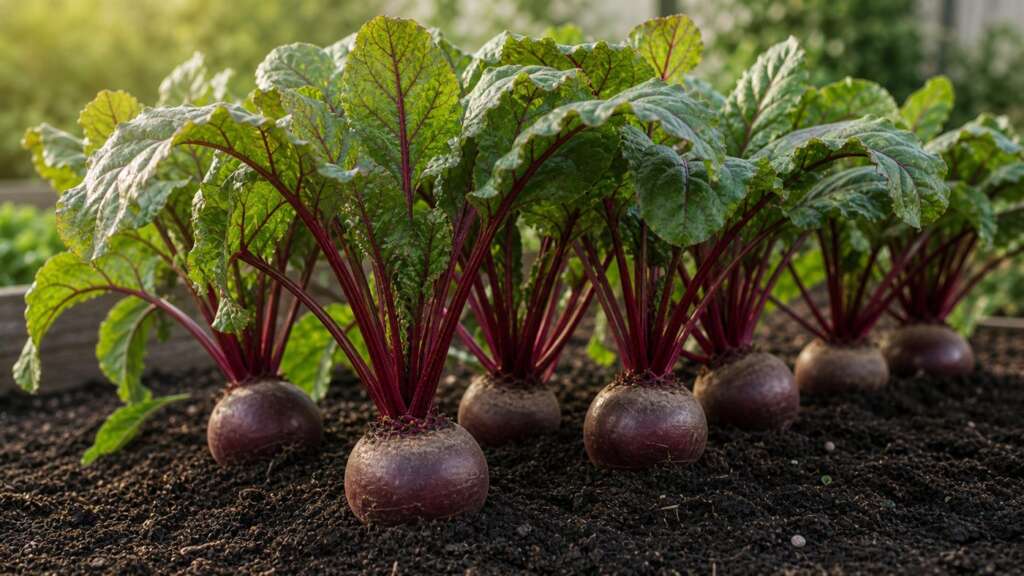
Detroit Dark Red is a classic heirloom beet grown for deep red, uniformly round roots and tender, edible greens. It is a cool-season root crop that earns its reputation in the spring and fall garden, when steady moisture and mild temperatures encourage crisp, sweet roots rather than woody or pithy ones.
Quick How-to
Direct sow Detroit Dark Red Beet outdoors as soon as the soil can be worked in spring, then again in late summer for a fall crop. Plant seed about 1/2 inch deep in loose, evenly moist soil, and expect germination in roughly 5 to 14 days. Each beet “seed” is actually a small cluster that can produce several seedlings, so thinning is not optional — thin to about 3 to 4 inches apart once seedlings are an inch or two tall to give each root room to size up.
Quick Guide
| Fact | Recommendation |
|---|---|
| Best method | Direct sow; beets do not transplant well once roots begin to form |
| Sowing depth | About 1/2 inch |
| Germination temperature | About 50 to 85 F soil; cool to mild conditions are most reliable |
| Days to germination | About 5 to 14 days, faster in mild soil and slower in cold soil |
| Light for germination | Cover seed lightly with fine soil; do not leave exposed |
| Spacing | Thin to about 3 to 4 inches between plants, with rows 12 to 18 inches apart |
| Sun | Full sun in cool weather; partial afternoon shade helps in late spring heat |
| Water | Even moisture is essential for crisp, smooth roots |
| Harvest | Commonly about 58 to 63 days from sowing for mature roots, with baby beets ready sooner |
| Plant size | Roots commonly mature at 2 to 3 inches across; greens reach roughly 12 to 14 inches |
Before You Sow
A beet “seed” is technically a small dried fruit that often contains two to four embryos, so a single planted unit can sprout multiple seedlings clustered together. This is normal for Detroit Dark Red and is the reason every beet guide treats thinning as a required step rather than a tidy extra.
Loose, stone-free soil is the second piece of the setup. Beets push their shoulders up out of the soil as they mature, and they need to swell sideways into a round shape without hitting clods, hardpan, or compacted crust. Work in finished compost if the bed is heavy or low in organic matter, and rake the surface smooth so seeds sit at an even depth.
Skip high-nitrogen fertilizers right before planting. Excess nitrogen pushes lush leaf growth at the expense of root development, which is the opposite of what you want from a beet bed. A balanced amendment worked in well ahead of sowing is enough for most home gardens.
Direct Sowing
Direct sowing is the standard method for Detroit Dark Red. Make shallow furrows about 1/2 inch deep, drop seed clusters every 1 to 2 inches along the row, cover lightly with fine soil, and firm gently so seed makes solid contact with damp soil. Water in with a soft spray rather than a hard stream so the row stays even.
Keep the surface evenly moist until you see emergence. Beet seed has a tough outer layer, and dry spells during germination can stretch the timeline well past two weeks. A light board or floating row cover laid over the row during the first few days helps hold moisture; lift it as soon as the first sprouts appear so seedlings get full light.
For a steady harvest, sow small successions every two to three weeks through the cool side of spring. Pause when soil temperatures climb past about 75 to 80 F, then resume in late summer roughly 8 to 10 weeks before your first expected fall frost. Fall crops often have the cleanest flavor because roots size up as nights cool.
Indoor Starting
Beets are usually a poor candidate for indoor starting because root crops resent transplant disturbance. The taproot forms early, and any check to that root tends to show up later as forked, twisted, or undersized beets.
If you have a strong reason to start indoors — a very short spring window, persistent pest pressure on direct-sown rows, or a small set of “placed” plants for a raised bed — use deep cells or soil blocks, sow one cluster per cell, and transplant out within about three weeks while seedlings are still small. Disturb the root ball as little as possible. For most gardeners, a well-prepared outdoor row will outperform an indoor start.
Transplanting and Thinning
Thinning is the single most important step between sowing and harvest. Because each seed cluster can produce two or more seedlings, an untouched row will quickly become a tangle that cannot size up.
Thin in two passes. When seedlings are about 1 to 2 inches tall, snip the weakest seedlings in each cluster at the soil line with scissors, leaving one strong plant per spot. Pulling can disturb neighbors, so cutting is gentler. When plants reach about 4 inches tall, thin again so remaining roots stand 3 to 4 inches apart. The thinnings are tender and entirely edible — wash them and use them like baby greens.
If you started a few plants indoors, transplant carefully into a pre-watered hole at the same depth they were growing, water in, and shade for a day or two if afternoon sun is strong.
Soil, Sun, and Water
Detroit Dark Red Beet prefers full sun in cool weather and tolerates light afternoon shade when temperatures climb. Soil should be loose, well-drained, and only moderately fertile. A pH in the neutral to slightly alkaline range, roughly 6.5 to 7.5, is commonly recommended for beets; very acidic soils can produce small or stunted roots.
Water is where most home-garden beet problems begin and end. Aim for even moisture from sowing through harvest — never bone-dry and never waterlogged. A finger pressed an inch into the soil should come out cool and damp. A 1- to 2-inch layer of light mulch applied after seedlings are up helps buffer the soil from heat and uneven watering. Drip irrigation or a slow soaker hose is gentler on shoulders that push up out of the row than overhead sprinkling.
A mid-season side-dressing of compost or a balanced fertilizer can help long-season fall plantings, but heavy feeding is not necessary and tends to favor leaves over roots.
Top Mistakes
- Skipping the second thinning. Beets look spaced out at the first pass and then crowd each other again as they bulk up. Plants that touch shoulders at four inches tall will not give you full-sized roots.
- Letting the seedbed dry out. Beet seed has a hard outer coat. A single dry afternoon during germination can stall the row, and a crusted surface can trap seedlings underneath even when seed has sprouted.
- Sowing into hot soil. Detroit Dark Red germinates and grows best in cool to mild conditions. Mid-summer sowings into warm soil often produce uneven stands, smaller roots, and stronger, earthier flavor.
- Overdoing nitrogen. A nitrogen-rich bed produces lush tops and disappointing roots. Use balanced amendments and favor compost over high-nitrogen blends.
- Harvesting too late. Roots held in the ground long after they reach full size can turn pithy or woody. Pick at the target size rather than waiting for the largest possible beet.
Troubleshooting by Symptom
| Symptom | Likely causes | What to do next |
|---|---|---|
| No sprouts after 14 days | Cold soil, dry seedbed, crusted surface, or seed buried too deep | Keep the surface evenly moist, scratch lightly to break crust, and resow shallowly if the row stays empty after two weeks of consistent care |
| Patchy or uneven germination | Inconsistent watering, cloddy soil, or seed dropped at varying depths | Smooth the bed before sowing, water gently with a fine spray, and consider a row cover during germination to even out moisture |
| Several seedlings from one spot | Normal — beet “seed” is a multigerm cluster | Thin to one strong seedling per spot once plants are 1 to 2 inches tall |
| Lots of leaves, small or no roots | Crowding, excess nitrogen, too much shade, or extended heat | Thin promptly, stop nitrogen feeding, move to a sunnier spot for the next sowing, and shift planting into cooler windows |
| Tough, woody, or pithy roots | Roots left in the ground too long, drought stress, or sustained heat during sizing | Harvest at target size, keep moisture even, and use mulch to buffer soil temperature |
| Split or cracked roots | Heavy watering or rain after a dry stretch | Water consistently rather than letting the bed swing dry and wet; mulch helps a great deal |
| White rings inside the root | Heat stress during sizing (Detroit Dark Red typically shows uniform color when grown cool) | Shift the next sowing into a cooler window and maintain steady moisture |
| Plants send up a flower stalk (bolting) | Heat stress, very long days, or a cold snap on young seedlings | Pull bolted plants, harvest any usable roots, and resow when conditions are milder |
| Holes or pale trails in leaves | Leaf miners or flea beetles, common beet pests | Cover new sowings with insect netting or floating row cover, and remove badly affected leaves |
Harvest and Kitchen Use
Detroit Dark Red is most tender and sweet when harvested at 2 to 3 inches across. Roots will continue to size up beyond that, but texture begins to slip from crisp to fibrous. Loosen soil with a fork before pulling so roots come up cleanly, and twist off the tops about an inch above the crown to reduce bleeding during storage.
The greens are a bonus crop. Pick a few outer leaves at a time while plants are still growing — taking no more than about a third of the foliage at once — and use them like chard. At harvest, the full top is excellent sauteed or added to soups.
For storage, brush off soil without washing, then refrigerate roots in a perforated bag or in damp sand in a cool root cellar. Detroit Dark Red holds well for roasting, canning, and pickling, which is the kitchen profile that has kept it in seed catalogs since the 1890s.
Seed Saving
Beets are biennial. To save true Detroit Dark Red seed, plants must overwinter — either in the ground in mild-winter areas with mulch protection, or lifted, stored cool, and replanted in spring — and then bolt and flower in their second year.
Two complications matter for purity. First, Beta vulgaris is wind-pollinated and crosses readily with other beets, Swiss chard, and sugar beet grown nearby; controlled seed saving usually requires substantial isolation distance or hand-managed pollination. Second, only a few plants are not enough to maintain genetic diversity in a population this outcrossing. For most gardeners, growing Detroit Dark Red as an annual eating crop is simpler than managing a controlled biennial seed crop.
Storing Leftover Seed
Keep unused Detroit Dark Red Beet seed in its labeled packet inside a sealed container in a cool, dry, dark indoor location. Avoid garages, sheds, greenhouses, and sunny windowsills, where temperature and humidity swing sharply. Label home-saved seed with the variety and harvest year before storing it.
FAQ
Why are several seedlings coming up from one spot?
That is normal. A Detroit Dark Red “seed” is a small multigerm cluster, and most clusters produce two to four seedlings. Thin to the single strongest seedling per spot when plants are 1 to 2 inches tall.
Can I eat the beet greens while the roots are still growing?
Yes. Take a few outer leaves from each plant at a time and leave the inner crown intact. Removing more than about a third of the foliage at once can slow root development.
Why are my roots small even though the tops look healthy?
Most often this is crowding or excess nitrogen. Big leafy tops with tiny roots usually means plants are too close together or the bed was fed too richly. Thin firmly and switch to compost-only feeding.
Can Detroit Dark Red grow in containers?
Yes. Use a container at least 8 to 10 inches deep with drainage holes, fill with a loose potting mix, sow as you would in the ground, and thin to the same spacing. Container soil dries quickly, so check moisture daily during germination and again as roots size up.
Do I need to soak beet seed before planting?
Soaking is optional. An overnight soak in room-temperature water can soften the tough outer coat and speed germination in cool spring soil, but it is not required when the bed is kept evenly moist.