
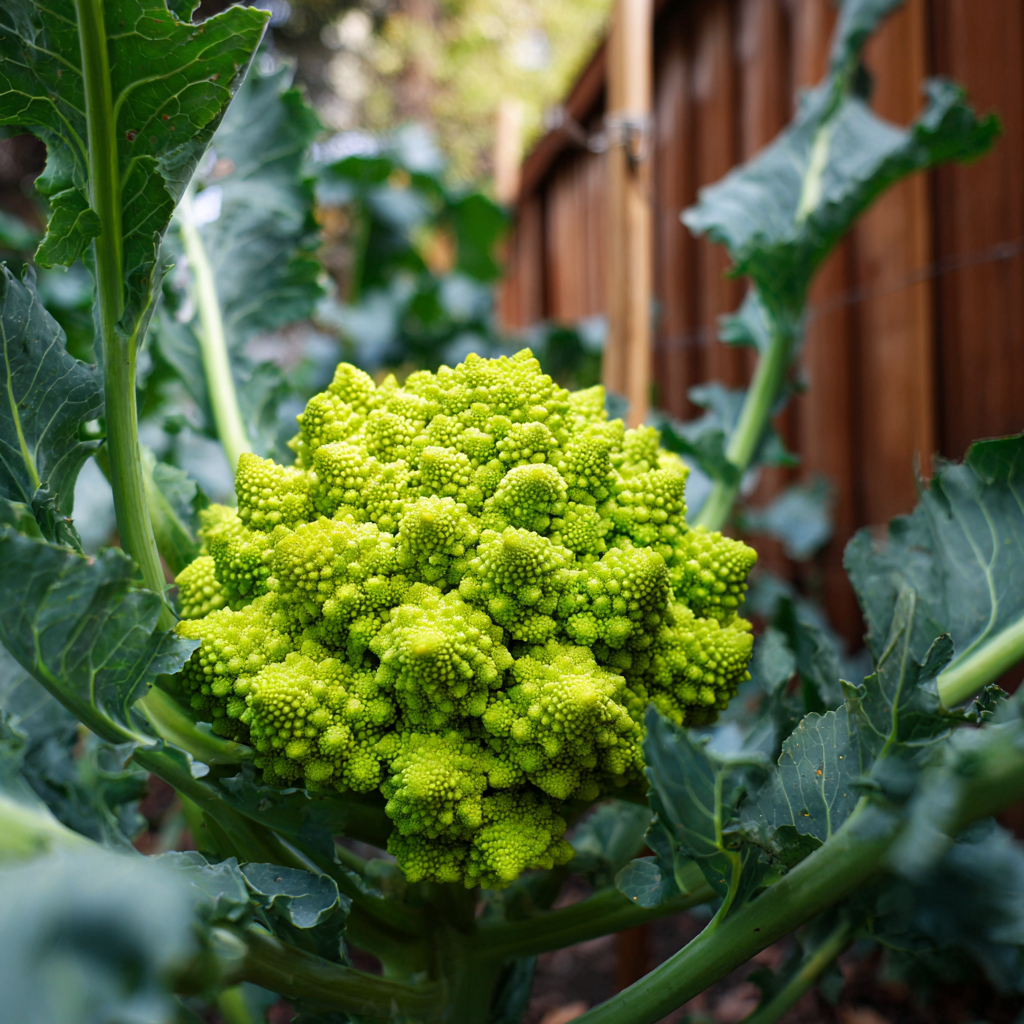
Romanesco goes by many names, including Roman cauliflower, broccoflower, broccolo romanesco, and fractal broccoli, and the naming can be genuinely confusing. Despite the word “broccoli” in its common name, Romanesco is botanically closer to cauliflower than to the familiar heading broccoli sold in grocery stores. Its botanical classification is Brassica oleracea var. botrytis, the same variety grouping as cauliflower. What sets it apart from both is its spectacular appearance: a chartreuse, lime-green head composed of dozens of spiraling conical buds arranged in a logarithmic Fibonacci pattern, forming a natural fractal structure that is genuinely striking in the garden and on the plate.
In flavor, Romanesco is milder and nuttier than standard cauliflower and less sulfurous than heading broccoli. It is an Italian heirloom with deep roots in northern Italian cooking, particularly the Roman countryside. Growing it requires the patience of a long, cool season and the attention to timing that all cauliflower-type crops demand.
Quick How-to
Start Romanesco seeds indoors 4 to 6 weeks before your target transplant date. Time the planting so the head develops and matures during cool fall weather. Sow 1/4 to 1/2 inch deep, grow under strong light at moderate indoor temperatures, and transplant outdoors once seedlings are 4 to 6 inches tall and hardened off. Space plants 18 to 24 inches apart in fertile, moisture-retentive soil and full sun. The head forms a single flush, so timing matters: the goal is cool temperatures, ideally 60 to 65 F, during head formation.
Quick Guide
| Fact | Recommendation |
|---|---|
| Best method | Start indoors, then transplant |
| Sowing depth | 1/4 to 1/2 inch |
| Germination temperature | 65 to 75 F |
| Days to germination | About 5 to 10 days |
| Light for germination | Cover seed; strong light required immediately after sprouting |
| Spacing | 18 to 24 inches apart |
| Sun | Full sun |
| Water | Consistent moisture; approximately 1 inch per week |
| Days to harvest | 75 to 100 days from transplant |
| Plant size | Heads typically 6 to 8 inches across; outer spread of 18 to 24 inches |
A Note on the Name
Romanesco is sold and described under several names that are used interchangeably by seed companies, produce markets, and gardeners. You may see it called Roman cauliflower, broccoflower, or fractal broccoli. All of these names refer to the same crop: a Brassica oleracea var. botrytis producing a chartreuse, spiraling, fractal head. It is not ordinary green heading broccoli (Brassica oleracea var. italica), which produces a different kind of head and is grown on a different schedule. When you see it marketed with the word “broccoli,” that is a common name convention rather than a precise botanical description. Growing it successfully requires treating it as cauliflower in terms of timing, spacing, fertility, and temperature sensitivity.
Before You Sow
Romanesco has a long cool-season requirement. In most northern gardens, the best approach is to start seeds indoors in late June or early July so transplants go in the ground in July or August, with heads maturing from September into November. A spring crop is possible but more difficult because the window between transplant and the arrival of summer heat is narrow, and heads that form under heat tend to be loose, off-color, or bolted.
Use sterile seed-starting mix in individual cells. Keep trays at moderate room temperature without supplemental bottom heat. Label clearly, because brassica seedlings of this age look alike. Strong overhead light is essential from the moment seedlings emerge.
Indoor Starting
Sow seeds 1/4 to 1/2 inch deep in pre-moistened mix. Cover and press lightly. Germination occurs within a week at typical indoor temperatures of 65 to 75 F. Remove any humidity dome at emergence and maintain good airflow around seedlings.
Provide strong overhead light immediately. Romanesco seedlings in weak light develop stretched, pale stems that do not produce vigorous transplants. Thin to the best seedling per cell once the first true leaf has expanded fully. Pot up to a larger container if roots become crowded before transplant time.
Hardening Off and Transplanting
Harden off over 7 to 10 days before transplanting, gradually increasing outdoor sun and wind exposure. Transplant on a cloudy day or in the evening to reduce wilting. Set plants 18 to 24 inches apart in the row. This spacing seems generous early in the season but becomes necessary as the large outer leaves expand to support the developing head.
Plant at the same depth the seedling grew indoors. Water in thoroughly. Apply mulch around the base to retain moisture and moderate soil temperature. Add a balanced fertilizer at planting if the soil is not already well-amended, and side-dress with nitrogen again about 3 to 4 weeks after transplanting.
Soil, Sun, and Water
Full sun is required. Shade reduces the plant’s ability to build the reserves needed for head formation, and Romanesco’s long season gives partial-shade problems plenty of time to compound. Soil should be fertile, well-drained, and moisture-retentive, with a pH of 6.0 to 7.0. Work in generous finished compost before planting. Romanesco is a heavy feeder over its long season and benefits from consistent fertility.
Water deeply and consistently, aiming for about 1 inch per week. The large outer leaves of Romanesco can obscure the soil surface, making it easy to underestimate how quickly the bed dries. Check soil moisture at the base of the plant, not just at the surface between plants.
Top Mistakes
- Treating it like ordinary broccoli: Romanesco is not grown or harvested like heading broccoli. It does not produce side shoots after the main head is cut, it does not tolerate summer heat at head formation the way some broccoli varieties do, and it takes longer to mature. Cauliflower culture is the correct mental model.
- Starting too late for fall harvest: Romanesco needs 75 to 100 days from transplant. In regions with hard frosts arriving in October, that means transplanting no later than early August. Seeds started in mid-August will likely not produce harvestable heads before frost.
- Uneven watering during head formation: Irregular moisture as the head is sizing up causes loose, uneven development, surface cracking, or off-color patches on the spiral structure. Consistent watering in the weeks before harvest is critical.
- Planting too closely: The outer leaves of a mature Romanesco plant are large. At 18 to 24 inches, plants have enough room to develop properly. Crowding reduces air circulation, worsens pest and disease pressure, and can prevent heads from forming normally.
- Harvesting too late: Romanesco’s spiraled head will begin to open and deteriorate if left past its harvest window. The buds that make up the fractal pattern will start to separate and push toward flowering. Harvest when the head is compact, the spirals are tight, and the color is a vivid lime green.
Troubleshooting by Symptom
| Symptom | Likely causes | What to do next |
|---|---|---|
| No head forms | Temperature stress, insufficient fertility, or starting too late | Romanesco needs consistently cool temperatures during heading; review planting date and soil fertility for the next season |
| Head opens, buds separate and yellow | Harvest delayed too long, or a sudden warm spell during head formation | Harvest the head immediately if any edible portion remains; for future crops, check daily once the head is 4 to 5 inches across |
| Head is small and loose | Heat during head formation, drought stress, or nutrient deficiency | Maintain consistent watering; time future crops for fall; ensure adequate fertility at planting |
| Plants develop many leaves but stall before heading | Extended warm autumn, insufficient fertilization, or transplanting too early into summer | Wait; Romanesco often heads when temperatures drop consistently into the 60s; avoid high-nitrogen feeding that delays heading |
| Caterpillar damage on outer leaves | Imported cabbage worm or cabbage looper, common on all brassicas | Check undersides of leaves weekly; use row cover on young transplants; remove eggs and larvae by hand |
| Off-color or spotted areas on the head | Frost damage to an exposed head, or fungal disease | If frost is coming, blanch the head by tying outer leaves over it loosely; remove spotted areas and use remaining head promptly |
Harvest
Cut the Romanesco head when it is fully developed, the spirals are compact and tight, and the color is vivid chartreuse or lime green. Use a sharp knife to cut the stem several inches below the head. Unlike broccoli varieties that produce side shoots after the main cut, Romanesco typically produces one head per plant and does not resprout usefully. Plan accordingly and stagger plantings if you want an extended harvest.
Romanesco heads store well in the refrigerator for up to a week. The fractal structure is fragile compared with smooth cauliflower, so handle gently after cutting.
Seed Saving
Romanesco Italia is open-pollinated and crosses freely with cauliflower, cabbage, broccoli, kale, Brussels sprouts, and every other Brassica oleracea crop flowering at the same time. It is biennial and must overwinter before it flowers and sets seed. For reliably true-to-type seed, Seed Savers Exchange recommends 800 feet to one-half mile between flowering B. oleracea varieties; growing only one variety for seed is the practical home-garden option when that distance is unavailable. Save from several well-formed plants, because poorly isolated or narrowly selected seed can lose the uniform color and spiral head form expected from Romanesco Italia.
Storing Leftover Seed
Keep unused Romanesco Italia Broccoli seed in its labeled packet inside a sealed container in a cool, dry, dark indoor location. Avoid garages, sheds, greenhouses, and sunny windowsills, where temperature and humidity swing sharply. Label home-saved seed with the variety and harvest year before storing it.
FAQ
Is Romanesco a broccoli or a cauliflower?
Botanically, Romanesco belongs to Brassica oleracea var. botrytis, the same variety group as cauliflower, not the var. italica group of ordinary heading broccoli. It is most accurately described as a type of cauliflower or as its own distinct crop. The name “broccoli” attached to it is a common name convention rather than a precise classification. Grow it using cauliflower timing and culture, not standard broccoli timing.
Why does Romanesco have a spiral, fractal appearance?
The spiraling pattern results from the way Romanesco’s growing tip produces new bud clusters following a logarithmic Fibonacci sequence. Each conical point on the head is itself made up of smaller spiraling points at the same angle, creating the self-similar fractal structure. This is a naturally occurring geometric phenomenon, not a result of cultivation technique.
Can I grow Romanesco in spring?
A spring crop is possible but challenging in most climates, because the window between when transplants are ready and the arrival of summer heat is short. Spring Romanesco that encounters heat during head formation often produces loose, off-colored, or bolted heads. Fall is strongly preferred by most experienced growers.
Does Romanesco produce side shoots after the main head is cut?
Unlike sprouting broccoli varieties, Romanesco produces one central head and does not reliably resprout after it is cut. Plan one head per plant. If you want a longer harvest window, start multiple transplants on staggered dates.