
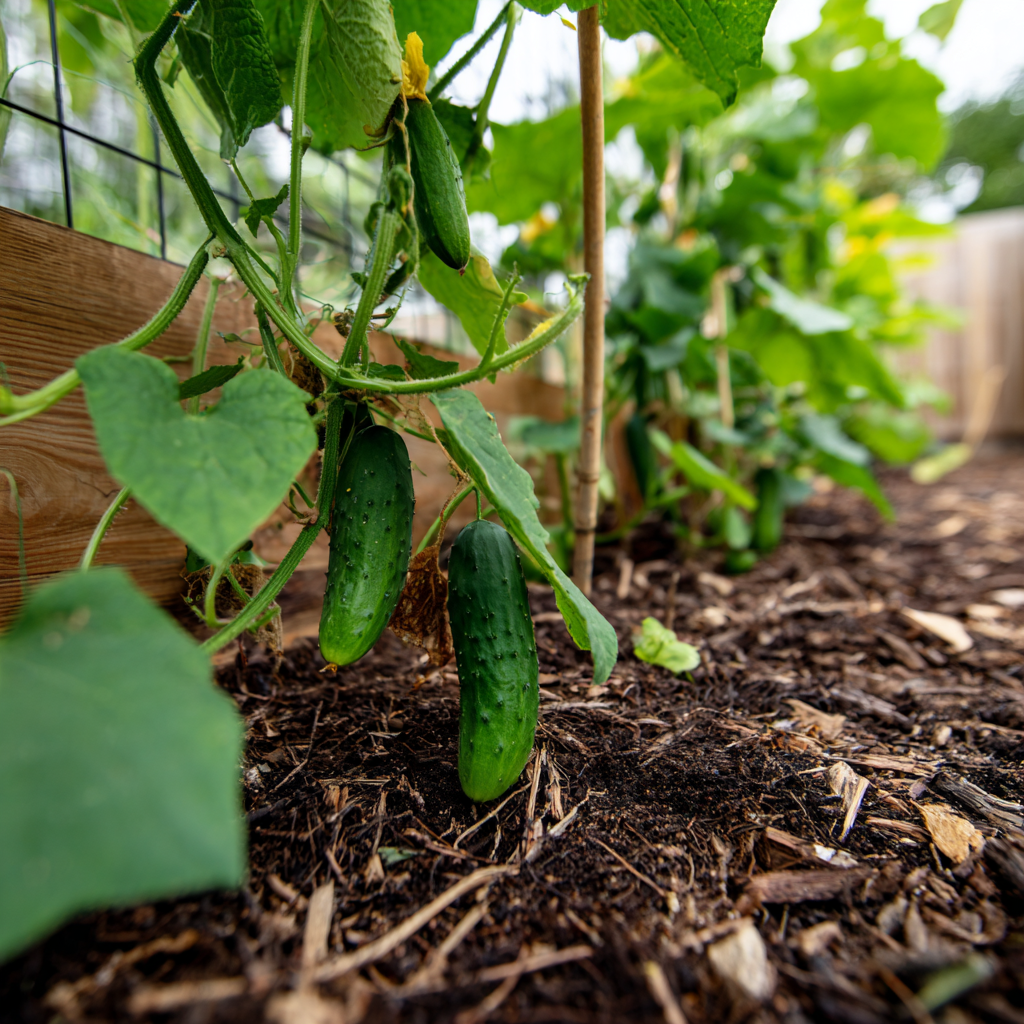
Marketmore 76 is a dependable open-pollinated slicing cucumber bred at Cornell University and released in 1976. It produces dark green, straight fruit about 8 to 9 inches long with a crisp interior and mild flavor. What sets Marketmore 76 apart from older cucumber varieties is its documented resistance to cucumber mosaic virus, powdery mildew, downy mildew, scab, and anthracnose — a combination of disease tolerance that makes it reliably productive in home gardens where disease pressure is common.
Quick How-to
Direct sow Marketmore 76 outdoors once soil temperature reaches 70 F and all frost risk has passed. Sow about 1/2 inch deep, thin seedlings to 8 to 12 inches apart, and provide a trellis or cage. Harvest fruit at 7 to 9 inches before the skin yellows or the fruit softens. Pick frequently to keep plants producing.
Quick Guide
| Fact | Recommendation |
|---|---|
| Best method | Direct sow after soil warms to 70 F; indoor start optional (3 to 4 weeks max) |
| Sowing depth | About 1/2 inch |
| Germination temperature | 70 to 95 F; 70 F minimum soil temperature |
| Days to germination | 7 to 10 days in warm soil |
| Light for germination | Cover seed; strong light needed immediately after sprouting |
| Spacing | 8 to 12 inches apart in rows; 36 to 48 inches if hills or wider spacing |
| Sun | Full sun, 6 or more hours daily |
| Water | Consistent, deep watering; avoid dry spells during flowering and fruiting |
| Days to harvest | Approximately 58 to 68 days from direct sow |
| Support | Trellis strongly recommended for straight fruit and airflow |
Before You Sow
Marketmore 76 is a vining cucumber that grows 4 to 6 feet of vine in a typical season. Even though it is not a bush type, its manageable habit works in most home gardens with a simple trellis or panel. Plan your support system before sowing — installing it after plants are growing disturbs roots and damages stems.
Prepare the bed with finished compost or well-rotted organic matter. Cucumber roots go deep in good soil, and a well-prepared bed pays dividends in both yield and disease resistance. Check that the planting area drains well; Marketmore 76’s disease tolerance does not protect it from crown rot in waterlogged soil.
Direct Sowing
Sow 2 to 3 seeds per planting point at 1/2 inch depth. Thin to the strongest seedling once true leaves are visible. For row planting, space planting points every 8 to 12 inches along the trellis. For hill planting, use 3 to 4 seeds per hill with hills 4 to 5 feet apart, then thin to 2 plants per hill.
Water in after sowing with a gentle spray. Keep the seedbed moist but not saturated until seedlings emerge. Once plants show true leaves, begin deep, less frequent watering to encourage root development.
Indoor Starting and Transplanting
If your season is short or you want a head start, sow Marketmore 76 indoors no more than 3 to 4 weeks before your last expected frost date. Use individual peat or coir pots that can be set into the ground without disturbing roots. Cucumbers grow fast and will outgrow a small tray quickly, becoming rootbound if held indoors too long.
Harden off over 5 to 7 days before transplanting. Set plants out only after frost risk has passed and the soil is genuinely warm — 70 F at 1 inch. Plant at the same depth as the pot, water in well, and begin guiding vines toward support within the first week.
Soil, Sun, and Water
Marketmore 76 produces its best fruit in full sun with fertile, well-draining soil and a pH of about 6.0 to 6.8. Once vines are running, a side dressing of balanced fertilizer or a light feeding of compost tea supports continued fruit production. Avoid excess nitrogen at this stage; overly lush vines with few flowers are a common result of heavy nitrogen after fruit set begins.
Water deeply and consistently. Uneven watering during fruit fill leads to bitter cucumbers and hollow centers in severe cases. Mulching after the soil warms helps stabilize moisture and temperature and keeps soil from splashing onto lower leaves, which can introduce soilborne disease.
Top Mistakes
- Planting into cold soil: Marketmore 76’s disease resistance offers no protection against the germination failures and root problems that come with cold, wet conditions. Wait for genuine soil warmth before sowing or transplanting.
- Harvesting too late: At 8 to 9 inches Marketmore 76 fruit is firm and dark green. Beyond that, seeds enlarge, skin yellows, and eating quality drops quickly. Pick at 7 to 9 inches and check plants every day or two at peak season.
- Leaving overripe fruit on the vine: A single yellow, seedy cucumber left on the plant will significantly slow new fruit production. The plant interprets ripe seed as a sign to stop flowering. Remove any overripe fruit promptly.
- Dense planting without a trellis: Even with good disease resistance, crowded cucumber plants with poor airflow develop mildew more readily. Trellis plants, maintain recommended spacing, and avoid overhead watering late in the day.
- Inconsistent watering: Fruit that develops during drought stress can be bitter even in a disease-resistant variety. Steady moisture throughout the season is one of the most important factors in producing clean-tasting slicers.
Troubleshooting by Symptom
| Symptom | Likely causes | What to do next |
|---|---|---|
| No germination after 10 to 14 days | Soil below 70 F, seed planted too deep, waterlogged bed | Verify soil temperature; re-sow at correct depth in warm, well-drained soil |
| Seedlings fall over at soil level | Damping-off from wet, poorly aerated conditions | Improve drainage and airflow; thin seedlings; avoid cold, saturated soil |
| White powdery coating on upper leaf surface | Powdery mildew, which Marketmore 76 has resistance to but not complete immunity | Remove heavily affected leaves; improve airflow; reduce overhead watering; Marketmore 76’s resistance should slow spread compared with susceptible varieties |
| Yellowing lower leaves with gray-purple fuzz on underside | Downy mildew, favored by cool humid nights | Trellis for airflow; water in the morning; remove and dispose of severely affected foliage |
| Fruit is short, swollen, or misshapen | Poor pollination, sudden temperature swings, or water stress during fruit fill | Ensure bees can access flowers; maintain even moisture; protect from cold overnight dips early in the season |
| Sudden vine wilt on a hot day | Bacterial wilt spread by cucumber beetles, or heat stress with root damage | Inspect for striped or spotted cucumber beetles on and under leaves; use row covers from emergence until flowering; remove covers at flower appearance for pollination |
| Fruit is bitter | Drought stress, irregular irrigation, or heat above 95 F during fruit fill | Mulch to moderate soil moisture and temperature; water deeply and consistently; harvest at correct size before quality declines |
Harvest and Kitchen Use
Marketmore 76 fruit is ready to harvest at 7 to 9 inches — dark green, firm, and slightly cool to the touch even in warm weather. The skin is slightly thicker than thin-skinned types but still mild and pleasant. Harvest every 1 to 2 days once production is underway.
Marketmore 76 is primarily a slicing cucumber: excellent in salads, on sandwiches, and in any preparation where a classic dark-green slicer is called for. It is also usable for fresh pickling when harvested young at 4 to 5 inches, though dedicated pickling varieties like National Pickling Cucumber have thinner skins and crisper texture in brine.
Seed Saving
Marketmore 76 is open-pollinated, bred and released from a public university program, and grows true to type from saved seed — a major advantage over hybrids. To save seed reliably, isolate from all other cucumber varieties by at least a quarter mile, since cucumbers cross readily via insects. Alternatively, hand-pollinate by bagging male and female flowers before opening, transferring pollen manually, and rebagging until fertilization is complete.
Allow designated fruit to remain on the vine until fully yellow and beginning to soften — much larger and more mature than eating stage. Remove seeds, ferment in water for 2 to 3 days to break down the gel coat, rinse clean, and dry on a non-stick surface for 1 to 2 weeks before storing in a labeled, sealed container.
Storing Leftover Seed
Keep unused Marketmore 76 Cucumber seed in its labeled packet inside a sealed container in a cool, dry, dark indoor location. Avoid garages, sheds, greenhouses, and sunny windowsills, where temperature and humidity swing sharply. Label home-saved seed with the variety and harvest year before storing it.
FAQ
What disease resistance does Marketmore 76 actually have?
Marketmore 76 was bred at Cornell University by Dr. Henry Munger with documented resistance to cucumber mosaic virus, powdery mildew, downy mildew, scab, and anthracnose. This combination of resistances makes it one of the more reliable open-pollinated slicers for gardeners who have experienced disease losses with other varieties. Resistance does not mean immunity — poor growing conditions can still allow disease to develop — but resistant plants typically show milder symptoms and recover more readily.
How is Marketmore 76 different from other Marketmore varieties?
The Cornell Marketmore series includes several releases (Marketmore 70, 76, 80, 86, and others). Marketmore 76 is one of the most widely available and broadly adapted, with a good combination of fruit quality and disease resistance. Different releases in the series have slightly different resistance profiles, but for home garden purposes they are very similar in culture and use.
Is Marketmore 76 good for pickling?
It is primarily a slicing variety, but small fruits harvested at 4 to 5 inches work adequately for fresh or refrigerator pickles. For traditional processed canning pickles, a dedicated pickling variety with thinner skin and higher crunch will give better results.
Can I save seed from Marketmore 76?
Yes. It is open-pollinated and will grow true from saved seed as long as no other cucumber varieties are flowering nearby. Isolate by distance or use hand-pollination, ferment and dry seeds properly, and you can maintain this variety from year to year.