
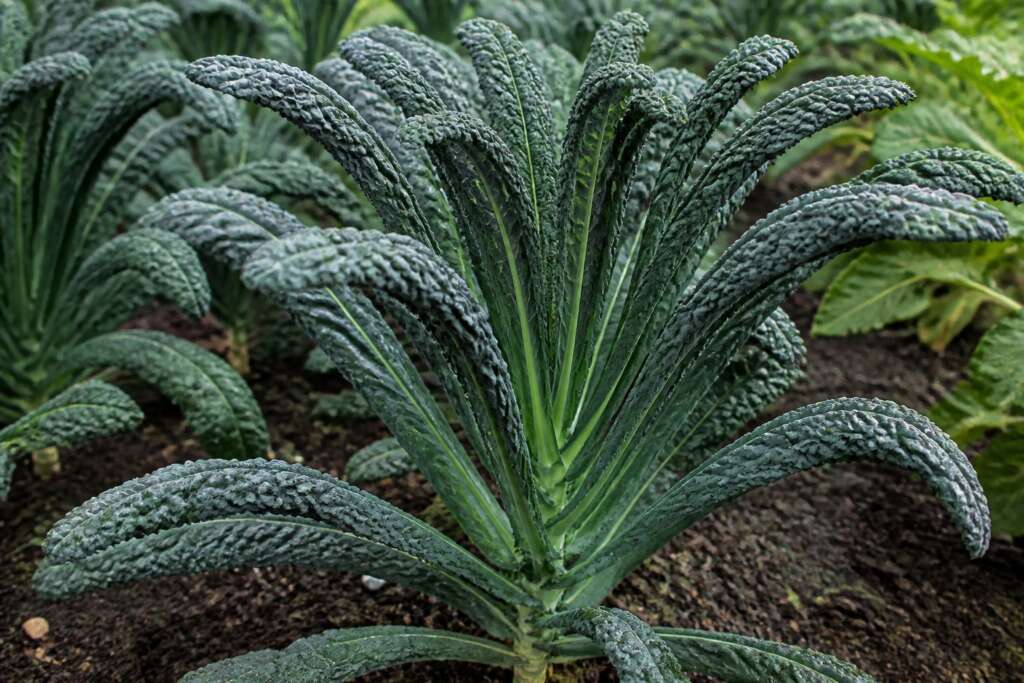
Lacinato kale is an Italian heirloom grown for its striking long, narrow leaves with a distinctly puckered or embossed surface texture — often described as resembling dragon or dinosaur skin. Unlike the tightly curled leaves of Scotch kale, Lacinato produces strap-like blue-green leaves that are particularly tender, earthy, and sweet compared with most other kale types. Grown since at least the 18th century in Tuscany, where it is called cavolo nero or Nero di Toscana, it has become a staple in Italian cooking and is now widely grown in home gardens throughout North America. It handles both heat and heavy frost with notable resilience, making it productive across a long season.
Quick How-to
Start Lacinato kale indoors 4 to 6 weeks before the last expected frost for spring planting, or direct sow in mid to late summer for a fall and winter harvest. Sow seeds about 1/4 inch deep in seed-starting mix, keep the mix warm and moist until germination, then move seedlings to cool, bright conditions. Transplant or thin to 12 to 18 inches apart. Harvest from the bottom of the plant upward, leaving the central crown intact so the plant keeps producing.
Quick Guide
| Fact | Recommendation |
|---|---|
| Best method | Indoor start (spring); direct sow or transplant (fall) |
| Sowing depth | About 1/4 inch indoors; 1/2 inch for direct sowing |
| Germination temperature | 45 to 85 F; fastest between 65 and 75 F; grow seedlings at 60 to 70 F |
| Days to germination | Typically 5 to 10 days |
| Light for germination | Cover seed; provide strong light immediately after sprouting |
| Spacing | 12 to 18 inches apart, rows 18 to 36 inches apart |
| Sun | Full sun; tolerates light shade |
| Water | Even moisture throughout; water deeply and let top inch dry between waterings |
| Harvest timing | Outer leaves ready from about 60 to 80 days after transplanting; production continues for months |
| Plant size | Typically 2 to 3 feet tall; upright, palm-like growth habit |
Before You Sow
Plan your timing around the season you want to harvest. Lacinato kale is a cool-season crop that tolerates both frost and summer warmth better than many brassicas, but its flavor and leaf quality are best in cool weather. Spring plantings work well in most climates when started indoors 4 to 6 weeks before the last frost and transplanted out while conditions are still cool. For the finest flavor, time a fall crop so plants are maturing when nights drop below 40 F.
Prepare the planting bed by working compost into the top several inches of soil. Lacinato kale prefers fertile, well-drained soil with a pH of 6.0 to 6.8. Because it grows tall and produces over many months, giving it good soil conditions at the start pays off significantly over the harvest season.
Indoor Starting
Sow seed about 1/4 inch deep in a seed-starting mix in individual cells or small pots. Keep the mix consistently moist; kale germinates over a wide range but is fastest when soil is between 65 and 75 F, typically within 5 to 10 days. Once seedlings emerge, move them to a cooler location with strong overhead light. Kale seedlings grown warm without enough light stretch rapidly and develop weak stems that make transplanting difficult.
Provide 14 to 16 hours of light per day under grow lights, or place in the brightest available window and supplement as needed. Pot up seedlings when roots fill their starting cell. Plants are ready to transplant when they have 4 to 6 true leaves and a sturdy stem.
Transplanting and Thinning
Harden off seedlings over 7 to 10 days before moving them outdoors. Start with brief, sheltered outdoor exposure and increase time and sun gradually over the week. Transplant at the same depth as the root ball. Water in well and mulch around the base.
For direct sowing, sow 3 to 4 seeds every 12 inches and thin to one plant per group. Thin when seedlings are 3 to 4 inches tall, cutting rather than pulling to avoid disturbing neighboring roots. The removed seedlings are edible as microgreens or baby greens.
Soil, Sun, and Water
Lacinato kale grows best in full sun — a minimum of six hours of direct light per day. It tolerates partial shade, particularly in hot climates, but shade reduces yield and can make plants stretch toward available light.
Soil should drain well and hold reasonable moisture. Sandy soils benefit from added compost to improve water retention; heavy clay soils benefit from compost or raised-bed preparation to improve drainage. Consistent moisture produces the most tender leaves. Allow the top inch of soil to guide watering rather than watering on a fixed schedule.
Once plants are established, a side-dressing of balanced fertilizer or compost at mid-season helps sustain the long production period. Kale is a moderate nitrogen feeder — enough to keep new growth coming, but excess nitrogen late in the season pushes soft growth that is less cold-hardy.
Hydroponic Growing
Lacinato Kale grows hydroponically as an upright, long-season leafy crop. Its narrow strap-like leaves use space efficiently, but the plant develops a substantial stem and root system. Choose deep-water culture or a sturdy, wide NFT channel; small countertop openings become restrictive as plants mature. Transplant one seedling per site when roots emerge from the plug.
Feed with a complete leafy-green nutrient around EC 1.4 to 2.0 mS/cm and pH 5.8 to 6.2. Keep the solution aerated and out of light, and adjust EC before pH. Lacinato can tolerate cool air, but stagnant cold water slows uptake while warm low-oxygen water damages roots, so aim for a stable moderate root zone.
Allow 10 to 12 inches between plants and provide strong overhead light. Harvest the oldest lower leaves and keep the center growing; remove yellowing leaves before they fall into the reservoir. The upright habit makes repeated harvest easy, but tall plants may need a clip or stake so the root crown is not rocked loose.
Long weak stems indicate insufficient light or crowding. Marginal burn can follow high EC, while pale leaves with normal EC often point to pH-related lockout. Wilt with a full reservoir requires an immediate check for pump failure, plugged channels, or brown roots rather than additional nutrient.
Top Mistakes
- Harvesting from the top: The most common harvesting error with any non-heading kale is removing the central growing tip. Always harvest the oldest outer leaves from the bottom of the plant. The central crown drives continued production for weeks or months.
- Letting plants bolt in spring without harvesting fully: Once days warm and lengthen, Lacinato kale may send up a flower stalk. Harvest aggressively in late spring — the flower buds and small leaves at the top are edible and delicious — before the plant devotes energy to flowering instead of leaf production.
- Planting in waterlogged soil: Lacinato kale is tall and long-lived, and persistent wet soil around the roots promotes rot and disease over a long season. Raised beds or mounded rows improve drainage significantly in heavier soils.
- Ignoring aphid colonies: Kale aphids (Brevicoryne brassicae) can build up rapidly on kale, particularly in spring and fall. A few aphids become thousands quickly. Check the undersides of leaves regularly and knock aphids off with a firm spray of water before colonies establish.
- Treating it as a single-harvest crop: Unlike lettuce or spinach, Lacinato kale is not pulled at once. A single well-established plant can supply leaves for 6 months or more when harvested correctly. Pulling the whole plant eliminates months of potential production.
Troubleshooting by Symptom
| Symptom | Likely causes | What to do next |
|---|---|---|
| No sprouts after 10 to 14 days | Soil too cold, seed too deep, or mix dried out | Verify soil temperature above 60 F, check depth is 1/4 inch, keep surface evenly moist |
| Seedlings stretch rapidly indoors | Insufficient light, excess warmth, or too little airflow | Move under brighter lights, lower temperature to 60-65 F, improve airflow between seedlings |
| Sticky residue and distorted leaves | Aphid infestation — check undersides of leaves | Blast with water spray; monitor regularly and repeat; beneficial insects naturally control light infestations |
| Leaves yellow from the bottom up | Normal aging, nitrogen deficiency, or overwatering | Remove yellow leaves; if widespread, test soil; avoid saturating soil around the root zone |
| Ragged irregular holes in leaves | Caterpillar feeding (cabbageworm, cabbage looper) | Inspect undersides for caterpillars or eggs; remove by hand or use appropriate caterpillar control |
| Plant wilts despite adequate soil moisture | Root damage from compacted or saturated soil, or root maggot activity | Check root condition and drainage; protect future plantings with row cover from the time of planting |
Harvest and Kitchen Use
Begin harvesting Lacinato kale leaves from the bottom of the plant when they reach about 8 to 10 inches long. The long, dark leaves with their pebbly texture stand up well to braising and sauteing and are a classic ingredient in ribollita and minestrone. They can also be massaged raw in salads when young and dressed early, which softens the texture significantly.
As the plant matures, the lower leaves become more fibrous. Harvest them while they are still relatively young for the best texture, and let the upper leaves continue growing. In fall, flavor intensifies after frost as the plant converts starches to sugars. Plants that survive winter in mild climates will produce edible flower shoots in early spring before setting seed.
Seed Saving
Like all kale, Lacinato is a biennial. It flowers in its second year after experiencing cold. Kale cross-pollinates freely with any other Brassica oleracea crop (cabbage, broccoli, Brussels sprouts, cauliflower, collards, and other kales) when they flower at the same time within range of pollinators. For seeds that reliably produce Lacinato-type offspring, isolate from other B. oleracea crops by at least half a mile, or use bagging and hand pollination. Save from the most vigorous plants showing the truest leaf characteristics.
Storing Leftover Seed
Keep unused Lacinato Kale seed in its labeled packet inside a sealed container in a cool, dry, dark indoor location. Avoid garages, sheds, greenhouses, and sunny windowsills, where temperature and humidity swing sharply. Label home-saved seed with the variety and harvest year before storing it.
FAQ
Is Lacinato kale different from other kales?
Yes, distinctly. Lacinato has long, narrow, dark blue-green leaves with a bumpy embossed texture, quite different from the tightly curled bright-green leaves of Scotch or curled kale types. The flavor is also different — earthier, more savory, and often considered more nuanced than curly kale, particularly when cooked.
Does Lacinato kale need a trellis or support?
It does not need staking under normal conditions, but tall plants in exposed, windy locations may lean. Hilling soil up around the base after plants are well established — similar to how you might hill Brussels sprouts — can improve stability.
Can I grow Lacinato kale as a cut-and-come-again crop?
Yes, though it differs from leaf lettuce cut-and-come-again. With kale, you harvest individual outer leaves rather than cutting the whole plant at once. Done correctly, a single plant produces continuously for many months across both spring and fall growing windows.
Why do my Lacinato kale leaves taste better after frost?
Cold temperatures trigger the plant to convert stored starches into sugars as a natural cold-hardening response. This is why fall-harvested kale has a notably sweeter, milder flavor than the same variety harvested in summer heat.