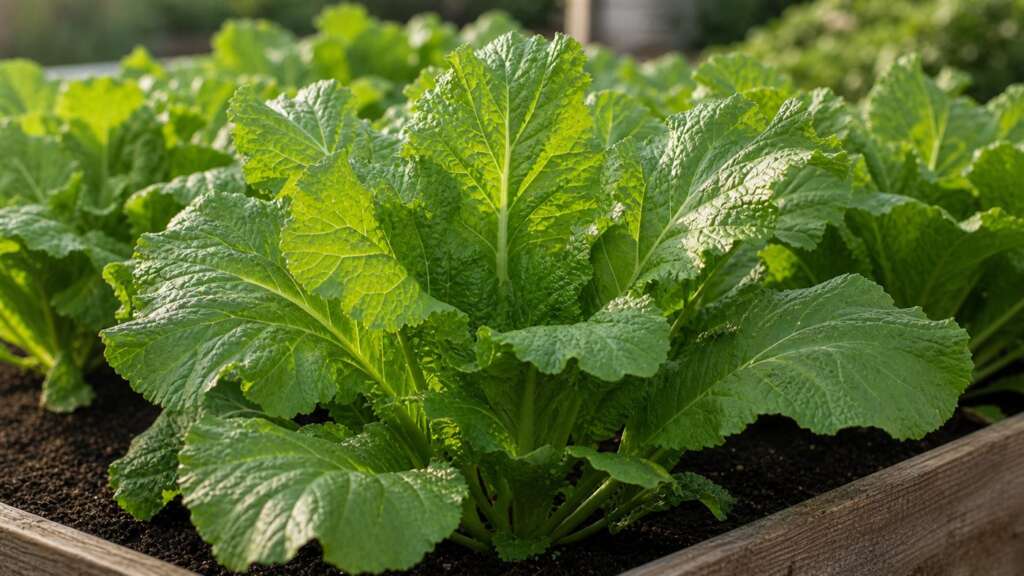
Florida Broadleaf Mustard is a fast, cool-season leafy green grown for its large, mildly spicy leaves and dependable performance in spring and fall gardens. It is one of the easier mustards for beginners because it germinates quickly, grows fast, and tolerates light frost better than most leafy greens.
Quick How-to
Direct sow Florida Broadleaf Mustard about 1/4 inch deep in early spring as soon as the soil can be worked, then again about 6 to 8 weeks before your first expected fall frost. Keep the seedbed evenly moist until seedlings emerge, usually within 4 to 10 days at soil temperatures around 60 to 75 F. Thin promptly so plants have room to make broad, tender leaves rather than crowded, stringy ones. Harvest outer leaves as needed or pull the whole plant before heat triggers bolting.
Quick Guide
| Fact | Recommendation |
|---|---|
| Best method | Direct sow preferred; transplants also work for an early start |
| Sowing depth | About 1/4 inch |
| Germination temperature | About 60 to 75 F for steady emergence |
| Days to germination | About 4 to 10 days |
| Light for germination | Cover lightly; seed does not need light to sprout |
| Spacing | About 6 to 12 inches apart for full-size plants; closer for baby leaf |
| Sun | Full sun in cool weather; afternoon shade in warming weather |
| Water | Even moisture; mustard turns hot and tough under drought stress |
| Days to harvest | Often about 45 to 50 days for full leaves, with baby leaves ready sooner |
| Plant size | Broad-leaved heirloom; large, upright rosette of light green leaves with white midribs |
Before You Sow
Florida Broadleaf is a true cool-season crop. The two best sowing windows are early spring, while nights are still chilly, and late summer for a fall harvest that finishes in cool weather. Spring sowings can be planted as soon as the ground is workable; fall sowings should be timed so the bulk of growth happens as days shorten and temperatures fall.
Pick a sunny bed with loose, fertile soil and good drainage. Mustard is shallow-rooted and responds well to a finely raked seedbed with no large clods. Work in finished compost if the soil is thin, but go easy on raw high-nitrogen fertilizer; pushing soft, lush growth can leave plants more attractive to flea beetles and aphids.
If flea beetles, cabbage worms, or slugs are common in your area, plan for floating row cover from the day you sow. Mustard is a brassica, so the same pest pressure that hits kale, collards, and turnips will find it.
Direct Sowing
Direct sowing is the simplest and most reliable method for this crop. Rake the surface smooth, water the bed lightly before sowing so tiny seed does not wash, and sow about 1/4 inch deep. You can plant in short rows about 12 to 18 inches apart or broadcast lightly across a small bed for a cut-and-come-again patch.
Cover the seed with a thin layer of fine soil or seed-starting mix and press gently for good contact. Water with a soft spray. Keep the top layer of soil evenly moist, not soggy, until seedlings appear. Germination is fast in cool soil, often within a week.
Once seedlings have one or two sets of true leaves, thin in stages. For baby-leaf harvests, leave plants about 2 to 3 inches apart. For full-size plants with broad, mature leaves, final spacing of about 8 to 12 inches gives the best results. The thinnings are edible and have the same peppery flavor as mature leaves.
Indoor Starting and Transplanting
Most gardeners do not need to start mustard indoors, but a short indoor start can be useful for the earliest spring planting or for placing exact numbers of plants in a tidy bed. Sow about 3 to 4 weeks before transplanting, one or two seeds per cell, and thin to a single seedling. Keep seedlings cool and brightly lit so they stay stocky rather than stretched.
Harden off over about a week before setting plants out. Transplant in cool, settled weather and water in well. Avoid letting transplants sit in their cells until they become rootbound; mustard prefers to grow forward, not to sit and stall.
Soil, Sun, and Water
Mustard wants fertile, well-drained soil with a steady moisture supply. Even moisture is the single most important factor for tender leaves. Plants that dry out and recover repeatedly tend to grow tough, more bitter, and more strongly spicy than plants that grow without interruption.
Full sun is best in cool weather. As temperatures rise toward late spring or early fall warm spells, a few hours of afternoon shade can slow bolting and keep leaves milder. A light mulch of straw or shredded leaves helps stabilize soil moisture and keeps splashing dirt off lower leaves.
A modest side-dressing of compost or balanced fertilizer partway through the crop can support steady leaf growth, especially in sandy soils. Avoid heavy nitrogen pushes; they create soft, watery leaves that wilt fast in heat and attract sap-feeding pests.
Succession Sowing
Mustard finishes quickly, so small, repeated sowings often work better than one big planting. Sow a short row every 2 to 3 weeks in spring until temperatures start climbing, then pause through the hottest part of summer and resume in late summer for fall harvests. Three or four short sowings give you a longer window of tender leaves than one large planting that all matures at once.
Hydroponic Growing
Florida Broadleaf Mustard performs strongly in hydroponics, but its large flat leaves need more room than baby salad greens. Deep-water culture, flood-and-drain media beds, or wide NFT channels are better choices than tightly spaced towers. Start one seedling per plug and transplant young, with the crown above the solution.
Use a complete leafy-green nutrient around EC 1.4 to 2.0 mS/cm and pH 5.8 to 6.2. Keep the reservoir shaded, clean, and aerated. Moderate temperatures produce broad tender leaves; warm conditions speed growth but also increase pungency and bolting. Begin at lower EC for seedlings, then increase within range as plants build leaf mass.
Space full plants 8 to 10 inches apart, or harvest earlier at closer spacing. Remove outside leaves regularly and keep the center intact. Because the broad blades overlap easily, move air across the canopy and remove damaged leaves before they decay into channels or rafts.
Small, sharply flavored leaves usually mean heat, crowding, or delayed harvest. Pale plants call for checks of pH, EC, and light in that order. If leaf edges burn while EC is high, dilute the solution; if roots darken and plants wilt, cool and oxygenate the reservoir and clean the system.
Top Mistakes
- Sowing into heat. Florida Broadleaf grows well in heat compared with some greens, but it still bolts and turns sharp when summer settles in. Time spring plantings early and fall plantings to ripen as nights cool.
- Skipping the thinning step. Crowded mustard looks healthy at first, then stalls. Thin to final spacing while plants are still small so the keepers can size up properly.
- Letting the seedbed crust over. A hard, dry surface can block tiny seedlings even when seed below has started to grow. Keep the top layer evenly moist until emergence.
- Ignoring flea beetles. Small round holes in young leaves are usually flea beetles. They can shred a young stand quickly. Row cover from day one is the simplest defense.
- Letting plants dry out and recover repeatedly. Drought stress makes leaves tough and pushes flavor toward bitter and overly hot.
Troubleshooting by Symptom
| Symptom | Likely causes | What to do next |
|---|---|---|
| No sprouts after 10 days | Seed buried too deep, dry or crusted surface, or cold soil | Resow shallowly, keep the surface evenly moist, and wait for soil to reach at least 50 F |
| Tiny round holes in young leaves | Flea beetles | Cover with floating row cover at sowing, keep edges sealed, and remove only at harvest |
| Ragged holes and green caterpillars | Cabbage worms or loopers | Hand-pick caterpillars, use row cover, or apply a Bt-based product labeled for brassicas |
| Plants bolt to flower stalks early | Heat, long days, transplant shock, or drought stress | Sow earlier or later in the cool window, water consistently, and harvest before stalks elongate |
| Leaves are unusually small or pale | Cold soil, low fertility, or crowding | Side-dress with compost or a balanced fertilizer and thin to final spacing |
| Leaves taste extremely sharp or bitter | Heat stress, drought, or over-mature plants | Harvest earlier, water more evenly, and grow in cooler weather |
| Yellowing lower leaves with sticky residue | Aphids feeding on undersides of leaves | Rinse with a strong water spray, encourage beneficial insects, or treat with insecticidal soap |
| Seedlings collapse at the soil line | Damping-off in wet, cool, low-airflow conditions | Improve drainage, water less often, and use fresh seed-starting mix for any indoor restarts |
Harvest and Kitchen Notes
You can harvest Florida Broadleaf two ways. For cut-and-come-again production, snip outer leaves about 2 inches above the crown once they reach 4 to 6 inches long; the plant will keep producing new leaves from the center. For a single harvest of large mature leaves, wait until the plant has a full rosette and cut the whole plant at the base.
Flavor changes with growing conditions. Leaves grown in cool weather are milder and sweeter, with the characteristic mustard kick concentrated mostly in the chewing finish. Plants that have lived through heat or drought taste hotter and sharper. A light frost typically improves flavor in fall plantings, softening any bitterness and bringing out a cleaner mustard taste.
Use young leaves raw in salads, sandwiches, and slaws. Mature leaves are excellent braised, simmered into soups and stews, sauteed with garlic, or cooked in the southern tradition with onions and a splash of vinegar. They wilt down significantly, so a large bowl of raw leaves cooks to a modest side dish.
Seed Saving
Florida Broadleaf is an open-pollinated heirloom, which makes seed saving feasible, but Brassica juncea readily crosses with other juncea mustards growing or flowering nearby. To save reasonably true seed, grow only one juncea variety at a time in your garden and from any neighboring gardens within reasonable distance.
Let several strong plants bolt, flower, and form long, narrow seed pods. Allow the pods to dry on the plant until they are tan and brittle, then cut whole stalks and finish drying on a tarp or in paper bags indoors. Thresh gently, winnow off chaff, and store cleaned seed in a labeled, airtight container. Note the variety and the year you collected it.
Storing Leftover Seed
Keep unused Florida Broadleaf Mustard seed in its labeled packet inside a sealed container in a cool, dry, dark indoor location. Avoid garages, sheds, greenhouses, and sunny windowsills, where temperature and humidity swing sharply. Label home-saved seed with the variety and harvest year before storing it.
FAQ
Is Florida Broadleaf Mustard spicy?
It has a true mustard flavor with a mild to moderate peppery kick that depends on growing conditions. Cool-grown plants are milder; heat-stressed or older plants are sharper. Cooking tames most of the heat.
Can I grow Florida Broadleaf Mustard in containers?
Yes. Use a wide container at least 8 to 10 inches deep with drainage, water more often than you would in-ground, and harvest leaves regularly. Containers heat up faster than soil beds, so move pots to afternoon shade as temperatures rise.
How cold-hardy is Florida Broadleaf?
Florida Broadleaf Mustard tolerates light frost and often develops a milder, sweeter flavor after cool nights. A hard freeze can damage exposed leaves, and winter survival depends on plant size, wind, snow cover, and local minimum temperatures. Use row cover for a few degrees of protection and treat unprotected overwintering as climate-dependent rather than guaranteed.
Will it survive summer heat?
It can grow through summer in mild coastal climates, but in most areas, it bolts and turns sharp as soon as hot weather settles in. Treat it as a spring and fall crop unless your summers are mild.
Do I have to thin the seedlings?
Yes, if you want full-size plants. For baby-leaf production, leave them dense and cut young. For broad mature leaves, thin to roughly 8 to 12 inches apart.