
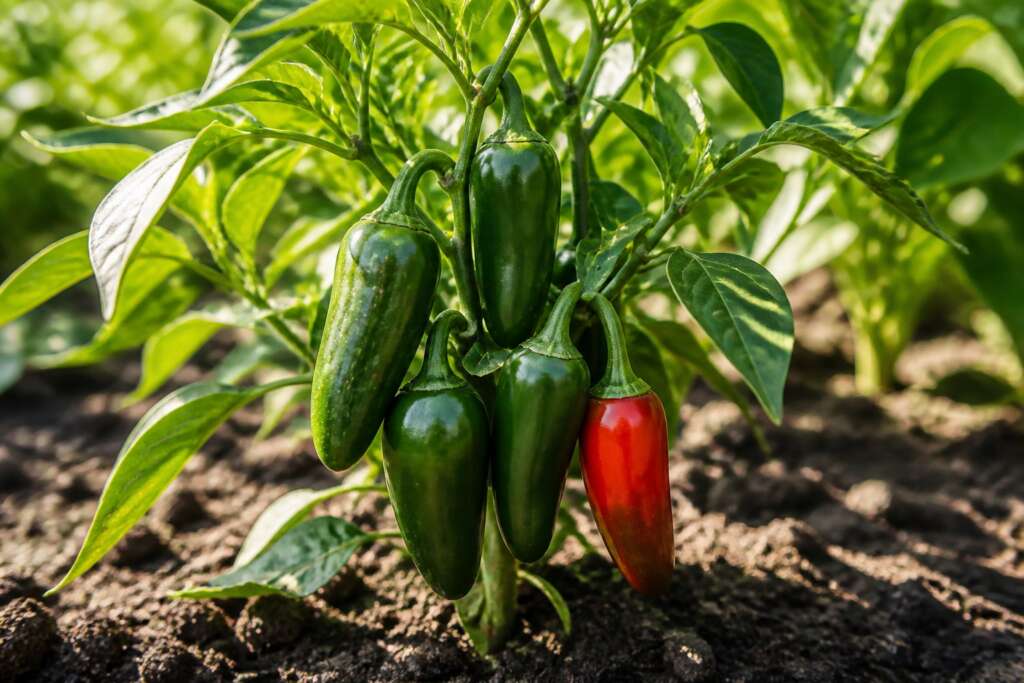
Jalapeño M is the benchmark jalapeno — an open-pollinated, high-yielding strain selected for reliable performance, consistent fruit size, and the medium heat that makes jalapeños one of the most widely grown chiles in home gardens. The fruit is thick-walled, deep glossy green at harvest, typically 3 to 4 inches long, and ripens to a bright red with a somewhat sweeter character. Plants grow to around 18 to 30 inches tall and produce abundantly in warm, sunny conditions. Where the Early Jalapeno is optimized for shorter seasons and quicker first harvest, Jalapeño M is a full-season workhorse — a steady, dependable producer through a long summer.
Quick How-to
Start Jalapeño M seeds indoors 8 to 10 weeks before your last expected spring frost. Sow about 1/4 inch deep and keep the germinating mix at 80 to 90 F. Move seedlings under bright light as soon as they emerge. Harden off over 10 to 14 days, then transplant when nights are reliably above 55 F and the soil has warmed. Space plants 12 to 18 inches apart in full sun.
Quick Guide
| Fact | Recommendation |
|---|---|
| Best method | Start indoors, then transplant |
| Sowing depth | About 1/4 inch |
| Germination temperature | 80 to 90 F; heat mat strongly recommended |
| Days to germination | About 7 to 14 days at 80-85 F |
| Light for germination | Cover seed; strong overhead light immediately after sprouting |
| Spacing | 12 to 18 inches apart; rows 24 to 36 inches apart |
| Sun | Full sun, at least 6 to 8 hours daily |
| Water | Consistent moisture; about 1 inch per week during fruit development |
| Harvest | About 70 to 75 days from transplant at green stage |
| Plant size | Upright, 18 to 30 inches tall; moderately compact |
Before You Sow
The “M” is part of this established cultivar’s name. Reliable primary references do not consistently document a longer meaning for the initial, so it is best understood as the name of a stabilized, open-pollinated jalapeño selection rather than an abbreviation that needs expanding. In the garden, Jalapeño M is valued for classic jalapeño-shaped fruit, a useful green-to-red harvest window, and dependable warm-season production.
Start seeds 8 to 10 weeks before your last expected spring frost. Pre-moisten your seed-starting mix before sowing so the seed is seated in even moisture from the start. Have a heat mat in place before you sow — pepper seeds are sensitive to germination temperature, and the difference between a cold tray and a properly warmed one is often the difference between 7 days to germination and 3 or more weeks.
Indoor Starting
Sow Jalapeño M seed about 1/4 inch deep and cover lightly. Keep the germination tray at 80 to 90 F. A humidity dome placed over the tray maintains surface moisture without requiring constant monitoring, but vent it daily and remove it as soon as seedlings emerge.
Move seedlings under strong overhead light immediately after they break through the mix. Jalapeño M seedlings that germinate in warmth but grow in low light develop pale, stretched stems that are less productive outdoors. A grow light running 14 to 16 hours per day provides consistent results; a very bright south-facing window can work as a backup if light duration is adequate.
When seedlings develop true leaves and the root ball begins to fill the cell, transplant into 3- to 4-inch containers. Set at the same depth as before — unlike tomatoes, peppers do not gain meaningful benefit from deep planting. Water carefully, allowing the mix to dry slightly at the surface between waterings to develop a strong root system without the wet conditions that slow pepper roots early on.
A light balanced fertilizer every 2 weeks once true leaves are established supports healthy indoor growth without pushing excessive leafy growth at the expense of later fruiting.
Hardening Off and Transplanting
Harden off over 10 to 14 days. Jalapeño M, like most peppers, transitions poorly when moved outside abruptly. Begin with short sheltered sessions in partial shade and build gradually toward full sun and outdoor conditions. Plants that are adequately hardened off establish outdoors quickly; plants that are rushed outdoors often drop leaves and sit idle for a week or more.
Transplant when nighttime temperatures are reliably above 55 F — ideally 60 F — and soil is warm. Cold soil is one of the most common reasons pepper plants fail to thrive after transplanting in spring. Jalapeño M is a full-season variety that performs best with a genuinely warm summer; a week of patience at transplant time pays off with a steadier season.
Space 12 to 18 inches apart and water in well. Mulch around the base of the plant once the soil is warm to maintain moisture and moderate soil temperature through summer.
Soil, Sun, and Water
Jalapeño M thrives in well-drained, moderately fertile soil with a pH around 6.0 to 6.8. Work in compost before planting. Once plants are in the ground, moderate fertility is sufficient; heavy nitrogen feeding through midsummer can delay fruit development by pushing leafy growth.
Full sun is important for maximum productivity. Plants in 6 to 8 hours of direct sun per day produce noticeably more fruit and ripen it more evenly than plants in partial shade.
Water consistently at the base of the plant, targeting about 1 inch per week during active growth and fruit development. Avoid letting the soil dry out sharply between waterings, particularly during flowering and fruit fill — moisture stress is one of the main causes of flower drop and undersized fruit in jalapeños. Avoid keeping the soil constantly wet, which can stress roots. Mulching after transplanting helps moderate the moisture cycle through summer.
Top Mistakes
- Using bottom heat only for germination then forgetting about transplant timing: Heat matters at the beginning and at transplanting. Seeds germinated on a heat mat and then transplanted into cold spring soil will sit motionless. Both stages require warmth for Jalapeño M to perform well.
- Watering overhead regularly: Overhead irrigation keeps foliage wet, which favors fungal issues on jalapeños in humid climates. Water at the base. Drip or soaker hose is ideal.
- Harvesting only at the green stage: Jalapeño M peppers can be picked green — which is the standard culinary stage — or allowed to ripen red, which increases sweetness and offers a different flavor profile. Both are useful, and leaving a few fruit on the vine to fully ripen does not harm the plant when done selectively.
- Planting too close together: Plants at 12 to 18 inches apart have adequate airflow. Tighter spacing creates humid canopy conditions where Phytophthora and fungal foliar diseases spread more easily.
- Underestimating irrigation needs in hot summers: Jalapeño M is a full-season producer, and summer heat combined with wind dries soil faster than gardeners sometimes expect. Mulch and regular irrigation become more important as the season heats up, not less.
Troubleshooting by Symptom
| Symptom | Likely causes | What to do next |
|---|---|---|
| No sprouts after 2 to 3 weeks indoors | Germination temperature below 75 F, seed buried too deep, or inconsistent moisture | Verify heat mat is reaching 80-90 F; keep mix evenly moist; resow at 1/4 inch if needed |
| Slow, uneven germination | Inadequate heat, dry surface, or seed buried too deep | Hold the seed zone near 80 to 85 F, keep the surface evenly moist, and confirm a shallow sowing depth |
| Seedlings are pale and elongated | Low light conditions after germination | Move under grow lights immediately; 14-16 hours daily at close range produces compact, healthy seedlings |
| Plants show no new growth after transplant | Cold soil, inadequate hardening-off, or root disturbance | Wait for warm nights; water lightly and consistently; use row cover if needed for nighttime warmth |
| Flower drop and poor fruit set | Cool nights (below 55 F), hot nights (above 75 F), drought stress, or excess nitrogen | Maintain consistent moisture; reduce nitrogen feeding; wait for temperature range to normalize |
| Fruit is small or misshapen | Water stress, calcium imbalance, or heat stress during pollination | Water consistently; mulch to buffer soil moisture and temperature; ensure adequate sun |
| Yellowing foliage with stunted growth | Nutrient deficiency, pH imbalance, or root stress from poor drainage | Test soil pH; apply balanced fertilizer; ensure good drainage around the root zone |
Harvest and Kitchen Use
Jalapeño M is typically harvested when the fruit is dark, glossy green, firm, and has reached its mature length of 3 to 4 inches — usually around 70 to 75 days from transplant. At this stage the skin is smooth and tight, and the heat is characteristic medium jalapeño — roughly 2,500 to 8,000 Scoville Heat Units. Harvest regularly with scissors or a sharp knife to keep the plant producing through the season.
Fully ripe red jalapeños develop a sweeter, deeper, more mature pepper flavor. Their heat can be milder, similar, or hotter than green fruit from the same planting because capsaicin level varies with genetics, temperature, moisture, and individual fruit; ripening red does not reliably reduce pungency. Leaving selected fruit to ripen red while continuing to harvest others green is a practical way to diversify the harvest. Red jalapeños are particularly good smoked, dehydrated, or used in sauces where their fuller flavor is welcome.
Jalapeño M peppers are well-suited for fresh salsa, sliced pickled jalapeños, nachos, guacamole, stuffed jalapeño poppers, and chopped into countless cooked preparations. Their thick walls hold up well to heat.
Seed Saving
Jalapeño M is open-pollinated and can be seed-saved with attention to isolation. Jalapeños cross readily with other Capsicum annuum varieties — bells, Anaheims, wax peppers, and other jalapeños — when insects are active. For reliable true-to-type seed, isolate Jalapeño M plants by at least 300 to 500 feet from other C. annuum varieties, or hand-pollinate and bag selected flowers before they open.
Save from fully red, ripe, healthy fruit. Slice open the pepper, scrape seeds into a bowl or directly onto a clean, non-stick surface, and dry for 1 to 2 weeks in a well-ventilated location out of direct sun. Seeds that snap when bent are fully dry. Label with variety name and year and store in a sealed container, cool and dark.
Storing Leftover Seed
Keep unused Jalapeño M Pepper seed in its labeled packet inside a sealed container in a cool, dry, dark indoor location. Avoid garages, sheds, greenhouses, and sunny windowsills, where temperature and humidity swing sharply. Label home-saved seed with the variety and harvest year before storing it.
FAQ
What does the “M” mean in Jalapeño M?
“M” is the established cultivar designation used in the seed trade, but dependable primary sources do not consistently assign the letter a longer expansion. The useful distinction is that Jalapeño M is sold as a stabilized, open-pollinated cultivar rather than an F1 hybrid, so seed saved with adequate isolation can reproduce its general type.
How is Jalapeño M different from Early Jalapeno?
Early Jalapeno is a variety selected specifically for faster maturity — around 65 to 68 days — making it advantageous in shorter growing seasons. Jalapeño M is a standard-season producer at around 70 to 75 days, with somewhat larger and thicker-walled fruit. Both deliver classic jalapeño heat and flavor; the choice between them depends largely on your season length and priorities.
When should I pick Jalapeño M peppers?
Pick green when fruit is firm and glossy at 3 to 4 inches long for the standard jalapeño experience. For red jalapeños, leave fruit on the plant until the skin turns fully red and may show slight wrinkling at the stem end. Both stages are perfectly fine; harvesting green keeps the plant producing new fruit more actively.
Are Jalapeño M peppers hot?
Medium heat: typically 2,500 to 8,000 Scoville Heat Units, which falls in the standard jalapeño range. Individual peppers vary, and stress conditions such as drought or high heat during fruit development can increase pungency. They are noticeably hotter than Anaheim chiles but milder than serrano or habanero peppers.