
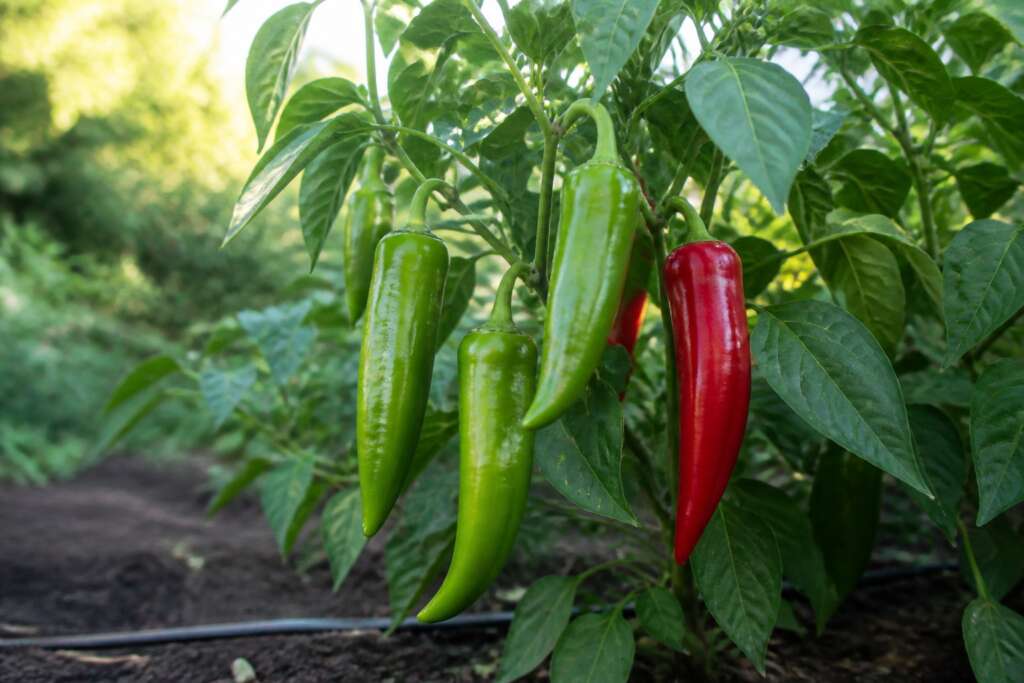
Anaheim pepper is a long, tapered mild chile that ripens from green to red and is one of the most versatile chiles in American kitchens. Its heat is gentle — roughly 500 to 2,500 Scoville Heat Units — making it approachable for fresh eating, roasting, stuffing, and salsa. The plants are upright and productive, reaching 18 to 30 inches tall, and they thrive in warm, sunny conditions with a long growing season. Because peppers need warmth from day one, starting seeds indoors 8 to 10 weeks before your last frost date is the right approach for most home gardeners.
Quick How-to
Start Anaheim pepper seeds indoors 8 to 10 weeks before your last expected spring frost. Sow about 1/4 inch deep in warm seed-starting mix and keep the mix at 80 to 90 F for germination. Move seedlings into strong light as soon as they sprout. After hardening off, transplant when nights are consistently above 55 F and soil is warm. Space plants 18 to 24 inches apart in full sun.
Quick Guide
| Fact | Recommendation |
|---|---|
| Best method | Start indoors, then transplant |
| Sowing depth | About 1/4 inch |
| Germination temperature | 80 to 90 F; heat mat strongly recommended |
| Days to germination | About 7 to 14 days at 80-85 F |
| Light for germination | Cover seed; bright light needed immediately after sprouting |
| Spacing | 18 to 24 inches apart; rows 24 to 36 inches apart |
| Sun | Full sun, at least 6 to 8 hours daily |
| Water | Consistent moisture; about 1 inch per week during fruit development |
| Harvest | About 70 to 80 days from transplant to green; 80 to 90 days for full red |
| Plant size | Upright, 18 to 30 inches tall |
Before You Sow
Anaheim peppers are warm-season crops that do not tolerate frost or prolonged cold. Unlike tomatoes, peppers are especially sensitive to cold soil and cold nights both before and after transplanting. Starting on time — 8 to 10 weeks before last frost — gives you transplant-size plants exactly when conditions outside become suitable.
Use pre-moistened seed-starting mix in small cells or pots, and have a heat mat ready. Pepper seeds are notoriously slow to germinate without adequate bottom heat. At room temperature (68 to 72 F), germination can take 3 weeks or more and is often spotty. At 80 to 90 F with steady moisture, most seeds sprout within 7 to 14 days. A heat mat under the tray is one of the most useful investments for pepper growers in any climate.
Indoor Starting
Sow seed about 1/4 inch deep and cover lightly. Keep the mix warm and evenly moist throughout germination. A humidity dome helps maintain steady surface moisture; open it slightly for airflow and remove completely once seedlings emerge.
Once sprouts appear, move seedlings immediately under bright overhead light. Peppers grown in low light become pale and stretched indoors, and they rarely recover their full potential after a weak start. Provide 14 to 16 hours of light per day from a grow light, or place on the brightest south-facing windowsill available.
When true leaves appear, the seedlings can be moved to 3- to 4-inch pots if roots are filling the cell. Water carefully, allowing the mix surface to dry slightly between waterings — peppers are more prone than tomatoes to sitting in wet mix, which can cause root issues early. Unlike tomatoes, peppers do not benefit from deep planting; set them at the same level they were growing indoors.
A light balanced fertilizer every 2 weeks once true leaves are present supports steady indoor growth.
Hardening Off and Transplanting
Peppers are more sensitive to transplant shock than most warm-season crops. Harden off over 10 to 14 days, starting with just 30 to 45 minutes in filtered shade and building slowly to full sun and breeze. A rushed hardening process on peppers often results in leaf drop or sunscald.
Transplant only when nighttime temperatures are consistently above 55 F — preferably 60 F or above. Peppers planted into cold nights simply sit without growing and are vulnerable to early fungal issues. Unlike tomatoes, there is little to be gained by planting Anaheim peppers even slightly early; warmth is the true accelerator for this crop.
Space 18 to 24 inches apart. Water in well at transplanting. Anaheim peppers do not need deep planting.
Soil, Sun, and Water
Anaheim peppers perform best in well-drained soil with a pH around 6.0 to 6.8. Work in compost before planting. A moderate-fertility soil suits peppers well; too much nitrogen produces lush foliage but fewer peppers and delayed fruit set.
Full sun is necessary for productive plants. Anaheim peppers grown in partial shade may survive but will flower and fruit far less than plants in 6 to 8 hours of direct sun.
Water consistently, targeting about 1 inch per week during active fruit development. Peppers do not like to sit in wet soil, but they also drop flowers and slow fruit development when the root zone dries out repeatedly. Drip irrigation or soaker hose at the base of the plant works well. Mulch around plants to moderate soil moisture and temperature, which is especially helpful during summer heat spikes.
Top Mistakes
- Skipping the heat mat for germination: Anaheim peppers germinate slowly or unevenly without bottom heat. At room temperature, germination can be erratic and take 3 or more weeks. A heat mat at 80 to 90 F dramatically improves both speed and uniformity.
- Transplanting into cool nights: Peppers respond poorly to cold nights even when frost is not a risk. Transplanting when nighttime temperatures are below 55 F delays the entire season. Wait for genuine warmth.
- Inconsistent watering during fruit set: Flower drop and undersized peppers are frequently linked to moisture swings. Consistent watering from flowering through fruit fill prevents this.
- Harvesting only green fruit: Anaheim peppers picked at the green stage have excellent fresh flavor, but allowing some fruit to ripen fully to red increases sweetness and provides a different culinary option. Both stages are useful.
- Letting the soil stay wet: Unlike tomatoes, peppers are particularly vulnerable to root rot in poorly drained or overly wet soil. Ensure good drainage and do not overwater, especially early in the season when plants are small.
Troubleshooting by Symptom
| Symptom | Likely causes | What to do next |
|---|---|---|
| No sprouts after 2 to 3 weeks | Mix temperature too low, seed too deep, or dry surface | Confirm heat mat is maintaining 80-90 F; keep mix evenly moist; resow at 1/4 inch if needed |
| Very slow, uneven germination | Inadequate heat, inconsistent moisture, or seed buried too deep | Hold the seed zone near 80 to 85 F, keep the mix evenly moist, and confirm the seed is only about 1/4 inch deep |
| Seedlings pale and stretched indoors | Insufficient light or too much heat without adequate light | Move under grow lights or to brightest available windowsill; extend light period to 14-16 hours |
| Transplants stall and barely grow after planting out | Soil or air temperature too cold, inadequate hardening-off | Protect with row cover at night if needed; wait for consistently warm nights above 55 F |
| Flower buds drop without setting | Temperature extremes (too cold or too hot), drought stress, or wind stress | Maintain even soil moisture; protect from cold nights; flowers usually resume setting as temperatures stabilize |
| Fruit pale, small, or poorly developed | Insufficient sun, water stress, or heavy nitrogen feeding | Ensure full sun and consistent watering; reduce nitrogen if foliage is lush but fruit is lacking |
| Wilting despite moist soil | Root rot from overwatering or poorly drained soil, or bacterial wilt | Check drainage; reduce watering frequency; inspect roots for discoloration |
Harvest and Kitchen Use
Anaheim peppers can be harvested at the green stage when they reach their mature length — typically 6 to 9 inches — with firm, glossy skin. At this stage the flavor is fresh, mildly grassy, and gently spicy. Left on the plant longer, the color transitions through yellow-orange to a deep red, and the flavor becomes somewhat sweeter and richer.
Harvest with clean scissors or a sharp knife, cutting the stem rather than pulling, which can damage the plant. Regular harvesting encourages more fruit production. In regions with long summers, a single plant can produce a generous yield of peppers over the course of the season.
Anaheim peppers are ideal for roasting directly over a flame or under a broiler; the charred skin peels off to reveal soft, smoky flesh. They are excellent stuffed and baked, used fresh in salsa, sliced in stir-fries, or cooked into chile verde. Dried and ground, ripe red Anaheims become a mild red chile powder.
Seed Saving
Anaheim pepper is open-pollinated and can be saved for seed. Peppers will cross-pollinate with other Capsicum annuum varieties (including jalapeños, bells, and most other common peppers) through insect activity. For reliable true-to-type seed, isolate Anaheim plants by at least 300 to 500 feet from other C. annuum varieties, or use bagging on selected flowers before they open.
Allow selected fruit to ripen fully to red on the plant. Cut open the ripe pepper, extract the seed cluster, and spread seeds on a dry surface in a well-ventilated area for 1 to 2 weeks. When seeds snap cleanly rather than bend, they are fully dry. Store in a sealed container, cool and dark.
Storing Leftover Seed
Keep unused Anaheim Pepper seed in its labeled packet inside a sealed container in a cool, dry, dark indoor location. Avoid garages, sheds, greenhouses, and sunny windowsills, where temperature and humidity swing sharply. Label home-saved seed with the variety and harvest year before storing it.
FAQ
How hot are Anaheim peppers?
Anaheim peppers are mild, typically measuring 500 to 2,500 Scoville Heat Units. Individual peppers vary, and growing conditions (particularly heat and moisture stress) can affect pungency somewhat. They are generally far milder than jalapeños and suitable for those who prefer chile flavor without significant heat.
Can I grow Anaheim peppers in a container?
Yes, in a container of at least 5 gallons with excellent drainage and full sun. Container peppers require more frequent watering and fertilizing than in-ground plants. A 10-gallon container gives more root room and better results for a full-season crop.
Should I pick Anaheim peppers green or let them ripen red?
Both are correct depending on intended use. Green Anaheims are standard for fresh chiles, roasting, and most savory applications. Fully ripe red Anaheims are sweeter and work well dried or used in sauces. Leaving some fruit to ripen fully adds diversity to the harvest.
Why aren’t my Anaheim plants setting fruit?
The most common causes are nighttime temperatures below 55 F or above 75 F, drought stress, or too much nitrogen in the soil. Maintain consistent watering, ensure adequate sunlight, and wait for temperatures to settle into the comfortable range for fruit set.