
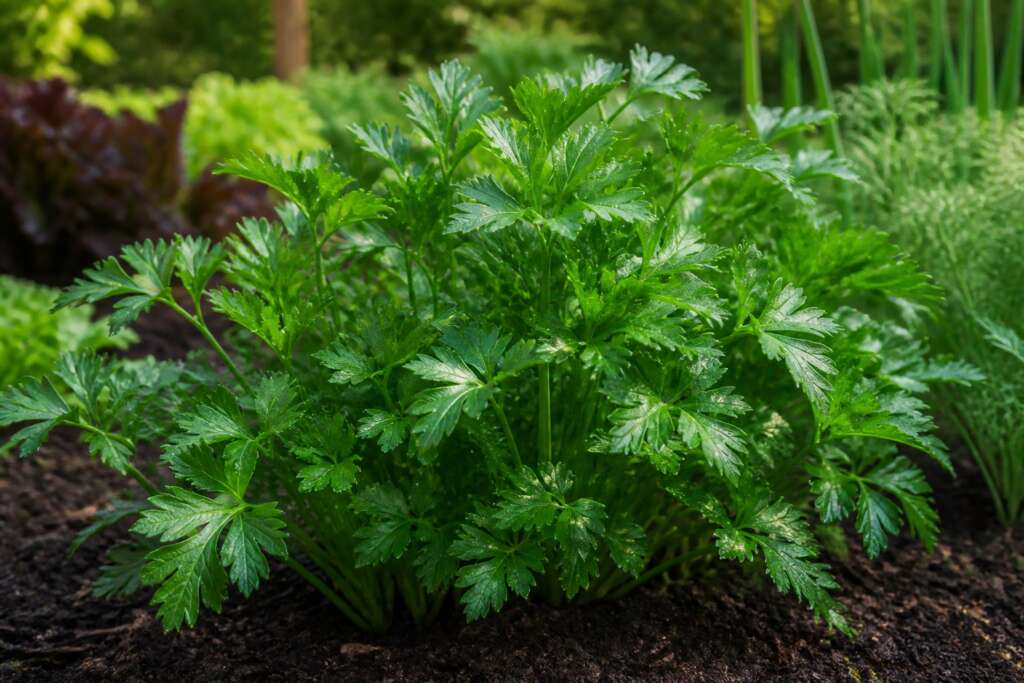
Italian Giant Flat Leaf Parsley (Petroselinum crispum var. neapolitanum) is the broad-leaved, deeply flavored cousin of curly parsley, and the type preferred by most cooks for its stronger, more aromatic character. Flat-leaved varieties contain significantly more essential oil than curly types, which accounts for that more pungent, full parsley flavor in sauces, salads, and garnishes.
Parsley is technically a biennial — it produces its lush leaf growth in the first year, then flowers and sets seed in the second before dying. Most gardeners grow it as an annual, sowing fresh each year for a steady harvest. The one fact every parsley grower needs to internalize before starting: parsley seed is famously slow and erratic. Germination can take 2 to 4 weeks under good conditions, and impatience is the most common reason for disappointing results.
Quick How-to
Soak parsley seeds in warm water for 24 hours before sowing to soften the seed coat and encourage faster, more even germination. Sow about 1/4 inch deep in moist soil. Keep the seedbed consistently moist and warm (65 to 75 F is ideal). Expect germination in 2 to 4 weeks. Start indoors 8 to 10 weeks before the last frost, or direct sow outdoors once soil is workable in early spring. Thin to 6 to 9 inches apart once seedlings are established.
Quick Guide
| Fact | Recommendation |
|---|---|
| Best method | Indoor start 8 to 10 weeks before last frost; direct sow early spring once soil workable |
| Sowing depth | About 1/4 inch; no deeper |
| Germination temperature | 65 to 75 F; warmer end of range speeds germination |
| Days to germination | 2 to 4 weeks (14 to 28 days); highly variable |
| Light for germination | Cover seed; light not required for germination |
| Spacing | 6 to 9 inches apart for leaf production |
| Sun | Full sun to light partial shade |
| Water | Consistently moist during establishment; moderately moist once growing |
| Harvest timing | Begin harvesting outer stems once plant has 8 to 10 stems; harvest through the season |
| Plant size | 12 to 24 inches tall in the first year; taller and more open in the second-year flowering stage |
Soaking and Pre-Germination
Parsley seeds have a hard, oil-impregnated seed coat that slows water uptake and delays germination. Soaking seeds in warm water for 24 hours before sowing is a widely recommended practice that helps soften this coat and improves germination speed and uniformity. Use water that starts warm (not boiling) and allow the seeds to soak at room temperature.
Drain the seeds, spread them briefly on a paper towel to remove excess surface water, and sow immediately. Soaked seeds should not be allowed to dry out before planting.
Some growers go a step further and pre-sprout seeds in a damp paper towel for 3 to 5 days at 70 to 75 F before sowing; this works well but requires careful handling to avoid breaking fragile emerging radicles.
Indoor Starting
Start Italian Flat Leaf Parsley indoors 8 to 10 weeks before the last expected frost. Use a good seed-starting mix, pre-moistened before sowing. Sow soaked seeds about 1/4 inch deep in cells or a shallow tray. Press gently for soil contact. Cover with plastic or a humidity dome and place in a warm location (70 to 75 F is optimal).
Check moisture daily — parsley seedbeds must stay consistently moist through the full germination window, which can extend 3 to 4 weeks. If the surface dries and crusts between checks, emergence is significantly delayed or patchy.
Once sprouts appear, remove the dome, move into strong light, and maintain even moisture. Parsley seedlings are small at first and grow slowly. Thin to one strong plant per cell once seedlings have true leaves. Plan to pot up into larger containers if transplanting date is still weeks away.
Direct Sowing
Direct sowing parsley works well in early spring when soil is workable, even if temperatures are still cool. Parsley tolerates light frost once germinated. Prepare a fine, smooth seedbed, sow soaked seeds about 1/4 inch deep, and cover with fine soil or a thin layer of seed-starting mix to prevent crusting. The no-crust requirement is important: if the soil surface dries and hardens, emerging parsley seedlings may not push through.
Keep the seedbed consistently moist. Mark the row clearly — parsley takes long enough to germinate that fast-growing weeds can obscure the row before seedlings appear. Thin to 6 to 9 inches apart once seedlings are 3 to 4 inches tall.
Transplanting
Harden off indoor-started parsley for 7 to 10 days before transplanting. Parsley develops a taproot and dislikes being disrupted, so transplant with care. Use cells rather than wide trays to minimize root disturbance. Plant at the same depth as the cell. Water in well and keep consistently moist for the first week after transplanting.
Parsley is somewhat cold hardy and can tolerate light frost once established; do not delay transplanting waiting for warm conditions.
Soil, Sun, and Water
Italian flat leaf parsley grows best in relatively rich, moist, well-drained soil. Unlike many herbs that perform well in lean conditions, parsley benefits from moderately fertile soil with reasonable organic matter content. A bed amended with compost before planting supports the strong, sustained leaf production that makes this herb worthwhile.
Full sun produces the strongest plants and richest flavor. Parsley tolerates light partial shade — especially welcome in hot-summer climates where afternoon shade keeps plants from bolting prematurely — but shade beyond 3 to 4 hours per day reduces leaf density and can make stems leggy.
Keep soil consistently moist but well-drained. Parsley does not tolerate waterlogged conditions, especially in cooler temperatures, but it also struggles in dry soil. Maintain a consistent moisture level for the best sustained growth.
Hydroponic Growing
Italian Giant Flat Leaf Parsley is a productive hydroponic herb once it passes its naturally slow germination stage. Germinate in a clean deep plug and be patient; keep it damp and warm enough to sprout without saturating it. Transfer after several true leaves form and roots reach the plug edge. Deep-water culture, NFT, and flood-and-drain systems can all support repeated harvest.
Use a complete hydroponic nutrient around EC 1.8 to 2.2 mS/cm and pH 6.0 to 6.5. Young plants should begin at the lower end. Keep the reservoir shaded and aerated, check EC before pH, and refresh the solution periodically. Parsley tolerates cool air but grows slowly in a cold root zone.
Allow 8 to 10 inches for the broad mature clump and provide strong overhead light. Harvest complete outside stems at the base, leaving the center to produce new growth. Do not remove every leaf at once; steady selective harvest gives the root system enough foliage to keep rebuilding.
Slow germination is normal, but seedlings that never progress after emergence may be too wet, too cold, or underlit. Pale new leaves with clean roots call for a pH check. Yellow outer stems can simply be old growth, while widespread yellowing, dark roots, or wilt in a full reservoir indicates nutrient imbalance or root-zone trouble.
Top Mistakes
- Expecting fast germination and giving up too soon: Parsley’s slow, erratic germination is a feature of the species, not a problem with growing conditions. Many gardeners assume the planting failed and resow at week 2, then discover the original sowing emerging at week 3 or 4. Sow, mark clearly, maintain moisture, and wait the full 4 weeks before drawing conclusions.
- Letting the seedbed surface dry out: A dry surface during the germination window is the single most common cause of poor parsley germination. Once the top layer crusts, seeds that were on the verge of sprouting can fail. Check daily and mist if needed.
- Sowing too deep: Parsley is small-seeded and needs to be covered, but not deeply. More than 1/4 inch of cover significantly delays or prevents emergence. Light, fine cover at exactly 1/4 inch is the target.
- Not soaking seeds before sowing: While parsley will germinate without soaking, the hard seed coat means germination is slower and less uniform. A 24-hour warm water soak is simple, effective, and well supported by growers and extension sources.
- Harvesting by pulling or cutting at the crown: Parsley regenerates from the growing crown. Cutting at or below the crown level damages the plant’s ability to produce new stems. Always cut outer stems from the outside of the plant, at least 1 inch above the crown, and leave the inner growth intact.
Troubleshooting by Symptom
| Symptom | Likely causes | What to do next |
|---|---|---|
| No sprouts after 14 days | Normal — parsley takes 14 to 28 days; surface may have dried | Continue maintaining even moisture for another 2 weeks before resowing |
| Patchy, uneven germination | Surface dried intermittently, seed depth uneven, or crusting | Water more consistently, protect the surface with fine mulch or seed-starting mix, and resow any bare spots |
| Seedlings emerge but collapse at soil line | Damping off from saturated mix or poor airflow | Improve airflow, water less frequently, and remove affected seedlings to prevent spread |
| Plants grow slowly with pale leaves | Insufficient light, overly cool temperatures, or nutrient-poor soil | Move to brighter location, warm the growing area, and side-dress with a balanced fertilizer |
| Plant bolts in midsummer (sends up flower stalk) | Normal second-year behavior, or heat stress triggering early bolting in first-year plants | In the first year, cut the flower stalk immediately to redirect growth to leaves; accept that bolted plants will decline |
| Yellow lower leaves | Normal — older outer leaves yellow with age; also caused by overwatering | Remove yellowed outer leaves; adjust watering if soil stays wet; this is generally a cosmetic issue in healthy plants |
Harvest and Use
Parsley is a cut-and-come-again herb. Once plants have 8 to 10 well-developed stems, begin harvesting by cutting outer stems at the base, leaving the inner growth to continue developing. Do not strip more than one-third of the plant at any one harvest, and never cut into the crown.
Flat leaf parsley is significantly more aromatic than curly types and is preferred for cooking. Use fresh in sauces, soups, chimichurri, and as a finishing herb. The flavor mellows somewhat with heat, so adding fresh parsley at the end of cooking preserves more of its character.
Parsley stores well in the refrigerator for up to a week with stems in water. For longer preservation, dry bunches in a warm airy location or freeze blanched leaves flat.
In the second year, the plant produces tall flower stalks and seeds. Second-year leaf quality declines after bolting; most gardeners start fresh from seed each season rather than carrying plants into the second year.
Seed Saving
Parsley flowers in its second year and produces abundant seed in compound umbels. Allow several healthy plants to overwinter so the saved seed represents the variety well. Harvest seed heads as they turn tan and begin to dry, then finish drying them indoors on paper or a screen before threshing. Parsley is insect-pollinated and can cross with curly parsley, Hamburg parsley, and other Petroselinum crispum varieties. For reliable varietal purity, separate flowering parsley varieties by 800 feet to one-half mile; growing only one parsley variety to seed is the simplest home-garden approach.
Storing Leftover Seed
Keep unused Italian Giant Flat Leaf Parsley seed in its labeled packet inside a sealed container in a cool, dry, dark indoor location. Avoid garages, sheds, greenhouses, and sunny windowsills, where temperature and humidity swing sharply. Label home-saved seed with the variety and harvest year before storing it.
FAQ
Why does parsley take so long to germinate?
Parsley seed contains germination inhibitors in the seed coat that slow water uptake. This is a natural adaptation. A 24-hour warm water soak before sowing removes some of these inhibitors and meaningfully speeds germination. Consistent soil moisture and warm temperatures (70 to 75 F) also help.
Can I direct sow parsley in fall?
In mild-winter climates, yes. Fall-sown parsley can overwinter as small plants and produce strong growth in spring. In cold climates, parsley planted in fall may winterkill. A heavy mulch after the ground freezes can help plants survive to spring in marginal zones.
Is flat leaf parsley better than curly parsley for cooking?
Most culinary references indicate that flat-leaved varieties have a stronger, more complex flavor because they contain more essential oil. For cooking, the Italian or flat type is generally preferred. Curly parsley is often used as a garnish where texture matters more than flavor intensity.
Will parsley come back next year?
Parsley is a biennial. In mild climates, it will survive the winter and return in spring to flower and set seed in its second year — but second-year leaf quality declines after the plant begins flowering. Most gardeners sow fresh each season for consistent leaf production.