
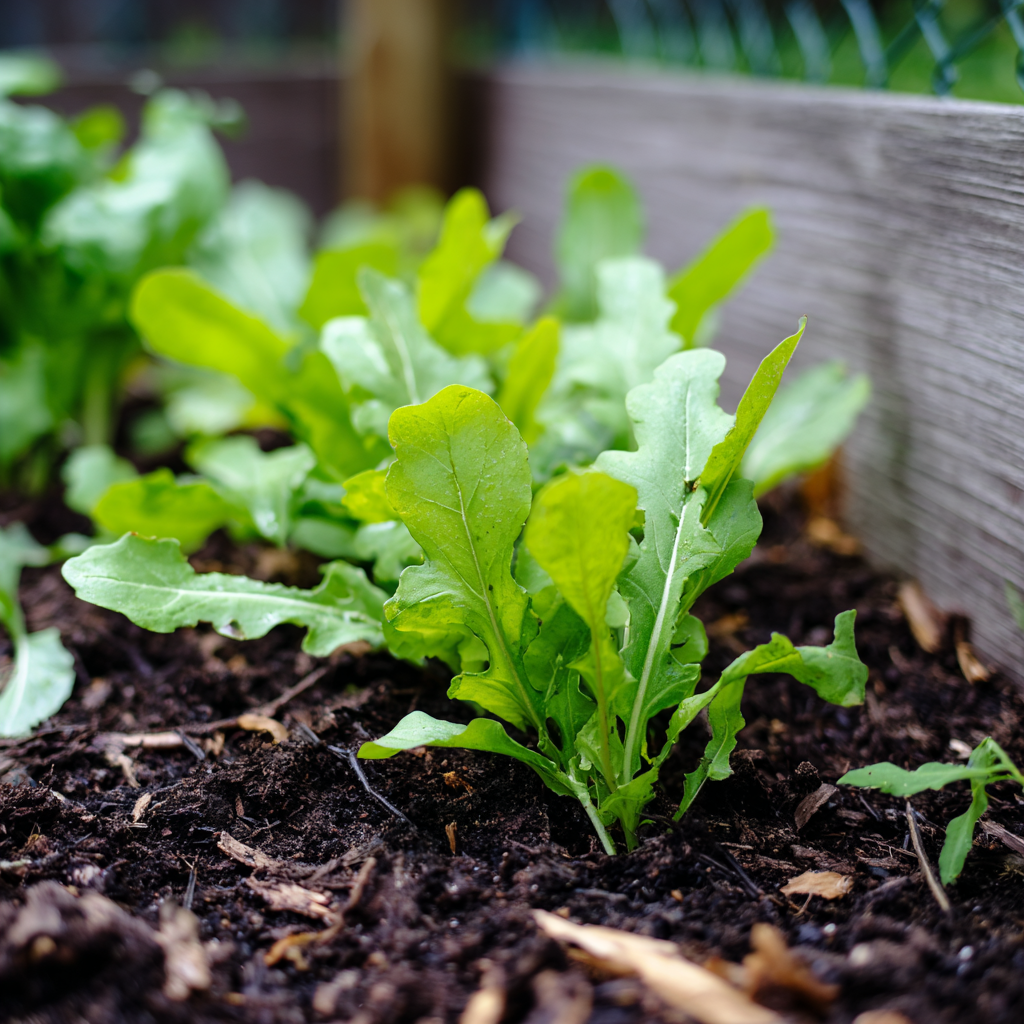
Astro arugula is a fast-maturing, mild-flavored salad arugula selected for quick baby-leaf production and broader, less deeply lobed leaves than classic peppery rocket types. Where traditional roquette arugula delivers an intense, sharp, peppery heat, Astro’s flavor is notably milder and more approachable — spicy without being aggressive — making it a popular choice for mixed salad greens and growers who prefer a gentler bite. The leaves are smoother, broader, and more strap-like in shape than the deeply lobed leaves of classic roquette selections. Astro germinates rapidly, tolerates both cool and moderately warm conditions well, and produces baby leaves ready to harvest in as few as 21 days from seeding.
Quick How-to
Direct sow Astro arugula shallowly — about 1/8 inch deep — in a prepared bed as soon as soil can be worked in spring, or in late summer and early fall for a fall harvest. Keep the seedbed evenly moist until germination, which typically takes 5 to 7 days. Thin seedlings to 4 to 6 inches apart or grow densely for baby-leaf cut-and-come-again harvests. Begin cutting when plants reach 3 to 5 inches tall. Sow a new batch every 10 to 14 days to maintain a continuous supply.
Quick Guide
| Fact | Recommendation |
|---|---|
| Best method | Direct sow |
| Sowing depth | About 1/8 inch |
| Germination temperature | 40 to 55 F optimal for cool-season sowing; germinates at temperatures up to low 70s F |
| Days to germination | Typically 5 to 7 days |
| Light for germination | Cover lightly; does not require darkness |
| Spacing | 4 to 6 inches for full leaves; dense sowing for baby-leaf cut-and-come-again |
| Sun | Full sun in cool weather; light afternoon shade helpful in warm weather |
| Water | Evenly moist soil; never let the seedbed fully dry during germination |
| Harvest timing | Baby leaf at 21 days; full leaf at about 38 days from seeding |
| Plant size | Low-growing rosette, typically 6 to 10 inches tall at maturity |
Before You Sow
Astro arugula is a cool-season annual that performs best when sown in spring or fall. It can germinate in a wide temperature range, but leaf quality and bolt resistance are better in cool conditions. Heat accelerates bolting, which causes leaves to become smaller, more lobed, and more intensely bitter.
Choose a well-drained bed with reasonable fertility. Arugula does not need rich soil, but very poor or compacted soil reduces leaf size and uniformity. Work in a light amount of compost if the bed is low in organic matter. The shallow root system means arugula responds quickly to surface soil conditions — good soil preparation pays off in even germination and uniform growth.
Direct Sowing
Astro arugula is almost always direct sown because it establishes quickly and does not transplant as cleanly as it germinates in place. Rake the bed smooth, broadcast or row-sow seed thinly, cover with no more than 1/8 inch of fine soil or vermiculite, and press gently for soil contact. Water with a fine spray to avoid displacing seed.
Keep the top of the soil consistently moist until germination. Arugula seed in dry soil will pause or fail to emerge evenly. Once seedlings are an inch or two tall, thin to 4 to 6 inches for full-size leaf production, or leave dense for baby-leaf harvests.
Succession Sowing
The key to continuous Astro arugula throughout the growing season is succession sowing every 10 to 14 days. Each batch bolts eventually — typically in warm weather within 4 to 6 weeks — so keeping fresh plantings going ensures a steady supply. In hot-summer climates, take a break from sowing when temperatures are consistently above 80 F during the day, then resume in late summer for a productive fall harvest. Astro’s tolerance for both cool and moderately warm conditions gives it a slightly wider succession window than more heat-sensitive arugula types.
Soil, Sun, and Water
In cool spring and fall conditions, Astro arugula grows well in full sun. As temperatures rise, some afternoon shade helps delay bolting and keeps leaves milder in flavor. Full shade is counterproductive — plants become weak and leggy — but partial shading on a warm south-facing bed can meaningfully extend the harvest window.
Arugula is not a heavy feeder. A reasonably fertile, well-drained soil is sufficient. Very high nitrogen encourages soft, lush growth that may be more susceptible to disease; average garden soil or a light compost amendment is generally enough.
Keep soil evenly moist throughout the growing period. Drought stress accelerates bolting and turns leaves sharper and more bitter, even in mild Astro. The shallow root system means arugula dries out faster than deep-rooted crops, so check soil moisture more frequently during warm, dry stretches.
Hydroponic Growing
Astro Arugula is an excellent hydroponic baby-leaf crop because it grows quickly and has a naturally mild flavor. Use NFT, deep-water culture, or a shallow flood-and-drain tray. Sow one or two seeds per plug for full plants, or use closer plug spacing for a one-cut baby-leaf crop. Transfer as soon as roots show outside the plug; older, crowded starts lose the speed that makes Astro useful.
Use a leafy-green nutrient and begin near the lower end of EC 1.2 to 2.0 mS/cm, with pH about 5.8 to 6.2. Increase strength only if established plants stay pale after pH and lighting are correct. Keep the reservoir clean, shaded, and oxygenated. Cool to moderate solution temperatures produce the mildest leaves; warmth accelerates growth but also sharpens flavor and bolting.
For full rosettes, allow about 5 to 6 inches between plants. For baby leaves, closer spacing is practical if the canopy stays dry and receives moving air. Cut 1 inch above the crown for regrowth, then replace plants when stems become woody or a flower stalk forms. Short successions outperform trying to keep one planting indefinitely.
Long pale petioles mean the light is too weak. Small hot-tasting leaves and a rising center mean the crop is too warm or overdue for harvest. If seedlings collapse, reduce plug saturation and improve airflow; if established plants wilt in a full channel, inspect flow and root color before changing nutrients.
Top Mistakes
- Sowing too deep: Arugula seed is very small and needs only a thin covering. Burying seed more than 1/4 inch results in uneven emergence or no emergence at all.
- Letting the seedbed dry between germination checks: The surface can look damp from below while the very top layer — where the seed sits — is dry. Keep the surface consistently moist until seedlings are several inches tall.
- Expecting Astro to behave like roquette: Astro’s milder flavor and broader leaf shape are cultivar traits, not a sign of under-performance. If you want the classic intense pepper-rocket flavor and deeply lobed leaf, that is roquette’s character, not Astro’s.
- Stopping successions too early in spring: Gardeners often stop sowing arugula as soon as weather warms. With Astro’s moderate heat tolerance, additional succession sowings in mid-spring or in partial shade can keep harvests coming several weeks longer than with standard roquette.
- Harvesting too late in the bolt cycle: Once Astro sends up a flower stalk, the remaining basal leaves become noticeably more pungent. Harvest regularly before the plant commits to flowering to maintain the mild flavor Astro is selected for.
Troubleshooting by Symptom
| Symptom | Likely causes | What to do next |
|---|---|---|
| No sprouts after 7 to 10 days | Seed buried too deep, seedbed dried out, soil too cold or too hot | Check depth (1/8 inch), keep surface moist, verify soil temperature is in the 45 to 70 F range |
| Patchy, uneven germination | Uneven seed coverage, soil surface crusted, or cloddy seedbed | Rake smooth before next sowing, cover with fine vermiculite, water gently to avoid crusting |
| Leaves turn very spicy and bitter | Bolting triggered by heat, drought stress, or plant maturity | Harvest remaining leaves, remove bolted plants, sow a fresh succession in a cooler spot or wait for fall |
| Leaves are very small and plant flowers quickly | Heat-triggered bolt; plants are completing their life cycle rapidly | Time sowings for cooler windows; use afternoon shade during warm stretches; fall sowings solve the problem |
| Holes in leaves | Flea beetle damage — tiny jumping beetles create small shot-hole damage | Row cover prevents flea beetle access; damage on established plants is usually cosmetic |
| Pale, yellow-green seedlings | Overwatered conditions, very low fertility, or poor drainage | Improve drainage, allow top soil to dry slightly between waterings, add compost to future beds |
Harvest and Kitchen Use
Astro arugula leaves are ready as baby greens at about 21 days from seeding when they are 3 to 4 inches long. For full-size leaves with more developed (but still mild) flavor, harvest at around 38 days when plants are 5 to 8 inches tall. Cut about an inch above the soil to allow clean regrowth, and the plant will produce a second or third flush before eventually bolting. The mild, slightly nutty flavor of Astro pairs well in salads with fresh fruit, nuts, and vinaigrette, and holds up as a pizza topping or sandwich green without overwhelming other flavors. The small white flowers with dark-pink veins are edible and can be used as a garnish.
Seed Saving
Arugula is primarily self-pollinating but does cross with other Eruca vesicaria types, including Roquette and Slow Bolt arugula, when they flower simultaneously within pollinator range. Separate varieties by at least 300 feet or bag individual plants for reliable seed. Allow pods to dry completely on the plant before collecting, as they shatter when fully ripe. Dry the collected pods further indoors, then thresh and store seed cool, dry, and sealed.
Storing Leftover Seed
Keep unused Astro Arugula seed in its labeled packet inside a sealed container in a cool, dry, dark indoor location. Avoid garages, sheds, greenhouses, and sunny windowsills, where temperature and humidity swing sharply. Label home-saved seed with the variety and harvest year before storing it.
FAQ
How is Astro arugula different from Roquette arugula?
Astro has broader, less deeply lobed leaves and a distinctly milder, more approachable spice level compared to Roquette. Roquette has the classic deeply lobed, narrow rocket leaf and an intense peppery heat that is sharper even when young. Both are Eruca vesicaria and both bolt in heat, but Astro is selected for milder flavor and quick salad-green production, while Roquette is the traditional sharp-flavored variety.
Can I grow Astro arugula indoors?
Yes. Arugula can be grown indoors in containers near a sunny window or under grow lights. Use a shallow container with drainage, sow shallowly, and provide at least 6 to 8 hours of direct sun or equivalent artificial light. Baby-leaf harvests work particularly well in indoor containers.
How often should I sow for a continuous supply?
Sow a small amount every 10 to 14 days throughout the cool season. Each planting will provide 2 to 4 cuttings before eventually bolting. Overlapping plantings ensure you always have a fresh batch at the right size for harvesting.
Does Astro arugula bolt faster than Roquette?
No. Astro is noted for moderate heat tolerance, which gives it at least as long a harvest window as Roquette in warm conditions. The key factor controlling bolt timing in both types is temperature — once daytime highs are consistently in the 80s F, most arugula types shift toward flowering regardless of cultivar.