
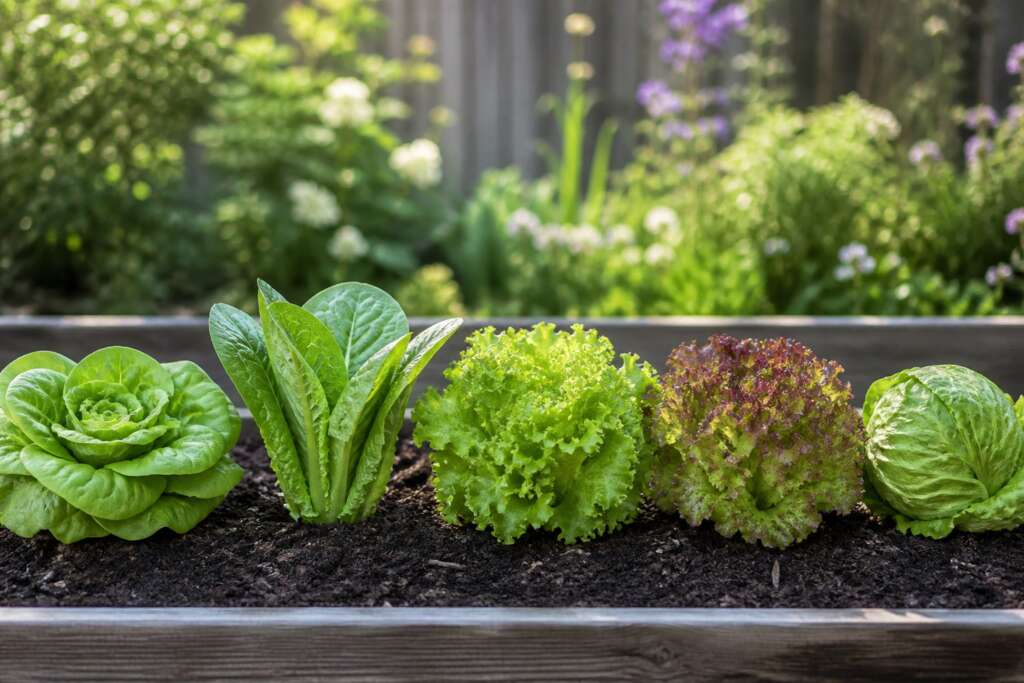
A lettuce variety pack gives you the pleasure of a mixed salad garden from a single planting, with different leaf shapes, textures, and colors from the same sowing date. This five-variety RDR pack contains Buttercrunch, Parris Island Cos, Oakleaf, Little Gem, and Iceberg lettuce. Together they represent butterhead, romaine or cos, loose-leaf, compact mini-romaine, and crisphead growth habits. Each has slightly different spacing and harvest cues, but all share the same fundamental requirements: cool weather, consistent moisture, and shallow sowing.
Quick How-to
Direct sow lettuce seed very shallowly — no deeper than 1/4 inch, and often just pressed to the surface — in a well-prepared bed as soon as soil can be worked in spring. Keep the seedbed evenly moist and cool until germination, which typically takes 7 to 14 days. Thin seedlings as they grow to allow enough room for each type to develop fully. Begin harvesting outer leaves from loose-leaf types when plants are 5 to 6 inches tall. Sow a fresh batch every 10 to 14 days to keep a continuous supply through the cool season.
Quick Guide
| Fact | Recommendation |
|---|---|
| Best method | Direct sow; or start indoors 4 to 6 weeks before last frost for transplanting |
| Sowing depth | 1/4 inch or shallower; light aids germination — press seed to surface for broadcast sowing |
| Germination temperature | 60 to 70 F optimal; germination fails above 85 F |
| Days to germination | About 7 to 14 days |
| Light for germination | Light can improve germination; do not bury deeply |
| Spacing | Leaf types: 6 to 10 inches; romaine and butterhead: 8 to 12 inches; crisphead: 12 to 14 inches |
| Sun | Full sun in cool weather; partial shade helpful when temperatures rise |
| Water | Evenly moist, never saturated; shallow roots need consistent attention |
| Harvest timing | Leaf types: outer leaves from about 45 to 75 days; head types: 55 to 85 days |
| Plant size | Varies by type: leaf types stay low; romaine reaches 12+ inches; crisphead forms a compact dense head |
Understanding the Types in Your Pack
The five varieties in this pack are Buttercrunch (butterhead), Parris Island Cos (romaine), Oakleaf (loose-leaf), Little Gem (compact mini-romaine), and Iceberg (crisphead). Their growth forms explain why the same planting produces leaves and heads at different rates:
Loose-leaf lettuce forms an open rosette without a central head. This is the easiest type for home gardeners — it tolerates more heat than head types, produces over a longer window, and is ideal for cut-and-come-again harvesting. Leaf lettuces come in green and red forms, with oak-leaf, frilly, or smooth shapes.
Romaine (cos) lettuce produces an upright, elongated head with thick, crisp leaves and a mild, slightly bitter flavor. It is more heat-tolerant than crisphead but still prefers cool weather. Romaine takes longer to mature and benefits from consistent moisture to develop a firm, tight head.
Butterhead lettuce forms loose, soft-leafed heads with a buttery, rich texture and mild flavor. It is more sensitive to heat than leaf types — above 75 F, inner leaves may tip-burn and flavor becomes bitter. Butterhead types mature in about 65 to 80 days and are among the most popular for home salad gardens.
Crisphead (iceberg-type) lettuce develops a dense, tightly packed head and is the most demanding type to grow at home. It requires a long cool season and steady temperatures to form a proper head. Heat causes it to bolt before heading properly, making it the most climate-sensitive type in a variety pack. In hot-summer climates, grow crisphead as a fall crop rather than spring.
Before You Sow
Lettuce prefers a bed with well-drained, organically rich soil and consistent moisture. Work compost into the top several inches before sowing. The ideal pH range is 6.0 to 6.7. Because lettuce has a very shallow root system, soil condition at the surface directly affects germination and early growth.
Plan your sowing around your local last frost date in spring and your first frost date in fall. Lettuce germinates in cool soil and performs best when it can grow and mature before temperatures rise above 75 to 80 F during the day. For fall, start counting back about 60 to 80 days (depending on type) from your first expected hard frost to time the final sowing.
Direct Sowing
Sow lettuce seed very shallowly. Light aids germination in lettuce, so covering seed with more than 1/4 inch of soil can reduce emergence. For broadcast sowing, press seed gently into the surface and cover with the thinnest possible layer of fine soil or vermiculite. For row sowing, make a shallow furrow, drop seed, and cover lightly.
Water with a gentle spray immediately after sowing. Keep the surface consistently moist until germination — lettuce germinates unevenly when the top of the seedbed dries between waterings. Once seedlings are 2 to 3 inches tall, thin to appropriate spacing for each type.
Indoor Starting
For spring planting, start lettuce indoors 4 to 6 weeks before the last expected frost. Use individual cells or trays, sow shallowly, and keep the mix cool and moist — lettuce seedlings prefer temperatures of 60 to 65 F and do not need supplemental heat. Provide bright light as soon as seedlings emerge.
Harden off transplants over 5 to 7 days and transplant out while temperatures are still cool. Lettuce transplants readily and can be set out 2 to 4 weeks before the last frost if nighttime temperatures stay above 28 F. For fall crops, direct sowing often works better than indoor starting because late-summer indoor temperatures can inhibit germination.
Succession Sowing
Succession sowing every 10 to 14 days through the cool season is the most effective strategy for a steady salad harvest from a variety pack. With mixed types, your later plantings give you information from the earlier ones — you will see which types perform best in your conditions and can weight future successions toward those. Take a break from sowing when daytime temperatures are consistently above 80 F, then resume in late summer for a productive fall crop.
Soil, Sun, and Water
Full sun in cool weather gives the best lettuce results. As temperatures rise, afternoon shade — either from a shade cloth or natural shadows from nearby taller plants — delays bolting and reduces tip-burn in sensitive types like butterhead and crisphead.
Water enough to keep the top few inches of soil evenly moist. Lettuce has a shallow root system and will show drought stress (wilting, bitter flavor, accelerated bolting) before deeper-rooted crops. Mulching the bed after seedlings are established helps retain moisture and moderate soil temperature during warm stretches.
Avoid excess nitrogen after plants are well established; lush leafy growth can mask flavor development in head types and does not improve cut-and-come-again production in leaf types. A light compost at planting is usually sufficient fertility for the season.
Cut-and-Come-Again Harvest
For loose-leaf types, begin harvesting individual outer leaves as soon as plants are 5 to 6 inches tall. Take only the outermost leaves, leaving at least half the plant intact to continue growing. The plant will regrow from the center and provide multiple cuttings before eventually bolting.
Alternatively, cut the whole plant about an inch above the soil — this works particularly well with leaf lettuce — and it will often regrow for one or two additional cuts before the plant’s energy shifts to flowering.
Head types (romaine, butterhead, crisphead) are generally harvested all at once by cutting at the base when the head has firmed to the appropriate density. You can also pull individual outer leaves from romaine plants over several weeks before cutting the whole head.
Hydroponic Growing
A lettuce variety pack is a strong hydroponic candidate because its cultivars all share a short crop cycle and compact root system, even though their head shapes differ. Deep-water culture, nutrient-film technique, and well-sized passive systems can all work. Start one seed in a clean inert plug, keep the plug damp rather than submerged, and move it into the system when roots show at the plug edge and the first true leaves are opening. Keep the crown above the nutrient solution; a constantly wet stem invites rot even when the roots look healthy.
Use a complete hydroponic nutrient made for leafy greens. A practical target is EC 1.2 to 1.8 mS/cm and pH 6.0 to 7.0. Check both at a consistent time, correct nutrient strength before adjusting pH, and replace the solution periodically instead of endlessly adding concentrate. Keep the reservoir shaded, clean, and well oxygenated. Lettuce roots perform best when the solution stays in the 60s to low 70s F; warmer water holds less oxygen and increases the chance of slimy roots and premature bolting.
Give each cultivar its own site so vigorous leaf types do not shade slower heading types. Begin around 6 inches apart for loose-leaf plants and 8 to 10 inches for larger heads, then widen spacing if leaves overlap and stay wet. Harvest leaf types from the outside and cut compact heads when they fill; do not wait for every cultivar in the mix to mature on the same day. Give the canopy steady airflow without aiming a hard fan directly at tender leaves. Under lights, keep the fixture close enough to prevent stretching while preserving a dark period each day. Raise or dim the light if leaf edges bleach or curl upward.
Judge the mixed planting plant by plant. A loose rosette is normal for a leaf lettuce, while a heading cultivar that stays open may be too warm, too crowded, or receiving weak light. Pale, firm roots with a fresh smell are normal. Brown slime, sour odor, or wilting while roots are wet points to warm solution, weak aeration, light entering the reservoir, or poor sanitation. Brown inner leaf edges are often tipburn caused by fast growth and weak calcium movement; improve airflow, moderate the temperature, and verify EC before adding more fertilizer.
Top Mistakes
- Sowing in warm soil: Lettuce seed germination is inhibited above 85 F. Sowing in warm late-spring or summer soil produces erratic results. Time sowings for cool windows, or pre-chill seed in the refrigerator for a day before sowing in marginally warm conditions.
- Burying seed too deep: Lettuce needs light to germinate reliably. Covering seed more than 1/4 inch significantly reduces emergence, especially in heavier soils.
- Skipping successions: A single spring planting runs its course in 3 to 5 weeks. Succession sowing every 10 to 14 days provides a continuous harvest rather than a single glut followed by nothing.
- Ignoring tip-burn on butterhead types: Tip-burn — brown, papery edges on inner leaves — is caused by calcium movement issues in the plant driven by heat and low humidity. It is not a disease. Improve airflow, increase watering consistency, and harvest earlier in the heading cycle if tip-burn appears.
- Treating crisphead as an easy type: Crisphead or iceberg-style lettuce requires a long, cool season to form a proper dense head. In short-season or hot-summer climates, focus first on leaf and butterhead types for reliable results.
Troubleshooting by Symptom
| Symptom | Likely causes | What to do next |
|---|---|---|
| No germination after 14 days | Soil too warm, seed buried too deep, or surface dried during germination | Check soil temperature (aim below 75 F), reduce sowing depth to 1/8 to 1/4 inch, and maintain moist surface |
| Seedlings are very pale or yellow | Overwatering, poor drainage, or insufficient light | Improve drainage, allow top soil to dry slightly between waterings, and increase light exposure |
| Plants bolt (send up flower stalk) quickly | Warm temperatures, long days, drought stress, or plant maturity | Harvest remaining leaves immediately; adjust future sowings to cooler windows; use shade cloth if needed |
| Tip-burn on inner leaves | Heat stress interfering with calcium movement in the plant — common in butterhead and romaine | Increase watering consistency, improve airflow around plants, and harvest heads before they reach maximum size in warm weather |
| Bitter flavor | Heat stress, drought, or plants past prime maturity | Harvest earlier in the cycle; prioritize cool-season windows; leaf types tolerate heat better than head types |
| Head types not forming a head | Insufficient cool weather for head maturation, or crisphead sown too late in spring | Focus head-type sowing earlier in spring or shift them to fall; leaf types do not require head formation |
Seed Saving
Lettuce is primarily self-pollinating and generally comes true from seed with minimal isolation. However, different varieties in a mix may cross occasionally, particularly under stress or with certain insects as vectors. For reliable seed saving from a specific lettuce type, grow that variety in isolation or bag individual flower heads before they open. Let seed stalks mature fully on the plant until seed heads dry, then cut and dry further indoors before threshing. Label with variety name and year.
Storing Leftover Seed
Keep unused Lettuce Variety Pack (5 types) seed in its labeled packet inside a sealed container in a cool, dry, dark indoor location. Avoid garages, sheds, greenhouses, and sunny windowsills, where temperature and humidity swing sharply. Label home-saved seed with the variety and harvest year before storing it.
FAQ
Do all the types in a variety pack germinate and grow at the same rate?
Not exactly. Leaf types generally germinate and mature faster than head types. Romaine and butterhead take moderately longer than loose-leaf types. Crisphead takes the longest and needs the most consistent cool-season conditions to form a proper head. Sowing all types together on the same date means your leaf lettuce will be ready to harvest while your romaine is still sizing up.
Can I grow the variety pack in containers?
Yes, particularly for loose-leaf types. Use containers at least 6 inches deep with drainage holes. A window box or large planter works well for several leaf-type plants. Head types (romaine, butterhead, crisphead) need more space and root depth — a container at least 10 to 12 inches deep accommodates one head-type plant. All container lettuce dries out quickly and needs more frequent watering than in-ground plantings.
Why do my lettuces go bitter so quickly?
Heat, drought stress, and the shift toward flowering make lettuce leaves progressively more bitter and tough. Harvest early and often to stay ahead of that change. Leaf types are more forgiving than head types, and fall crops generally stay mild much longer than spring crops that run into summer heat.
How do I know when a butterhead or romaine is ready?
Butterhead is ready when the center of the plant forms a loose, soft head that feels gently filled when pressed. Do not wait for a tight, dense head — butterhead is naturally looser than crisphead. Romaine is ready when the head is upright, firm, and the inner leaves have blanched slightly to a paler green or yellow-green. Cut at the base with a sharp knife.