
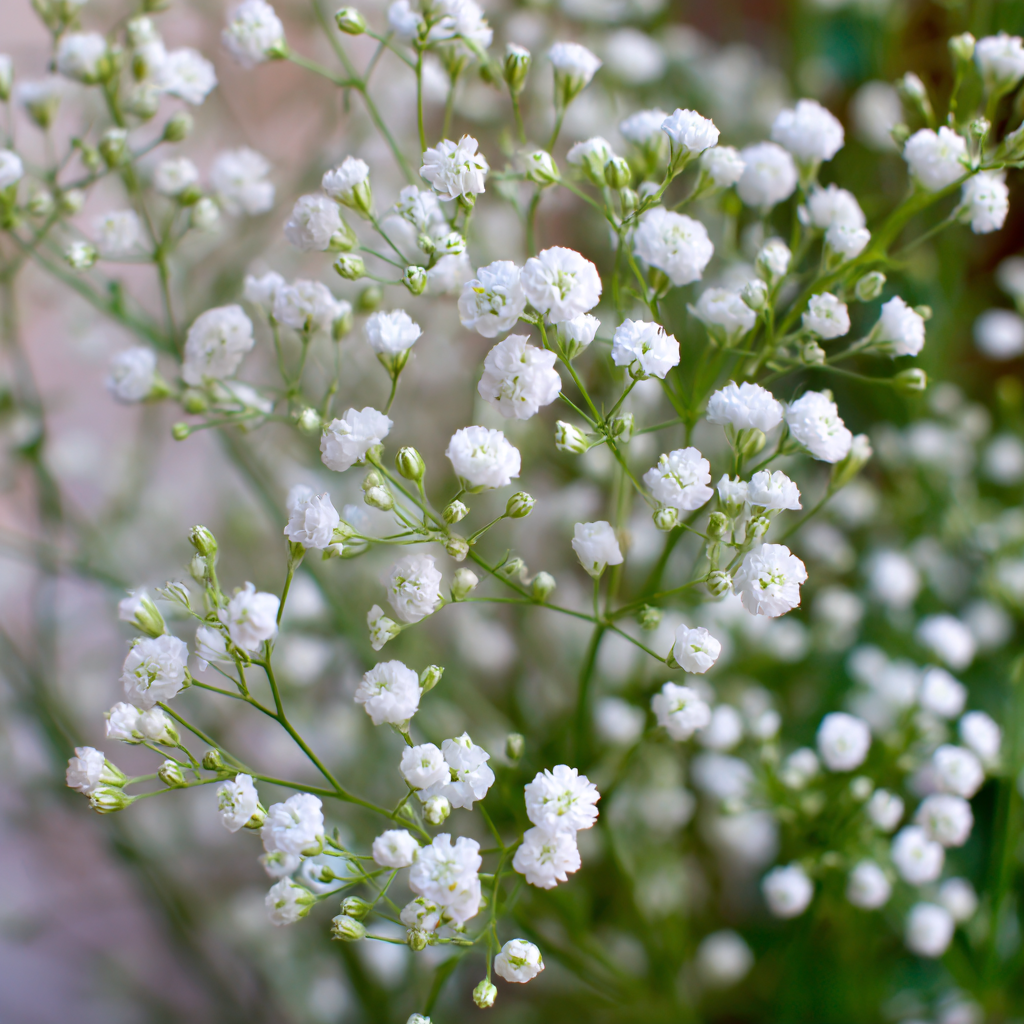
Covent Garden Baby’s Breath (Gypsophila elegans) is a cool-season annual grown for its airy clouds of small white flowers that serve as one of the most versatile fillers in fresh-cut arrangements. Unlike the perennial Gypsophila paniculata, this annual form completes its life cycle quickly, typically blooming for only 4 to 6 weeks before going to seed. The key to a continuous supply of flowers is succession sowing: make a new planting every 2 to 3 weeks throughout the cool season, and the garden or cutting patch stays in bloom from late spring through early summer, with another flush in fall where seasons allow.
Quick How-to
Direct sow Covent Garden Baby’s Breath in early spring once the soil has thawed and frost danger is easing, or again in late summer for fall bloom. Sow shallowly, barely pressing seeds into the soil surface; this annual prefers some light exposure during germination. Expect sprouts in 7 to 14 days when soil is around 65 to 70 F. Because each planting blooms for only a few weeks, make a new sowing every 2 to 3 weeks for a lasting supply of flowers.
Quick Guide
| Fact | Recommendation |
|---|---|
| Best method | Direct sow strongly preferred; dislikes root disturbance |
| Sowing depth | Very shallow, about 1/8 inch or lightly pressed in; needs some light |
| Germination temperature | About 65 to 70 F |
| Days to germination | About 7 to 14 days |
| Light for germination | Lightly cover; some light exposure aids germination |
| Spacing | Thin to about 6 to 9 inches apart |
| Sun | Full sun |
| Water | Keep evenly moist until established; dislikes heavy, saturated soil |
| Bloom timing | Flowers appear 6 to 8 weeks after sowing; each planting blooms for 4 to 6 weeks |
| Plant size | Typically 12 to 18 inches tall with a fine, branching habit |
Before You Sow
This is an important distinction for home gardeners: Gypsophila elegans is an annual, not the perennial baby’s breath (Gypsophila paniculata) sold as a florist filler or used as a long-lived border plant. The annual form blooms earlier and more quickly than the perennial, but each planting is short-lived. Gardeners who expect one sowing to provide months of flowers will be disappointed; the solution is planned succession sowing, not a single large planting.
Because the plant has a taproot and dislikes being moved, transplanting is generally not reliable. Direct sowing in the intended location is the standard method.
Direct Sowing
Prepare a smooth, fine seedbed in full sun with good drainage. Heavy or compacted soil is not ideal; work in some compost if the soil is dense. Scatter seeds thinly and press them gently into the soil surface or cover them with no more than 1/8 inch of fine soil. The seeds are small and should not be buried deeply.
Water gently with a fine spray and keep the surface evenly moist until germination. If the top layer dries out or crusts between waterings, seedlings may struggle to push through. Once seedlings have developed their first pair of true leaves, thin to about 6 to 9 inches apart. Leaving plants crowded produces weak, floppy stems and reduces the quality of the airy effect that makes baby’s breath useful as a filler.
For a continuous cutting supply, make successive sowings every 2 to 3 weeks from early spring through late spring, and again in late summer for a fall flush. In climates with hot summers, the gap in midsummer can be filled by timing an early planting to bloom before the heat and a later planting to bloom when temperatures ease in early fall.
Succession Sowing Plan
A simple three-sowing schedule works well for most home gardeners:
- First sowing: As early as the soil can be worked and frost danger is easing (late winter to early spring in mild climates).
- Second sowing: 2 to 3 weeks after the first, to overlap bloom windows.
- Third sowing: Late summer to early fall for an autumn flush before hard frost.
For a cutting patch that needs weekly stems, sow every 2 weeks through the cool season. Even a small row of 6 to 10 plants every few weeks produces a steady stream of useful filler stems.
Soil, Sun, and Water
Gypsophila elegans does best in full sun with well-drained, moderately fertile soil. It has some tolerance for poor or dry soil once established, but rich, heavy, or constantly wet conditions lead to root problems and weak growth. Alkaline to neutral soil pH suits it well; very acidic soils can limit performance.
Until germination, the surface must stay consistently moist. After seedlings are established and thinned, allow the top inch of soil to dry between waterings rather than keeping the bed constantly wet. In wet, cool weather, good drainage is especially important because the crowns can rot in saturated conditions.
Avoid applying high-nitrogen fertilizer to established plants; excess leafy growth comes at the expense of flowering.
Top Mistakes
- Sowing once and expecting continuous bloom: Each planting of annual baby’s breath blooms for only 4 to 6 weeks. A single sowing means a single short display. Succession sowing is essential for a lasting supply.
- Trying to transplant established plants: Gypsophila elegans has a taproot that resents disturbance. Transplanting established plants typically results in failure. Sow directly where plants are to grow.
- Burying seed too deeply: These small seeds germinate poorly when buried more than 1/8 inch. A light pressing into the soil or a very thin covering is all that is needed.
- Planting into waterlogged or heavy soil: Dense, wet soil causes root rot and poor establishment. Improve drainage with compost before sowing if the bed holds water.
- Expecting perennial behavior: This annual form will not return next year from the same plant. Allow some to set seed for self-sown volunteers, or save seed for replanting next season.
Troubleshooting by Symptom
| Symptom | Likely causes | What to do next |
|---|---|---|
| No sprouts after 14 days | Seed buried too deeply, soil surface dried, cold soil, or poor seed-to-soil contact | Lightly press seed into moistened soil without deep burial; keep the surface consistently moist in cool conditions |
| Seedlings collapse after emerging | Damping-off from overly wet or poorly drained soil | Improve drainage, avoid overwatering, use fresh mix if sowing in containers, and increase airflow |
| Plants bloom briefly then stop | Natural lifecycle of a short-season annual | This is expected; start the next succession sowing before the current planting fades |
| Stems are floppy and sparse | Overcrowding, too little sun, or sowing too thickly | Thin promptly to 6 to 9 inches, ensure full sun, and avoid dense sowings |
| Poor germination in warm soil | Annual baby’s breath germinates best in cool soil; hot weather inhibits emergence | Wait for fall to sow the next round; shift sowing timing to cooler parts of the season |
| Plants set seed very quickly | This is typical behavior for Gypsophila elegans | The normal response is to have the next succession planting ready so there is no gap in flower supply |
Harvest and Use as a Cut Flower
Harvest stems when about one-third to one-half of the tiny florets on the stem are open. Cutting at this stage allows the remaining buds to continue opening in the vase. Baby’s breath stems last well in cool water and are best recut every day or two for maximum vase life.
The stems are excellent as fresh filler in mixed bouquets, softening bold blooms like zinnias or sunflowers. They also dry reasonably well when hung upside down in a well-ventilated spot away from direct sun, though dried annual baby’s breath tends to be more fragile than the perennial form.
Seed Saving
Let some plants go to seed fully at the end of the season. The seed capsules are small and papery; collect them when they have turned tan and dry before the seeds scatter. Spread the stems on a tray indoors to finish drying, then thresh gently to separate seed from chaff. Label and store in a cool, dry, sealed container.
Do not assume a seed head was self-pollinated. The nectar-rich flowers attract bees and butterflies, and pollen can move among nearby plants. For the best chance of keeping Covent Garden characteristics, grow only one Gypsophila elegans strain nearby or isolate flowering plants with insect-proof mesh and hand-transfer pollen within the selected group. Even carefully saved open-pollinated seed can show modest variation.
Storing Leftover Seed
Keep unused Covent Garden Baby’s Breath seed in its labeled packet inside a sealed container in a cool, dry, dark indoor location. Avoid garages, sheds, greenhouses, and sunny windowsills, where temperature and humidity swing sharply. Label home-saved seed with the variety and harvest year before storing it.
FAQ
What is the difference between annual and perennial baby’s breath?
Annual baby’s breath (Gypsophila elegans) grows, blooms, sets seed, and dies within one season. Perennial baby’s breath (Gypsophila paniculata) comes back each year from an established root system and is the form commonly seen in commercial florist work. The annual form is shorter-lived per planting but responds very well to succession sowing for a continuous cut flower supply.
Why did my baby’s breath stop blooming so quickly?
This is normal for the annual form. Each planting blooms for roughly 4 to 6 weeks before going to seed. The solution is to have a second or third sowing started before the first one finishes so you always have plants coming into bloom.
Can I grow Covent Garden Baby’s Breath in a container?
It is possible but requires a deep pot to accommodate the taproot and consistent moisture. In-ground sowing is more reliable and produces better results. If using a container, choose a deep pot with excellent drainage and avoid disturbing the roots after the taproot develops.
Does baby’s breath dry well for arrangements?
Yes, though the annual form is more delicate when dried than the perennial. Harvest stems when florets are opening but not fully spent, tie loosely in small bundles, and hang upside down in a cool, dry, ventilated spot out of direct sunlight for 1 to 2 weeks.