
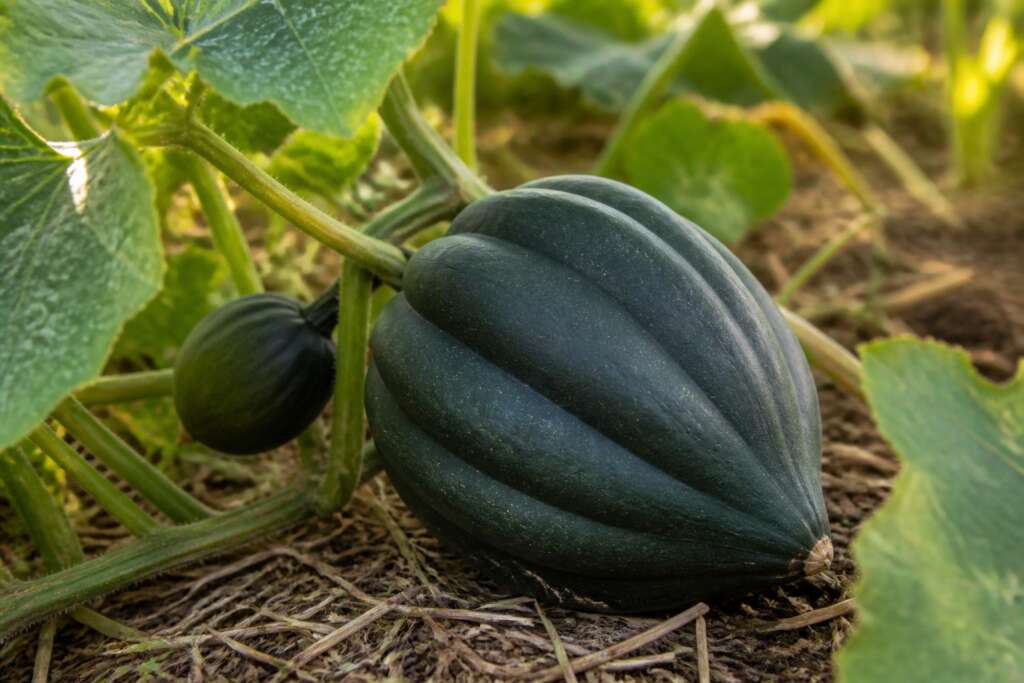
Table Queen is one of the oldest and most recognized acorn squash varieties, producing the classic dark green, deeply ribbed, acorn-shaped fruits that are cut in half, roasted, and eaten directly from the shell. Unlike summer squash, which is harvested young and eaten fresh, Table Queen is a winter squash: it stays on the vine for a full season until the skin is hard and resistant to scratching, then cured and stored for months. A single vine takes up significant garden space and a long frost-free season, but the reward is a pantry shelf of sweet, dense squash that keeps through winter.
Quick How-to
Direct sow Table Queen acorn squash outdoors once soil temperature is at least 70 F and all frost risk has passed. Sow 1 inch deep, allow 4 to 6 feet per plant, and keep the soil consistently moist through fruit development. Harvest mature fruit before frost, when the dark-green rind is hard enough to resist a thumbnail and the stem has become dry and corky. Do not warm-cure acorn squash; move sound, dry fruit directly into a cool, well-ventilated storage area.
Quick Guide
| Fact | Recommendation |
|---|---|
| Best method | Direct sow after soil warms; indoor start 2 to 3 weeks before transplant date in short seasons |
| Sowing depth | About 1 inch |
| Germination temperature | 70 to 95 F; minimum 60 F soil temperature |
| Days to germination | 7 to 10 days in warm soil |
| Light for germination | Cover seed; provide strong light immediately after sprouting |
| Spacing | 4 to 6 feet between plants; 6 to 8 feet between rows for sprawling vines |
| Sun | Full sun, at least 6 to 8 hours daily |
| Water | Consistent moisture throughout the long growing season |
| Days to harvest | Approximately 80 to 100 days from direct sow |
| Plant size | Long vining plant requiring significant space; not a bush type |
Before You Sow
Table Queen is a long-season crop. Before sowing, count the frost-free days in your climate and confirm you have at least 85 to 100 days between your last spring frost and your first expected fall frost. In short-season areas, an indoor start of 2 to 3 weeks can provide the buffer needed for a successful harvest.
Plan space carefully. Table Queen produces sprawling vines, not compact bushes. Each plant can run 6 to 8 feet in multiple directions. Trying to confine it to a small bed leads to crowded conditions, poor airflow, and reduced fruit quality. In small gardens, vertical training on a very sturdy trellis is possible but requires slings to support the weight of maturing acorn squash.
Prepare the planting area with generous compost worked into the top 8 to 10 inches. Squash roots explore deeply in good soil, and well-amended beds support the long growing season this crop needs.
Direct Sowing
Sow 2 to 3 seeds per planting point, 1 inch deep. Thin to the strongest single seedling once true leaves develop. Space planting points at least 4 feet apart if growing a vining type along a fence or trellis, or 5 to 6 feet apart for open hill planting.
Water gently after sowing and maintain even moisture until germination. In warm soil at 70 F or above, emergence typically takes 7 to 10 days. If soil is cool, germination will be erratic and slow; waiting for genuine warmth gives faster, more uniform results.
Indoor Starting and Transplanting
In short-season climates, sow Table Queen indoors no more than 2 to 3 weeks before your planned transplant date. Squash grows fast in warm indoor conditions and can become rootbound in a small pot faster than most gardeners expect. Use 3 to 4 inch individual pots and transplant while seedlings are still young and manageable.
Harden off over 5 to 7 days, starting with sheltered conditions and gradually increasing sun and outdoor exposure. Transplant into warm soil with minimal root disturbance. Water in thoroughly and protect from cold nights — winter squash transplanted into cold soil stalls and may not recover its growth rhythm before fall arrives.
Soil, Sun, and Water
Table Queen needs full sun. The long season and large vine canopy demand sustained photosynthesis, and in less than 6 hours of direct light per day, fruit development will be slower and yields will drop. Site selection matters more for winter squash than for most garden crops.
Rich, well-draining soil with good moisture-holding capacity gives the best results. Side dress with balanced fertilizer once vines begin to run — about 3 to 4 weeks after emergence — and again when the first fruits are setting. Avoid heavy nitrogen at the fruit-setting stage, which can push vegetative growth instead of supporting fruit fill.
Water deeply and consistently, especially through fruit fill. The long season means sustained moisture management is needed from planting through harvest. Mulching around the base of established plants conserves moisture, moderates soil temperature, and provides a clean surface for vines to trail. Keep mulch pulled back a few inches from the stem crown to prevent rot.
Top Mistakes
- Starting too late: Table Queen needs 80 to 100 days of warm, frost-free growing. In most climates, this means sowing no later than mid-summer — and in short-season areas, starting indoors 2 to 3 weeks before the last frost date. A late start almost always means the fruit never matures fully before fall frost cuts the season.
- Picking too early: The most costly error with winter squash. An acorn squash harvested before the rind is truly hard will not cure properly and will decay in storage rather than keeping for months. The skin should resist a thumbnail pressed firmly into it. The vine near the fruit should be dry and corky. Wait for these signs before cutting.
- Skipping curing: Curing is not optional. Field-cure for 10 days in warm sun after harvest, or bring indoors and hold in a warm room (around 80 to 85 F) for 4 to 5 days. Curing hardens the skin, heals surface cuts, and significantly extends storage life.
- Improper storage: After curing, Table Queen stores best at 50 to 55 F with moderate humidity (60 to 70 percent) and good airflow. A warm house interior above 65 F shortens storage life noticeably. A cold basement below 50 F damages the flesh. Store fruits in a single layer so they do not touch, and check monthly for soft spots.
- Dense planting without room for vines: Squash vines shaded by other vines or crops produce less and are more susceptible to disease. Give each plant the space it actually needs, even if it means growing fewer plants.
Troubleshooting by Symptom
| Symptom | Likely causes | What to do next |
|---|---|---|
| Poor or no germination | Soil temperature below 60 F, seed depth too shallow or too deep, or waterlogged bed | Check soil temperature; re-sow at 1 inch depth in warm, well-drained soil |
| Young fruits shrivel and drop | Incomplete pollination, drought stress, or heat spike above 95 F during fruit set | Confirm bee activity; hand-pollinate if needed by transferring pollen from male flowers to open female flowers; maintain consistent watering |
| Powdery white patches on leaves | Powdery mildew, typically appearing mid-to-late season | Remove heavily affected leaves; allow time for remaining fruit to mature; late-season mildew often does not prevent a full harvest if fruit is already sizing up |
| Vine wilting with hollow stems | Squash vine borer damage; a major pest east of the Rocky Mountains | Look for entry holes and frass at the vine base; try to slit and remove borers from young infestations; a mid-June sowing may allow vines to partially escape the first borer flight |
| Fruit sits on vine but will not enlarge | Inadequate pollination of the female flower, drought stress, or overcrowded planting | Ensure bees can access flowers; thin competing growth to give each developing fruit sun and space |
| Spots or rot on stored fruit | Harvest before full maturity, inadequate curing, or damage to the rind during harvest | Harvest when rind is hard, cure properly for 10 days, handle gently, and store fruits separately so they do not touch |
| Plants produce vines but few flowers | Too much nitrogen, insufficient sun, or weather too hot for early flower production | Reduce high-nitrogen feeding; ensure at least 6 to 8 hours of direct sun; be patient as hot, humid weather often suppresses early squash flowering |
Harvest and Curing
Harvest Table Queen when the skin is dark green, fully hardened, and will not yield to a thumbnail pressed firmly against it. The vine and stem near the fruit should feel dry and corky rather than green and fleshy. Bring the crop in before frost; freezing injury weakens the rind and sharply shortens storage life. Cut the stem with pruning shears, leaving about 1 to 2 inches attached, and handle the fruit gently because bruises and punctures become entry points for rot.
Unlike butternut, Hubbard, and many pumpkins, acorn squash should not be deliberately cured at 80 to 85 F. That warm, humid treatment can reduce acorn squash quality and storage life. Let any surface moisture dry in a shaded, well-ventilated place, then store sound fruit in a single layer at about 50 to 55 F with moderate humidity and good airflow. Table Queen generally keeps about 5 to 8 weeks; inspect it weekly and use any fruit that develops a soft spot, crack, or stem damage first.
To use, cut in half lengthwise, scoop out seeds, and roast cut-side down with butter and a small amount of brown sugar or maple syrup in a moderate oven until the flesh is tender. The ribbed shell serves naturally as a single-serving bowl.
Seed Saving
Table Queen is open-pollinated and an excellent candidate for seed saving. The challenge is isolation: acorn squash belongs to Cucurbita pepo along with zucchini, spaghetti squash, patty pan, delicata, many pumpkins, and ornamental gourds — all of which will cross-pollinate via bees. To save true seed, separate Table Queen from all other C. pepo varieties by at least a quarter mile, or hand-pollinate designated fruits by bagging male and female flowers before opening, transferring pollen by hand in the early morning, and securing the female flower until fertilization is complete.
For seed saving, the fruit must remain on the vine until fully mature — winter squash is already left on the plant longer than summer squash, so this requires simply selecting a fruit for seed and leaving it until you harvest for storage. Scoop out seeds, rinse off pulp, and dry on a non-stick surface for 2 to 3 weeks until fully dry. Store labeled and sealed in a cool, dry place.
Storing Leftover Seed
Keep unused Table Queen Acorn Squash seed in its labeled packet inside a sealed container in a cool, dry, dark indoor location. Avoid garages, sheds, greenhouses, and sunny windowsills, where temperature and humidity swing sharply. Label home-saved seed with the variety and harvest year before storing it.
FAQ
What is the difference between summer squash and winter squash?
Summer squash — such as zucchini — is harvested young and tender and eaten fresh within days of picking. The term refers to when it is eaten, not when it is grown. Winter squash, like Table Queen acorn squash, is left on the vine until the rind hardens fully, then cured and stored for use through fall and winter. Both are warm-season crops planted after frost danger passes.
Can Table Queen squash cross-pollinate with my zucchini?
Yes. Table Queen acorn squash and all zucchini types are both Cucurbita pepo and will cross-pollinate via bees. This does not affect the current season’s fruit — the squash you harvest this year will taste exactly as expected. Crossing only matters if you plan to save seed. Seed saved from plants that were cross-pollinated will produce unpredictable offspring the following year.
How do I know when Table Queen acorn squash is ready to harvest?
The rind should be dark green, very hard, and not yield to a thumbnail pressed firmly against it. The stem and vine near the fruit should feel dry and brown rather than green. In most climates this happens around 85 to 100 days after sowing. Do not rely on fruit size alone — a squash can reach full size weeks before it is actually mature enough to store well.
How long will Table Queen acorn squash last in storage?
With proper curing and storage at 50 to 55 F with good airflow, expect 4 to 8 weeks in most home conditions. Some sources report up to 3 months in truly ideal storage. Warmer storage temperatures (above 65 F) shorten shelf life. Check stored squash monthly and use any that show soft spots first.