
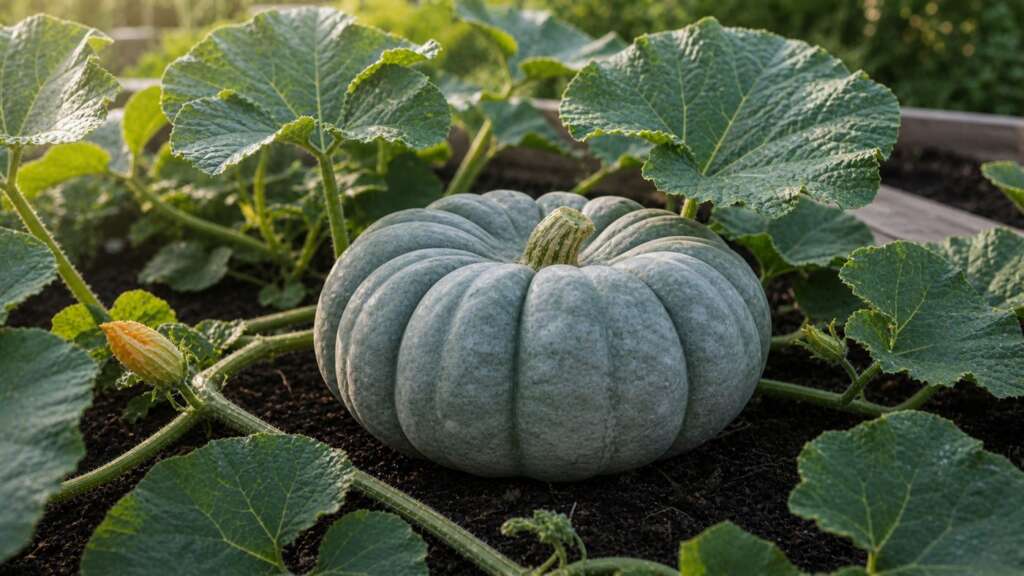
Jarrahdale Pumpkin is an Australian heirloom winter squash known for its slate-blue, deeply ribbed rind and dense, sweet orange flesh. It is a long-vining, warm-season member of Cucurbita maxima grown for pies, soups, roasting, and long autumn storage. Like other large maxima pumpkins, it rewards patience: warm soil at sowing, plenty of room to run, steady moisture during fruit fill, and a proper cure before the fruit goes into storage.
Quick How-to
Direct sow Jarrahdale Pumpkin into warm soil after all frost danger has passed, typically two weeks after your last spring frost when soil temperatures reach at least 70 F. Plant seeds 1 inch deep in hills or rows, give vines room to run, and keep the seedbed evenly moist until emergence. Germination usually takes 5 to 10 days in warm conditions. In short-season climates, start indoors 2 to 4 weeks before transplanting so vines have time to size up the fruit before fall.
Quick Guide
| Fact | Recommendation |
|---|---|
| Best method | Direct sow into warm soil; short indoor start for short-season areas |
| Sowing depth | About 1 inch |
| Germination temperature | About 70 to 95 F; 70 F is roughly the practical floor |
| Days to germination | About 5 to 10 days in warm soil |
| Light for germination | Cover seed; give strong light immediately after sprouting |
| Spacing | About 4 to 6 feet between plants, with 6 to 10 feet between rows for vines |
| Sun | Full sun, at least 6 to 8 hours |
| Water | Deep, even moisture; ease off near harvest to help fruit firm up |
| Days to harvest | Usually about 95 to 110 days from sowing |
| Plant size | Long vining habit; fruit commonly 6 to 12 pounds, sometimes larger |
Before You Sow
Jarrahdale wants three things you can control before a single seed goes into the ground: warm soil, open space, and fertile drainage. A bed that has been amended with finished compost the previous fall or several weeks before sowing performs better than one fertilized heavily right at planting. Excess fresh nitrogen pushes lush leaves and delays flowering on Cucurbita maxima, which is the opposite of what a long-season storage pumpkin needs.
Choose the sunniest part of the garden. Vines can run 10 to 15 feet, so plan a corner of the bed, a back fence line, or a section where the plant can spill onto lawn or mulch without smothering smaller crops. If space is tight, allow the vine to ramble outside the bed; the roots stay where you plant them.
Soil temperature, not the calendar, is the trigger. A simple soil thermometer pushed 2 to 3 inches deep at mid-morning is the most reliable check. Below about 65 F, maxima seed often sits and rots rather than germinating. Black plastic or a dark biodegradable mulch laid over the bed for a week or two before sowing can warm cool spring soil noticeably in northern gardens.
Direct Sowing
Direct sowing is the simplest path for Jarrahdale where the growing season is long enough. The classic method is to mound a low hill of loose, compost-enriched soil about 12 inches across and a few inches high. Plant 3 to 4 seeds per hill, 1 inch deep, spaced a few inches apart on the hill. Water the hill gently so seeds stay at the correct depth.
After the seedlings have one or two true leaves, thin to the strongest 1 or 2 plants per hill. Cutting unwanted seedlings off at the soil line with scissors avoids disturbing the roots of the keepers. Space hills about 4 to 6 feet apart, with at least 6 feet between rows. Row sowing also works: drop seeds at the same depth and spacing along a furrow, then thin to one plant every 3 to 4 feet.
Mulch lightly after the seedlings establish. A thin layer of straw or shredded leaves cools the surface, retains moisture, and keeps developing fruit cleaner as the season progresses. Hold off heavy mulching until the soil is fully warm; piling cold mulch on top of cool soil works against germination.
Indoor Starting
Indoor starting is optional and best kept short. Cucurbits resent root disturbance, and seedlings that sit too long in cells stall after transplanting. Sow 2 to 4 weeks before your planned outdoor date, no longer. Use 3 to 4 inch biodegradable pots or roomy cell trays so the root ball can move outside intact.
Plant one seed per pot at 1 inch deep in pre-moistened seed-starting mix. A heat mat helps the mix hold the 75 to 85 F range that maxima prefers for fast, even germination. Once sprouts appear, remove the heat mat and give the seedlings strong overhead light right away. Bright sun in a south window often works; weak indirect light produces leggy seedlings within days.
Harden off over 7 to 10 days, starting with an hour or two in dappled shade and building up to full sun and overnight stays. Transplant on a calm, overcast afternoon if you can, water in deeply, and avoid breaking the root ball when you slide the seedling out of the pot.
Soil, Sun, and Water
Jarrahdale produces best in deep, well-drained loam rich in organic matter, with a soil pH near 6.0 to 7.0. Heavy clay will grow a vine but rarely a good pumpkin; raised beds, mounded hills, or generous compost work-in helps in tight soils. Sandy soils benefit from compost as well, mainly to hold moisture during fruit fill.
Water deeply rather than often. The aim is consistent moisture in the root zone, not a damp surface. A long, slow soak once or twice a week (more often in hot, dry weather or in containers) supports the steady cell expansion that gives large fruit. Drip irrigation or soaker hoses are ideal because they keep foliage dry and reduce powdery mildew pressure later in the summer.
A side-dressing of balanced compost or a low-nitrogen, higher-potassium feed when the first female flowers form can help fruit set without pushing more leaves. As the fruit approaches full size and the rind begins to harden, ease back on water. Drier conditions in the final two to three weeks help the rind cure on the vine and improve storage life.
Pollination
Jarrahdale carries separate male and female flowers on the same plant. Male flowers usually open first, sometimes a week or more before the first females, which is normal and not a problem. Female flowers are easy to spot: they have a small immature pumpkin at the base of the bloom. Bees, especially squash bees and bumblebees, do most of the work.
If pollinators are scarce, you can hand pollinate in the early morning when flowers are fully open. Pick a freshly opened male flower, peel back the petals, and brush the pollen-coated anther directly against the sticky stigma at the center of a female flower. One male flower can pollinate two or three females.
Top Mistakes
- Sowing into cold soil. Cucurbita maxima seed needs genuine warmth to germinate without rotting. Wait for soil at or above 70 F rather than going by the air temperature on a sunny afternoon.
- Crowding the vines. Jarrahdale spreads far, and tight spacing reduces airflow, encourages mildew, and makes it harder for pollinators to find female flowers. Give each plant the full 4 to 6 feet it wants.
- Overhead watering late in the day. Wet leaves overnight invite powdery and downy mildew on cucurbits. Water at the base in the morning so the foliage dries.
- Heavy nitrogen at fruit set. A nitrogen-heavy feed when blossoms are forming can produce a sea of leaves with few fruit. Favor compost and balanced or potassium-leaning feeds once flowering begins.
- Cutting fruit from the vine too early. Jarrahdale develops its color and storage rind late. Pulling fruit before the rind is hard and the stem starts to dry shortens storage life considerably.
Troubleshooting by Symptom
| Symptom | Likely causes | What to do next |
|---|---|---|
| Seed rots before sprouting | Cold soil, saturated bed, or seed planted too deep in heavy soil | Wait for soil at 70 F or warmer, plant about 1 inch deep, and avoid sowing right before heavy rain |
| Seedlings emerge but stall | Cool nights, transplant shock, or compacted soil at the root zone | Protect with row cover until nights warm, loosen surrounding soil, and water deeply rather than frequently |
| Many male flowers, no female flowers yet | Normal early bloom pattern for Cucurbita maxima | Wait one to two weeks; females typically follow once the vine has length and the weather is settled |
| Female flowers form a tiny fruit, then shrivel and drop | Incomplete pollination, extreme heat above 90 F, or moisture stress | Encourage pollinators, hand pollinate in early morning, and keep soil moisture steady through bloom |
| Sudden vine wilt on a hot afternoon, recovers overnight | Brief heat and water stress | Mulch the root zone, water deeply at the base in the morning, and check again after sundown |
| Whole vine wilts and does not recover | Squash vine borer in the main stem, or Fusarium-type wilt | Inspect the base of the vine for a small hole and sawdust-like frass; slit lengthwise to remove the borer if found, then mound soil over the wound to encourage new roots |
| White powdery patches on leaves in mid to late summer | Powdery mildew, common on mature cucurbits | Improve airflow, remove the worst leaves, water at the base in the morning, and accept some mildew late in the season once fruit is sizing up |
| Fruit stays green or pale rather than turning slate blue | Harvested early, cool cloudy summer, or shade from over-rich foliage | Leave fruit on the vine until the stem corks and the rind cannot be dented with a thumbnail; thin nearby foliage if needed |
| Fruit rots on the soil side | Wet ground contact, cool damp weather | Slip a board, tile, or thick straw pad under each developing pumpkin once it is the size of a softball |
Harvest and Curing
Jarrahdale is mature when the rind shifts from dusty green to its characteristic blue-gray, the surface is hard enough that a fingernail will not pierce it, and the stem begins to dry and turn corky. In most regions this lines up with the first cool weeks of autumn, but a light frost on the foliage is fine as long as the fruit itself is not frozen.
Cut, do not pull. Use sharp pruners or a knife and leave a 3 to 4 inch stem attached. The stem acts as a seal; broken or pulled stems open a path for storage rot. Lift fruit by the body, never by the stem, even when it looks sturdy.
Cure cut pumpkins for about 10 to 14 days in a warm, dry, well-ventilated spot, ideally around 80 to 85 F with good airflow. A sunny porch, greenhouse bench, or covered patio works. Curing hardens the rind further, heals minor surface scratches, and noticeably extends storage life. After curing, move pumpkins to a cool, dry storage area around 50 to 60 F with moderate humidity. Properly cured Jarrahdale routinely keeps for 4 to 6 months, sometimes longer.
Seed Saving
Jarrahdale is an open-pollinated heirloom, so saved seed can grow true to type, but only with careful isolation. Cucurbita maxima crosses readily with other maxima varieties such as Hubbard, Buttercup, Kabocha, Lakota, and many giants. It will not cross with summer squash, zucchini, or most pie pumpkins (those are typically Cucurbita pepo) or with butternut-type squashes (Cucurbita moschata).
To save seed for replanting, grow Jarrahdale at least a half mile from any other maxima variety, or hand pollinate and tape blossoms shut. Choose a fully mature, well-shaped fruit and let it cure on the vine as long as possible. Scoop out the seeds, rinse off the pulp in a colander, and spread the clean seed on a screen or paper plate in a single layer to dry for two to three weeks until a seed snaps cleanly rather than bending. Label with variety and year before storage.
Storing Leftover Seed
Keep unused Jarrahdale Pumpkin seed in its labeled packet inside a sealed container in a cool, dry, dark indoor location. Avoid garages, sheds, greenhouses, and sunny windowsills, where temperature and humidity swing sharply. Label home-saved seed with the variety and harvest year before storing it.
FAQ
Is Jarrahdale a pie pumpkin or a decorative pumpkin?
Both. The blue-gray rind makes Jarrahdale a striking fall display pumpkin, and the dense, fine-grained orange flesh is genuinely good for pies, soups, and roasting. It is often described as sweeter and less stringy than typical jack-o’-lantern types.
Can I grow Jarrahdale in a container?
Possible but not ideal. The vines and fruit are large, and the root system pulls a lot of water. If you must use a container, choose the largest you can manage, at least 20 to 25 gallons, plant a single seed, and either let the vine trail or train it up a sturdy trellis with slings supporting each fruit.
How big do the pumpkins get?
Jarrahdale fruit commonly weighs about 6 to 12 pounds, although favorable soil, moisture, and season length can produce larger fruit. Use the mature slate-blue color, a hard rind, a drying stem, and a harvest window of roughly 95 to 110 days as a combined maturity check rather than relying on size alone.
Do I need to prune the vines?
Pruning is not required. Some gardeners pinch the growing tips after a few fruit have set to push energy into the developing pumpkins, especially in short-season climates. In a long season with room to spread, letting the vine run produces the best overall yield.
How long will the harvest store?
A properly cured Jarrahdale stored at 50 to 60 F with moderate humidity often keeps 4 to 6 months. Check fruit monthly and use any with soft spots first.