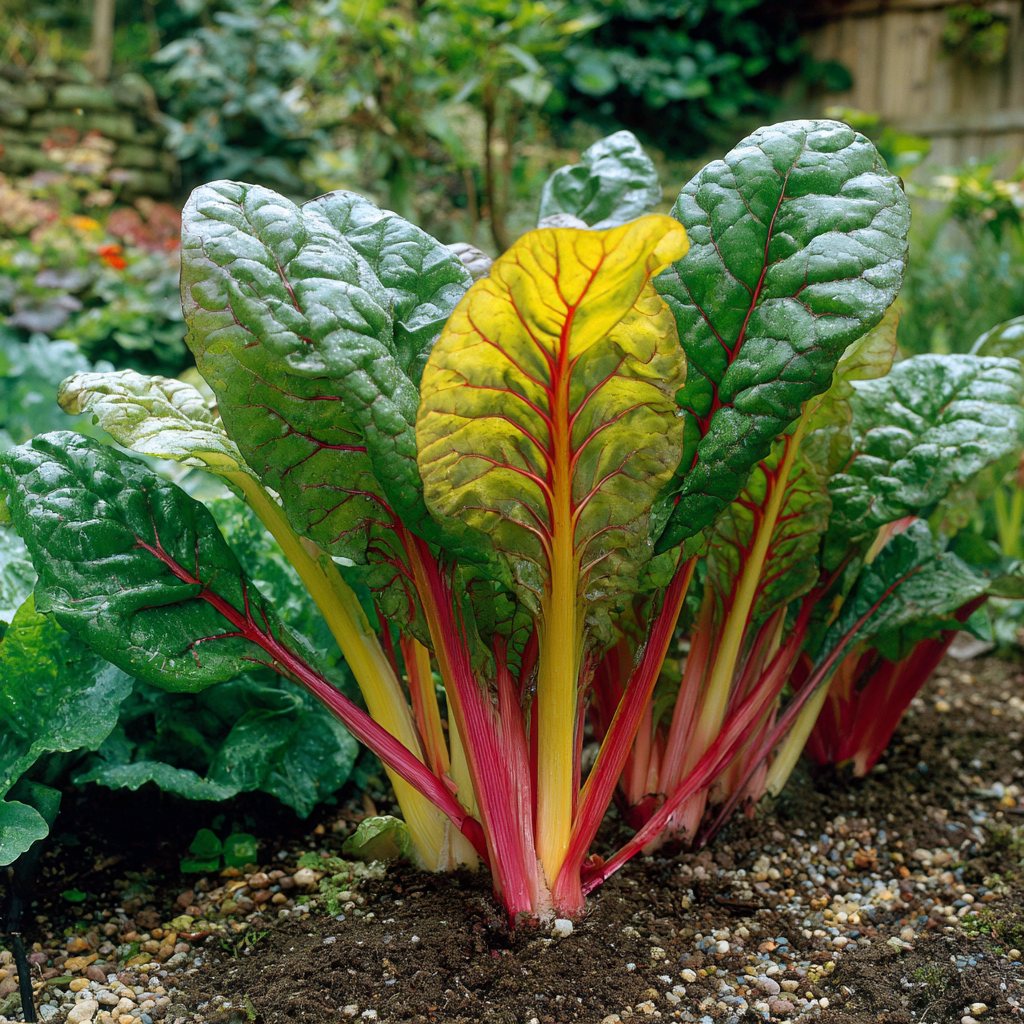
Rainbow Swiss Chard is a leafy vegetable grown for tender, mildly earthy leaves carried on bright midribs in red, pink, orange, yellow, and white. Botanically it is the same species as beets, but selected for top growth instead of swollen roots. It is happiest in cool weather, but unlike spinach it holds quality well into summer heat and is one of the few greens that can produce all season from a single planting.
Quick How-to
Direct sow Rainbow Swiss Chard outdoors in early spring as soon as the soil can be worked, or in late summer for a fall crop. Plant seed about 1/2 inch deep in loose, fertile soil and keep the bed evenly moist. Sprouts usually appear in 5 to 10 days at soil temperatures of about 50 to 85 F. Because each chard “seed” is actually a small fruit holding several embryos, expect clusters of seedlings and thin them early to 8 to 12 inches apart for full-size plants, or about 3 to 4 inches for baby leaves. Harvest outer leaves repeatedly and leave the crown intact so the plant keeps producing.
Quick Guide
| Fact | Recommendation |
|---|---|
| Best method | Direct sow preferred; indoor start 3 to 4 weeks before transplanting also works |
| Sowing depth | About 1/2 inch |
| Soil temperature for germination | About 50 to 85 F, with 70 to 75 F often quickest |
| Days to germination | Usually 5 to 10 days |
| Light for germination | Cover seed; light is not required to sprout |
| Spacing | 8 to 12 inches apart for full leaves; 3 to 4 inches for baby greens |
| Sun | Full sun in cool weather; light afternoon shade helps in summer heat |
| Water | Even moisture; chard dislikes drying out then flooding |
| Baby leaf harvest | Often about 25 to 35 days after sowing |
| Mature harvest | About 50 to 60 days after sowing for full-size outer leaves |
| Plant size | Typically 12 to 24 inches tall with broad upright leaves |
Before You Sow
Chard rewards a little soil prep. It is a steady grower rather than a sprinter, and it pulls noticeable nutrients out of the bed over a long season. Loosen the top 8 to 10 inches of soil, work in finished compost, and rake the surface smooth so the small seed clusters sit at an even depth. A neutral or slightly acidic soil with good drainage suits it well; very heavy clay tends to slow root development and make leaves smaller.
Note how chard seed looks. Each round, corky unit is technically a fruit that contains two or more true seeds, which is why one planting spot often sprouts a small bouquet of seedlings. This is normal, not a packet error. Plan from the start to thin those clusters rather than expecting one seed in, one plant out.
If your spring is short or unpredictable, you can hedge by starting a tray indoors at the same time as the first outdoor sowing. Sow into deep cells, since chard puts down a noticeable taproot quickly and resents being moved when it is rootbound.
Direct Sowing
Direct sowing is the most natural method for chard. The plant establishes well in cool soil, recovers easily from light frost as a seedling, and avoids the transplant shock that can stall growth.
Open a shallow furrow about 1/2 inch deep. Drop seed clusters every 3 to 4 inches if you want baby leaves and intend to thin progressively, or every 6 to 8 inches if you want fewer, fuller plants. Cover lightly with fine soil or seed-starting mix, firm with the back of your hand for soil contact, and water with a gentle spray so the seed is not washed out of place.
Keep the top inch of soil consistently moist until emergence. A thin layer of straw, fine compost, or shade cloth can keep the surface from crusting during dry, windy spring weather. Once seedlings have one or two true leaves and the clusters are obvious, snip extras off at soil level with scissors rather than pulling, so the chosen seedling’s roots stay undisturbed.
Indoor Starting and Transplanting
Indoor starting is optional but useful for a head start in short-season gardens or for filling specific spots in a mixed bed. Sow 3 to 4 weeks before your intended transplant date. Use 2 to 3 inch cells and pre-moistened seed-starting mix. Place one seed cluster per cell, cover about 1/2 inch deep, and keep the mix evenly moist and warm. Once seedlings emerge, move them under strong overhead light immediately. Bright windowsills alone often produce stretched, floppy seedlings.
Thin to the strongest one or two seedlings per cell once true leaves appear. Harden off over 5 to 7 days by gradually exposing the tray to outdoor sun and breeze, starting with sheltered shade. Transplant before the taproot circles the bottom of the cell. Set plants at the same depth they grew in the cell, water in deeply, and protect young transplants from slugs and chewing pests for the first week or two.
Soil, Sun, and Water
Chard thrives in fertile, well-drained soil with steady moisture. Full sun produces the strongest color and fastest growth in cool weather. As the season heats up, six hours of morning sun followed by light afternoon shade often gives better leaf quality than full all-day sun, which can make plants wilt and accelerate bolting.
Water is the single biggest factor in leaf quality. Plants that yo-yo between bone dry and saturated produce smaller, tougher leaves and are more prone to bitter flavor. Aim for the equivalent of about an inch of water per week in mild weather, more during heat or in containers. Mulch with straw, shredded leaves, or fine compost once seedlings are well established to even out moisture and keep soil from splashing color-stained mud onto the lower leaves.
Chard is a moderate feeder. A balanced side-dressing of compost or a gentle organic fertilizer about a month after thinning, and again midway through the harvest window, supports continuous regrowth. Avoid heavy nitrogen pushes late in the season, especially with a fall planting headed into cool weather.
Hydroponic Growing
Rainbow Swiss Chard grows well hydroponically and can be harvested repeatedly, but each color in the mix may grow at a slightly different rate. Deep-water culture, flood-and-drain beds, and sturdy NFT channels all work. Start one seed cluster per plug, then thin to the strongest seedling if multiple plants emerge. Transfer after true leaves open and roots reach the plug edge.
Use a complete leafy-green nutrient around EC 1.4 to 2.0 mS/cm and pH 5.8 to 6.2. Keep the reservoir shaded, aerated, and stable. Chard tolerates somewhat warmer air than lettuce, but warm low-oxygen water still causes root trouble. Check EC before pH and replace solution periodically.
Allow 10 to 12 inches for mature plants because the petioles and root systems become substantial. Harvest the oldest outer stalks at the base and leave the center intact. Strong light improves color and sturdy stems; if one color overwhelms the mix, harvest it more often rather than crowding the slower plants.
Long weak petioles mean insufficient light. Brown margins can reflect high EC, while pale new growth may come from pH drift. Wilt in a full reservoir, dark roots, or a sour smell requires immediate attention to oxygen, temperature, and sanitation.
Top Mistakes
- Treating the seed cluster as one seed. Every chard “seed” can produce a cluster. If you skip thinning, those crowded sprouts compete for light and water and stay stunted.
- Sowing into cold, wet soil and walking away. Chard tolerates cool soil but does not like sitting in saturated mud. Wait for soil that drains rather than puddles, and water based on what the bed needs, not on the calendar.
- Letting plants dry hard between waterings. Drought stress is a leading cause of tough leaves, bitter flavor, and premature bolting.
- Cutting the growing center. Chard regrows from the crown. Harvest outer leaves and leave the small inner whorl alone so the plant can keep producing.
- Planting only once in spring. A single sowing carries many gardens, but in long-season climates a second sowing in mid to late summer often gives the best fall and early-winter harvest.
Troubleshooting by Symptom
| Symptom | Likely causes | What to do next |
|---|---|---|
| Several seedlings emerge from one spot | Normal: chard seed clusters contain multiple embryos | Thin to the strongest one or two seedlings per spot by snipping extras at soil level |
| Spotty or no emergence after 10 to 14 days | Soil too cold, surface crusted, sown too deep, or seedbed dried out repeatedly | Confirm soil warmth, gently scratch any crust, resow at 1/2 inch where gaps remain, and keep the surface consistently moist |
| Pale, stretched seedlings indoors | Not enough overhead light, too much warmth, or crowded cells | Lower lights closer to the leaves, run them 12 to 14 hours, thin to one seedling per cell, and remove any extra heat |
| Pale tan or whitish tunnels and blisters inside leaves | Leaf miner larvae feeding between the leaf surfaces | Remove and discard affected leaves promptly, cover new plantings with row cover at sowing to block egg-laying, and rotate chard away from beets and spinach the following season |
| Small, ragged holes scattered across leaves | Flea beetles, slugs, or caterpillars | Inspect undersides at dusk and dawn, set out slug bait or beer traps if slime trails are present, and use lightweight row cover on young plants |
| Outer leaves yellow while center looks normal | Older leaves naturally aging, low nitrogen, or persistent overwatering | Harvest the oldest leaves, side-dress with compost or a balanced organic feed, and check that the bed drains rather than stays soggy |
| Bitter or fibrous leaves | Heat stress, drought, plant approaching bolt, or harvesting only the oldest leaves | Water more evenly, mulch, harvest in the cool of the morning, and pick younger mid-size leaves rather than the largest ones |
| Plant sends up a tall central stalk and stops making tender leaves | Bolting triggered by heat, long days, or stress; chard is biennial and will eventually bolt | Harvest remaining usable leaves quickly, pull the plant, and sow a fresh round for the next cool window |
| Stems are vivid but leaves stay small | Crowding, low fertility, or shallow soil | Thin further, top-dress with compost, and water more deeply rather than more often |
Harvest and Kitchen Use
You can begin baby-leaf harvest about three to five weeks after sowing, once plants are tall enough to spare a few leaves without bare crowns. For full-size harvest, wait until plants are 8 to 12 inches tall, then cut outer leaves close to the base with a knife or scissors, leaving the small inner leaves untouched. A healthy chard plant can produce for several months from this kind of rolling harvest.
Pick in the cool of the morning when leaves are fully turgid and rinse them promptly. The colored midribs hold their color best when leaves and stems are cooked separately: slice the stems and start them in the pan a few minutes before adding the chopped leaves so both finish tender at the same time. Younger stems eat almost like a delicate celery; older stems benefit from a longer sauté or braise.
In mild-winter regions, chard can carry through winter under a light row cover and resume vigorous growth in early spring before it bolts. In colder zones, a final fall harvest before hard freezes usually gives the best quality.
Seed Saving
Chard is biennial. To produce seed, plants must live through a cool period and then flower the following season, so home seed saving requires either a mild winter or careful overwintering. Chard cross-pollinates readily with beets and other chard varieties because they share the same species. Seed Savers Exchange recommends 800 feet to one mile between chard varieties, while Oregon State Extension gives 3,200 feet for separating flowering beets and chard. Growing only one beet-or-chard seed crop is the practical choice where that distance is unavailable.
Let several healthy plants overwinter, allow the tall flowering stalks to mature and dry, then strip the dry seed clusters into a paper bag and finish drying indoors before storage. Rainbow chard is a color mixture rather than a single uniform line, so saved seed may shift toward whichever stem colors and plant types set the most seed; the next generation is not guaranteed to preserve the original color proportions. Use fresh commercial seed when reproducing a balanced rainbow display matters, or deliberately save from multiple plants representing every color you want to retain.
Storing Leftover Seed
Keep unused Rainbow Swiss Chard seed in its labeled packet inside a sealed container in a cool, dry, dark indoor location. Avoid garages, sheds, greenhouses, and sunny windowsills, where temperature and humidity swing sharply. Label home-saved seed with the variety and harvest year before storing it.
Container and Small-Space Notes
Chard is one of the better leafy greens for containers. Use a pot at least 10 to 12 inches deep and at least 10 inches across for a single full-size plant, or a wider rectangular planter for a baby-leaf cutting row. Choose a quality potting mix, not garden soil, and water more often than you would in the ground; in summer heat, container chard may need water daily. Mix a slow-release organic fertilizer into the mix at planting and follow up with a diluted liquid feed every two to three weeks during active growth. The colored stems make chard one of the more ornamental edibles for porch and patio displays.
Timing and Climate Notes
In most regions, the first sowing goes in two to four weeks before the average last spring frost, with succession sowings every three to four weeks until early summer if you want a continuous baby-leaf supply. A second main sowing about 8 to 10 weeks before your average first fall frost often produces some of the best-quality chard of the year, since cool nights deepen color and sweeten flavor. In hot-summer climates, skip the deep-summer sowings and rely on spring and fall windows instead.
FAQ
Is Rainbow Swiss Chard hard to grow from seed?
No. It is one of the more forgiving leafy greens for new gardeners as long as you remember to thin the seedling clusters and keep soil moisture steady.
Why are several seedlings coming up where I planted one seed?
Chard seed is multigerm; each corky “seed” is actually a small fruit containing several embryos. Thin the cluster to the strongest one or two seedlings once they are easy to handle.
Can chard handle summer heat?
It handles heat better than spinach or most lettuces, especially with steady moisture and a little afternoon shade. Very hot, dry conditions still slow growth and can push plants toward bolting.
Do the different stem colors taste different?
The color differences are largely visual. Subtle flavor variation exists between strains, but harvest age and growing conditions affect taste more than stem color. Young leaves are mild; older leaves and thicker stems develop a stronger, earthier flavor.
Should I cut the whole plant or just the outer leaves?
For the longest harvest, take outer leaves and leave the small center leaves intact so the plant keeps producing. Whole-plant cuts work for baby-leaf rows where you want a quick clean harvest and plan to resow.