
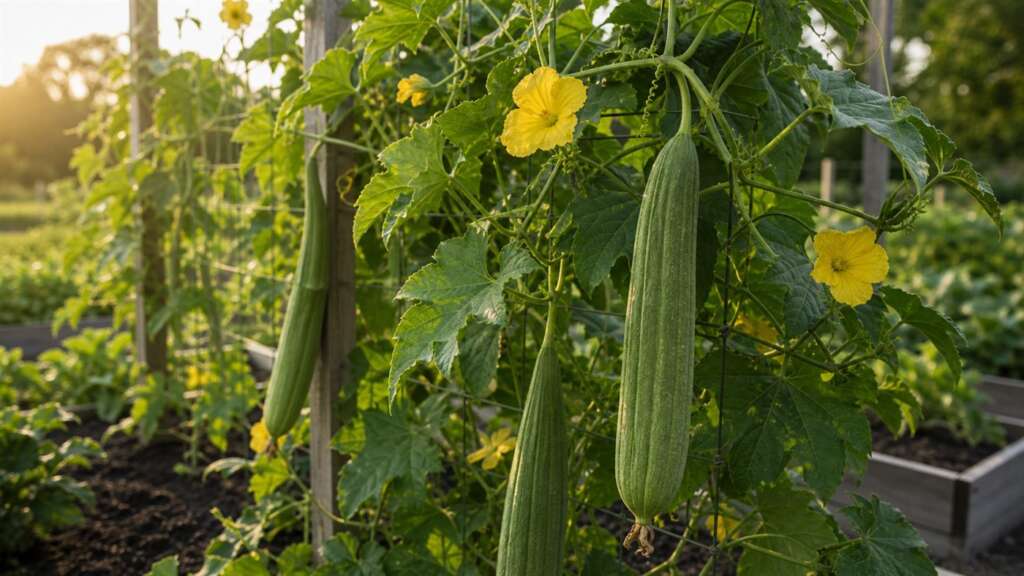
Luffa gourd is a vigorous warm-season vine grown for two purposes from the same plant: tender young fruits that cook like summer squash, and fully mature fruits that dry into the natural sponges sold as loofahs. The crop needs heat, a long season, and a strong trellis. Growers in cool or short-season regions often start seed indoors early, give the vines a sturdy support, and plan the calendar carefully so the latest fruits have time to mature on the vine.
Quick How-to
Start luffa seed indoors about 4 to 6 weeks before your last spring frost, or direct sow once soil is reliably warm and frost danger has passed. Sow about 1/2 to 1 inch deep in a warm, evenly moist mix and expect germination in roughly 7 to 14 days once temperatures sit in the 70s to mid 80s F. Transplant after hardening off, train the vines up a strong trellis, water consistently, and let fruit intended for sponges stay on the vine until the skin turns tan or brown and the gourd feels light.
Quick Guide
| Fact | Recommendation |
|---|---|
| Best method | Indoor start for most climates; direct sow only where the warm season is long |
| Sowing depth | About 1/2 to 1 inch |
| Germination temperature | About 70 to 85 F; warmer soil sprouts more evenly |
| Days to germination | Often 7 to 14 days; a hard seed coat can slow water uptake, so soaking or light scarification may help |
| Pre-sowing prep | Optional 12- to 24-hour soak or light scarification can speed water uptake |
| Light for germination | Cover seed; provide strong light as soon as seedlings emerge |
| Spacing | About 12 to 18 inches between plants along a trellis; 4 to 6 feet between rows |
| Sun | Full sun, ideally 8 or more hours |
| Water | Deep, even moisture throughout flowering and fruit development |
| Support | Strong trellis, fence, or arbor; vines climb 10 to 20 feet |
| Days to harvest | Harvest young edible fruit during summer; allow roughly 150 to 200 frost-free days for fully mature sponges |
| Plant habit | Aggressive vining annual with large leaves and yellow flowers |
Before You Sow
Luffa rewards planning. The plant is easy in concept, but it asks for heat, room, and time. Pick the sunniest spot you have, ideally against a fence, arbor, or tall trellis where the vines can climb without sprawling into beds you want to keep clear. South or west exposures with reflected warmth from a wall often outperform open garden spots in cooler climates.
Prepare the bed with compost or well-rotted manure worked into the top several inches. Drainage matters more than richness. Heavy, soggy ground keeps roots cold and slows the plant during the early weeks when it should be building leaf area. Where soil is dense, build a low mound or raised bed so the planting zone warms faster in spring.
Have your trellis in place before you plant. Luffa vines grow long, twine readily with tendrils, and become heavy as fruit fills out. A flimsy structure that worked for peas will not survive a luffa crop. Cattle panels, wooden arbors, sturdy chain-link fencing, and reinforced wood frames all work well. Aim for a support that can hold mature gourds weighing one to three pounds each.
Indoor Starting
In most of the continental United States, indoor starting is the practical path. Sow about 4 to 6 weeks before your last spring frost. Earlier is rarely better; luffa seedlings dislike sitting in small cells for long stretches and resent root disturbance at transplant, so a short, vigorous indoor window beats a long, leggy one.
Use 3 to 4 inch pots or deep cells so the taproot has somewhere to go. Fill with fresh seed-starting mix, pre-moisten until it feels like a wrung-out sponge, and sow one seed per pot at about 1/2 to 1 inch deep. Two seeds per pot is reasonable insurance; snip the weaker seedling at the soil line after true leaves appear rather than pulling it.
Luffa seed coats are hard. Many growers improve and even out germination by soaking seed in warm water for 12 to 24 hours before sowing, or by lightly nicking the edge of the seed coat with a nail file, taking care not to damage the embryo. These steps are optional but often shorten the wait from “still nothing” to “first sprout.”
A heat mat helps. Aim for soil in the upper 70s to mid 80s F until seedlings emerge, then move trays off the mat and under strong overhead light immediately. Warmth plus weak light is the recipe for stretched, pale seedlings that struggle later. A bright south window is rarely enough on its own; a basic shop light or grow light positioned a few inches above the seedlings is more reliable.
Direct Sowing
Direct sowing works in long, hot growing seasons where summer arrives early and stays late. Wait until all frost danger has passed, nighttime temperatures stay above the mid 50s F, and the soil at planting depth feels genuinely warm to the touch. Cold, wet ground is the most common reason direct-sown luffa fails to sprout.
Plant in hills or along the base of a trellis. Sow 2 to 3 seeds per spot at about 1/2 to 1 inch deep, water gently, and thin to the strongest seedling once true leaves appear. Mulch lightly after seedlings establish to hold moisture without smothering the crown.
If your last-frost date is late and your first-fall-frost date is early, direct sowing may not leave enough season for sponges to fully mature. In that case, indoor starting is worth the extra effort.
Hardening Off and Transplanting
Begin hardening off about a week to ten days before transplanting. Set seedlings outside in a sheltered, shaded spot for an hour or two on the first day, then gradually increase sun, wind exposure, and time outdoors. Bring them in if a cold night is forecast. Luffa is frost-sensitive at every stage, and a single cold night can stall a transplant for weeks.
Transplant in the evening or on an overcast day. Set the root ball at the same depth it grew in the pot, firm the soil gently, and water in thoroughly. Space plants about 12 to 18 inches apart along a trellis; closer spacing crowds the canopy, while wider spacing can leave the trellis under-filled. Use a floating row cover for the first week or two if cool nights are still possible.
Trellising and Training
Luffa is built to climb. Vines can stretch 10 to 20 feet in a single season, and fruit hanging from a trellis grows straighter, cleaner, and easier to harvest than fruit sprawled on the ground. Ground-grown gourds tend to curl, develop flat spots, and pick up rot where they sit.
In the first few weeks after transplant, gently guide young vines onto the support. Once they catch on with tendrils, they take over the work themselves. Tie in any wandering shoots that miss the structure. As fruit forms, glance occasionally at the points where heavy gourds bear weight; large fruits sometimes benefit from a soft sling of cloth or pantyhose if the trellis has wide openings.
Soil, Sun, and Water
Full sun is non-negotiable. Plants in partial shade may grow leaves but rarely set the volume of fruit needed to produce useful sponges. Choose your sunniest available spot, even if it means giving up space planned for something else.
Aim for steady, deep watering rather than shallow daily sprinkles. A long soak two or three times a week is usually better than frequent light watering, especially once vines are established. Drip irrigation or soaker hoses at the base of the plants keep foliage dry and reduce disease pressure. Mulch with straw or shredded leaves once the soil has warmed to conserve moisture.
Luffa is a moderate feeder. A compost-enriched bed is often enough for the season. If the plants look pale and weak by mid-summer, a balanced organic fertilizer or a top-dressing of compost can help. Avoid heavy nitrogen once flowering begins; lush leaf growth at that stage can come at the expense of fruit set.
Top Mistakes
- Planting too early into cold soil: Luffa stalls or rots in cool, wet ground. Wait for stable warmth, even if neighbors are already planting tomatoes.
- Skimping on the trellis: A weak support collapses under mature fruit and leaves the crop on the ground. Build for full-season weight from day one.
- Running out of season: Sponges need months of warm weather to mature. Start seed early enough that the latest fruits set well before fall cool-down.
- Harvesting sponges too early: Green, heavy fruit picked too soon will not cure into useful sponges. Wait for the skin to dry and the fruit to feel light before pulling it from the vine.
- Letting the soil dry then flooding it: Big swings in moisture stress vines during flowering and fruit fill, leading to dropped blooms and smaller gourds.
Troubleshooting by Symptom
| Symptom | Likely causes | What to do next |
|---|---|---|
| No sprouts after 14 days | Soil too cold, mix too wet, seed buried too deep, or hard seed coat slow to absorb water | Confirm warmth, ease back on watering, resow at 1/2 to 1 inch, and consider an overnight soak for the next batch |
| Seedlings stretch and look pale | Too little light, too much warmth after germination, or crowded trays | Move lights closer, reduce heat after emergence, and pot up promptly so roots have room |
| Vines grow but few flowers form | Too much shade, excess nitrogen, or young plant still building structure | Confirm full sun, hold off on high-nitrogen feeding, and allow time; luffa often flowers heavily only after the vine is well established |
| Flowers form but small fruits shrivel and drop | Poor pollination, heat stress, or inconsistent moisture | Encourage pollinators with nearby flowering plants, water deeply and evenly, and consider hand-pollinating with a soft brush in the morning |
| Leaves develop powdery white coating | Powdery mildew, often late in the season | Improve airflow by thinning crowded growth, water at soil level, and tolerate some leaf damage if fruit is already maturing |
| Mature fruit rots on the vine | Wet weather, ground contact, or damaged skin | Trellis fruit off the soil, harvest at first sign of skin yellowing if heavy rains are forecast, and remove damaged gourds promptly |
| Sponges feel mushy after curing | Fruit picked too green, or curing area too damp | Wait for skin to dry and fruit to lighten before picking; cure in a warm, dry, airy spot |
Harvest and Use
Luffa is a dual-purpose crop, and timing depends on what you want from it.
For eating, pick fruits young, when they are about 4 to 6 inches long, smooth-skinned, and still tender enough that a fingernail leaves a mark. At this stage they cook much like zucchini, with a mild flavor that takes well to stir-frying, soups, and curries. Pick regularly; small fruits left to mature on the vine signal the plant to slow flower production.
For sponges, let selected fruits stay on the vine as long as possible. Mature gourds may reach 12 to 24 inches or more, depending on variety and conditions. The fruit is ready when the skin turns from green to tan or brown, the gourd feels noticeably lighter than it looks, and you can hear loose seeds rattling inside when you shake it. If hard frost is forecast before fruits are fully dry on the vine, pick the largest gourds and finish curing them indoors in a warm, airy room.
To process a sponge, soak the dried gourd in water until the skin softens, then peel it away. Shake or rinse out the seeds (save the best ones for next year), and rinse the fibrous interior under running water until clean. A short soak in a mild bleach solution followed by a thorough rinse and air-dry brightens the color and helps with long-term storage. Let sponges dry completely before storing.
Seed Saving
Luffa is monoecious, with separate male and female flowers on the same plant, and is pollinated by insects. It can cross with other Luffa aegyptiaca plantings nearby. For seed that comes true, grow only one variety, or isolate by distance from other luffa.
Save seed from fully mature gourds you would otherwise process into sponges. Seed from a mature gourd is developed, but processing and rinsing can leave enough surface moisture to cause mold in storage. Spread cleaned seed in a single layer in a shaded, airy place and let it dry for at least several days, turning it occasionally. Store only hard, fully dry seed; discard flattened or damaged seed, label the remainder by variety and year, and keep it cool, dark, and sealed.
Storing Leftover Seed
Keep unused Luffa Gourd seed in its labeled packet inside a sealed container in a cool, dry, dark indoor location. Avoid garages, sheds, greenhouses, and sunny windowsills, where temperature and humidity swing sharply. Label home-saved seed with the variety and harvest year before storing it.
FAQ
Do I really need to start luffa indoors?
In most of the United States, yes. Luffa needs a long warm season to produce mature sponges, and starting indoors about 4 to 6 weeks before your last spring frost gives the plant the head start it needs. In the Deep South and other long-season regions, direct sowing into warm soil can work.
Why are my luffa flowers dropping without setting fruit?
Early in the season, plants often produce only male flowers for a stretch before female flowers (the ones with a small gourd-shaped swelling at the base) appear. If both flower types are open and fruit still does not set, pollination is the usual culprit. Encourage bees and other pollinators, or hand-pollinate by brushing pollen from a male flower onto the center of a female flower early in the morning.
Can I grow luffa in a container?
A very large container, 15 gallons or more, with a sturdy trellis can support a single luffa plant in a small space. Water and feeding needs are higher than in-ground plants because the root zone dries out faster. Expect smaller yields than from a well-prepared garden bed.
What if frost arrives before my gourds finish drying?
Pick the largest, heaviest fruits before the first hard frost and finish curing them indoors in a warm, airy spot, such as a sunny windowsill or a dry attic. Smaller, very green gourds picked early are unlikely to cure into useful sponges, but they are often edible if still tender.
Can young luffa really be eaten like squash?
Yes. Harvested young, while the skin is still soft and the flesh is tender, luffa cooks like zucchini or okra. It is widely used in Asian cuisines. Once the fruit begins to develop fiber, it becomes tough and is better left to mature for sponge use.