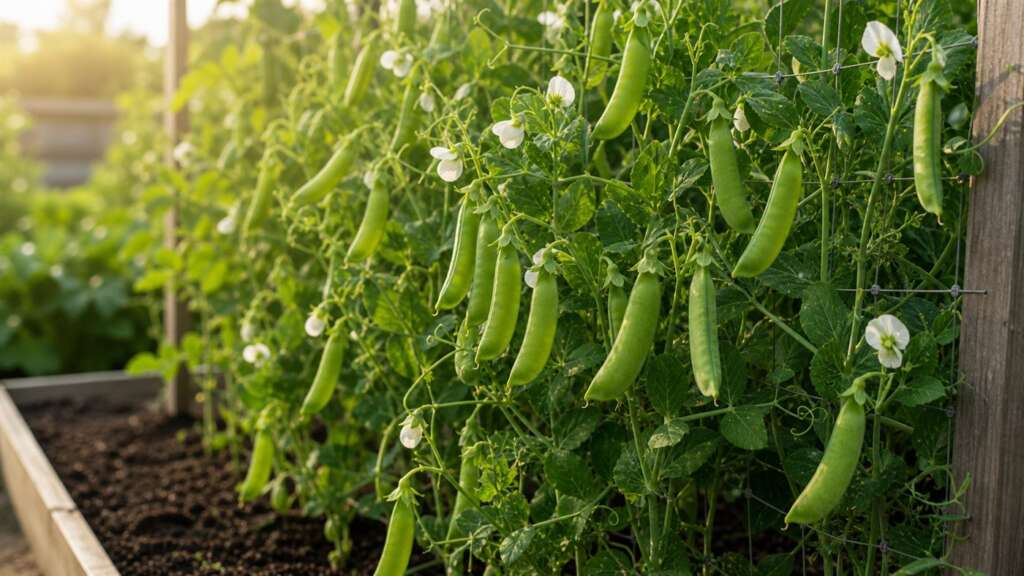
Sugar Snap Pea is a cool-season legume grown for plump, crisp, edible pods you can eat whole, raw or cooked. It is one of the most beginner-friendly garden crops because the seed is large, easy to handle, and forgiving of imperfect technique, as long as the timing is right. Get peas in the ground while the soil is still cool, give the vines something to climb, and most of the work is done.
Quick How-to
Direct sow Sugar Snap Pea outdoors as early in spring as the soil can be worked, often 4 to 6 weeks before your last expected frost. Plant about 1 inch deep, space seeds 2 to 3 inches apart in the row, and set up a trellis or netting at the same time you sow. Expect germination in roughly 7 to 14 days, faster as soil warms into the 60s F. Keep the bed evenly moist, never soggy, and harvest pods young and often for the sweetest flavor.
Quick Guide
| Fact | Recommendation |
|---|---|
| Best method | Direct sow outdoors in cool soil |
| Sowing depth | About 1 inch; up to 1.5 inches in warm, dry weather |
| Germination temperature | Sprouts from around 40 F; about 60 to 75 F is ideal |
| Days to germination | About 7 to 14 days; slower in cold soil |
| Light for germination | Cover the seed; light is needed strongly after emergence |
| Spacing | 2 to 3 inches apart in the row, rows 18 to 24 inches apart |
| Sun | Full sun; tolerates light afternoon shade in warm climates |
| Water | Even moisture, especially during flowering and pod fill |
| Harvest timing | About 60 to 70 days from sowing; pick while pods are crisp and bright green |
| Plant size | Climbing vines, commonly 4 to 6 feet; support is required |
Before You Sow
Pick a sunny bed with good drainage and average garden soil. Peas do not need rich feeding; they fix some of their own nitrogen with help from soil bacteria, so heavy nitrogen fertilizer often produces lush vines with disappointing pod set. A bed that grew a heavy feeder last season is usually fine for peas with no added nitrogen.
Work the bed when it crumbles in your hand rather than smearing into a ribbon. Cold, soggy soil is the single most common reason pea seed rots before it ever sprouts. If the bed is still cold and wet, wait a week. Peas planted into the right conditions catch up quickly with peas rushed into mud.
Put your support in place before sowing, not after. Sugar Snap Pea is a climbing variety with tendrils that grasp string, netting, brush, or wire mesh. A simple A-frame of bamboo and netting works well; so does a single row of nylon pea netting strung between two stakes. Setting it up at sowing time avoids root disturbance later, and it gives you a clean row to plant along.
If you garden in a new bed or have never grown legumes there before, a pea/bean inoculant powder can boost nodulation. It is optional, especially in established gardens, but it is inexpensive and easy to dust onto damp seed before sowing.
Direct Sowing
Open a shallow furrow about 1 inch deep along the base of your trellis. Drop seeds 2 to 3 inches apart, cover with fine soil, and firm gently so each seed has contact with moist earth. In warm, dry spring weather you can plant slightly deeper, up to about 1.5 inches, to reach steadier moisture. Water in with a gentle spray, then keep the seedbed evenly damp until you see sprouts.
Sugar Snap Pea germinates faster as the soil warms. At soil temperatures near 40 F, emergence can take two weeks or more. By the time soil reaches the 60s F, sprouts often appear within a week. If you live where springs are short, succession sow a second short row 10 to 14 days after the first to spread out the harvest before summer heat shuts production down.
In mild-winter regions, a fall sowing roughly 8 to 10 weeks before the first expected hard freeze can give a second crop. Count backward far enough for vines to flower and fill pods before severe cold, and use local frost records because fall pea timing varies sharply by region.
Indoor Starting
Indoor starting is rarely necessary for peas and usually not recommended. The seedlings dislike root disturbance, and the early advantage often disappears once direct-sown peas catch up in the field. If you want to start a few plants indoors to fill gaps or get a small jump on the season, sow into deep cells or biodegradable pots about 2 to 3 weeks before transplant. Transplant young, before roots circle the cell, and water in carefully.
A more reliable trick for a small head start is pre-sprouting: soak seed for a few hours, then keep it between damp paper towels for one to two days until the radicle just emerges, then plant immediately. Do not let pre-sprouted seed dry out before sowing.
Transplanting and Spacing
If you grow transplants, handle them like fragile teenagers, not seedlings. Move the whole root ball intact, water before and after transplanting, and shade for a day or two if conditions are harsh. Final in-row spacing of about 2 to 3 inches gives a thick, productive curtain of vines without strangling airflow. Keep rows 18 to 24 inches apart, wider if you want easy harvest access from both sides of a double-row trellis.
Soil, Sun, and Water
Full sun produces the heaviest pod set, though peas tolerate a few hours of afternoon shade in warm climates. Soil should drain well; raised beds and sandy loam often outperform heavy clay in early spring because they warm and dry faster. A slightly acidic to neutral soil, roughly pH 6.0 to 7.0, is ideal, although peas generally tolerate soil up to about pH 7.5. A laboratory soil test is the reliable way to diagnose a persistent pH or fertility problem.
Watering matters most at two stages: from sowing through emergence, and from first flower through pod fill. During germination, keep the surface from crusting; a light, even watering is better than an occasional deep soak that hardens the crust. Once vines are flowering, dry stretches cause flowers to drop and pods to develop unevenly. Water at the soil level when possible, mulch lightly after the soil warms, and avoid working among wet foliage to limit disease spread.
Top Mistakes
- Sowing too late: The most common mistake is waiting for warm spring weather. Peas planted after heat arrives often grow leaves but set few pods. Aim for cool, workable soil even if it feels early.
- Skipping the trellis: Sugar Snap vines climb 4 to 6 feet and tangle quickly without support. Once they flop, breakage and disease climb fast. Set up support at sowing time.
- Waterlogged seedbed: Pea seed needs oxygen as much as moisture. Sodden, cold soil rots seed before it can sprout. Keep the bed evenly moist, not swampy.
- Harvesting too late: Snap peas turn starchy and fibrous if left on the vine past their prime. Pick when pods are plump, glossy, and still crisp.
- Over-fertilizing with nitrogen: Peas fix their own nitrogen. Heavy nitrogen feeding produces tall, lush vines with reduced pod set.
Troubleshooting by Symptom
| Symptom | Likely causes | What to do next |
|---|---|---|
| Seed rots before sprouting | Cold, saturated soil or sowing too deep | Wait for the soil to warm and drain, then resow at about 1 inch |
| Patchy or thin stand | Uneven planting depth, soil crusting, birds digging seed, or pill bugs | Smooth the bed before sowing, water gently to keep the crust soft, and cover newly sown rows with light row cover until emergence |
| Vines look healthy but few pods | Too much nitrogen, heat stress, drought during flowering, or planted too late | Cut back nitrogen feeding, keep moisture steady through flowering, and plan an earlier sowing next season |
| Pods are tough or starchy | Harvested past peak, or vines stressed by heat | Pick more often, every 1 to 3 days during peak production, and harvest pods while still plump and glossy |
| Yellow leaves climbing up the vine | Cool wet feet, root rot, or end-of-season decline | Improve drainage, avoid overwatering, and accept that peas naturally fade as temperatures rise |
| White powdery coating on leaves | Powdery mildew, common late in the season | Water at the soil level, improve airflow by thinning weak vines, and plan to pull plants once production drops |
| Vines collapse or fall off trellis | Support set up too late or too flimsy for the variety | Re-tie gently to a stronger structure; for next season, install netting at sowing |
Germination Diagnostics
If your peas are slow to come up, work through the seedbed in order rather than changing everything at once. First, check depth by gently digging up a few seeds: anything buried much deeper than 1.5 inches will struggle, and anything sitting on the surface may have dried out. Second, check soil temperature. A simple soil thermometer pushed an inch into the bed tells you more than the daytime air feels like; below about 40 F, expect a long wait.
Third, check moisture by feeling an inch below the surface. A wrung-out-sponge feel is the target. Shiny wet, swampy, or dusty dry are all warning signs. Fourth, after emergence, watch the seedlings for a few days. Sturdy little vines with green stems are doing fine. Pale, stretched seedlings usually want more sun or less crowding, not more fertilizer.
Timing and Climate Notes
Treat Sugar Snap Pea as a cool-season crop. In most of the continental US, that means a spring sowing 4 to 6 weeks before the last frost, with harvest wrapping up before summer heat arrives. In mild coastal climates and the Pacific Northwest, the season runs longer and a fall sowing is often productive. In the deep South, peas behave almost like a winter crop, planted in fall for winter and early-spring harvest. Use local frost records and extension planting calendars to place flowering and pod fill in cool weather.
If a warm spell threatens an unfinished crop, you can buy time with a few practical tricks: deep mulch to cool the root zone, light afternoon shade cloth, and consistent watering. None of this turns peas into a summer crop, but it can carry the harvest a week or two further.
Harvest and Kitchen Use
Sugar Snap pods are at their best when fully filled and still bright, glossy, and crisp. Hold the vine with one hand and pinch the pod off with the other so you do not tear the plant. Pick every one to three days during peak production; pods left on the vine signal the plant to slow further flowering. The flat, smaller pods that look almost empty are still tender and sweet; the swollen, slightly dull pods are nearing the end of their window and are best cooked rather than eaten raw.
Pods store about a week in a cool refrigerator, but flavor is at its peak within an hour of picking. They freeze well after a brief blanch. Vines themselves are mildly edible: pea shoots and tender tips are good in salads and stir-fry.
Seed Saving
Sugar Snap is typically open-pollinated, so saved seed can come reasonably true to type if you keep different pea varieties apart. To save seed, leave a few healthy, well-shaped pods on the strongest vines and let them dry on the plant until the pods turn tan and rattle. Shell the seeds, dry them indoors for another week or two on a screen out of direct sun, then store in a labeled, sealed container in a cool, dry place. Pull and inspect; the dried seeds should be hard and unblemished.
Storing Leftover Seed
Keep unused Sugar Snap Pea seed in its labeled packet inside a sealed container in a cool, dry, dark indoor location. Avoid garages, sheds, greenhouses, and sunny windowsills, where temperature and humidity swing sharply. Label home-saved seed with the variety and harvest year before storing it.
FAQ
Do Sugar Snap Peas need a trellis?
Yes. This is a vining variety that climbs 4 to 6 feet. Without support, vines collapse, pods rot on wet soil, and disease spreads quickly. Netting, brush, or a simple A-frame all work.
Can I plant Sugar Snap Peas in containers?
Yes, in a deep container of at least about 12 inches with a built-in or attached trellis. Water more frequently than an in-ground row because container soil dries faster, and avoid heavy fertilizer.
Should I inoculate the seed?
Inoculant, a powder containing the bacteria peas use to fix nitrogen, is most useful in new beds or beds where legumes have not grown recently. It is optional in established gardens but inexpensive and easy to apply.
Can Sugar Snap Peas tolerate frost?
Young plants tolerate light frosts and cool nights well. Hard freezes can damage open flowers and developing pods, so a row cover on cold nights protects the crop late in spring or early in fall.
Why are my pea vines flowering but not setting pods?
The most common causes are heat, irregular watering during bloom, or excessive nitrogen. Steady moisture and modest fertility usually fix the problem; if heat is already here, accept the partial crop and plan an earlier sowing next year.